

























































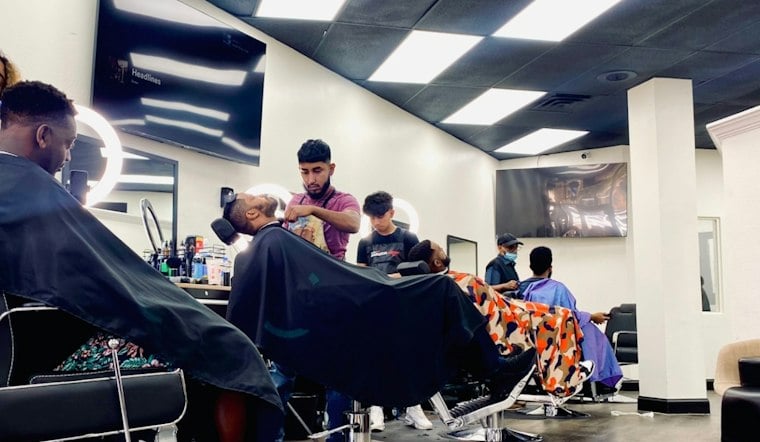
A barber working just outside Dallas is putting on a five-camera vest to record his own hands at work so a robot might one day learn to do the same job. Dre Wooden is one of a growing number of American workers strapping cameras to their bodies to collect footage that gets sent off to train robots, according to The New York Times.
Wooden's footage goes to a private technology company that uses it to train robots, the Times reports, and he says the arrangement works out well for him financially. “I would cut hair and I would do recording at the same time, so I'm getting paid for both,” Wooden said, per the Times. He's part of what the outlet describes as a rapidly growing gig-worker industry built entirely around teaching machines to move and work like people do.
A Nail Tech's Ten Hours of Footage
Virginia Gutierrez, a nail technician, recorded roughly 10 hours of footage over several days as part of the same kind of work, according to the Times. That footage will eventually be annotated and converted into learnable data for robots, the outlet reports. Gutierrez has three teenage daughters, and she said the money she earned covered two weeks of groceries for her family of four along with back-to-school shopping.
Neither Gutierrez nor the company involved, Instawork, would disclose her exact pay, citing a confidentiality agreement, the Times reports. Instawork told the Times it pays well above minimum wage, though that claim has not been independently verified beyond the company's own statement. A worker identified as Natasha McLemore delivers the recording rigs to gig workers on Instawork's behalf, per the same report.
Instawork's Bet on Robotics Data
Instawork describes itself on its site as offering on-demand real-world data to train what it calls embodied AI, according to Instawork's own robotics page. The company serves industries including landscaping, hairstyling, nail technology and telecommunications, the Times notes. Instawork has said the data collected through its Instacore program will be opt-in and anonymized, capturing workflows rather than identities, according to Business Insider.
That same Business Insider reporting estimates Instawork's robotic-training data collection ballooned from roughly 100,000 hours in 2024 to 1 million hours in 2025, and is projected to hit 20 million hours in 2026. Demand for robot-training data overall is now roughly ten times higher than it was a year earlier, Business Insider separately reports.
Why Companies Are Scrambling for This Footage
The surge traces back to a basic bottleneck: machine-learning and deep-learning tools used to build robots need millions of hours of human-perspective, or egocentric, footage, and there simply isn't an existing library of it, according to NPR. The Washington Post has reported that researchers are betting on what the industry calls scaling laws — the idea that robotics models will keep improving as more training data gets fed into them — and that there is no ready-made repository showing robots how to do something as mundane as household chores.
Robots have grown more nimble thanks to advances in artificial intelligence, but they are not yet perfect, and the Times notes that workers face real uncertainty over whether this work will ultimately help or harm them. One of Wooden's associates, who also records work and household chores for this kind of training, told the Times he worried that robot training could eventually take his job, but said he didn't want to be left behind by the technology either.
Pay Varies Wildly Around the Globe
The pay for this kind of work swings dramatically depending on where in the world it's done. In Karur, India, textile workers wear GoPro cameras and smart glasses to record their hand movements for training AI robots, NPR reports. NPR also reports that Shoba earns $90 a month. A worker in Nigeria was paid US$50 by a company called Atlas Capture for 17 hours of household-task video — about US$2.94 an hour — according to The Globe and Mail.
American gig workers have generally fared better. The Washington Post reports that workers recording chores for DoorDash can earn as much as $25 an hour. In Los Angeles, one Instawork assignment paid gig worker Salvador Arciga $80 for two hours of footage, according to the Los Angeles Times.
Critics Question Who Really Benefits
Not everyone is convinced the arrangement is fair to the workers doing the filming. An anonymous critic cited by the Times argued that workers are paid far less than the value their footage ultimately provides to the companies collecting it, and warned that once a company has captured enough footage of how a job is performed, it may no longer need the worker at all.
A skeptic quoted in the same report said robots that end up cheaper to run than human employees could eventually be deployed across many other kinds of jobs beyond the ones currently being recorded. Instawork, for its part, has said robots will continue to require human supervision and that new jobs will emerge to manage them — though experts cited by NPR cautioned that widespread deployment of AI robots, at least in India, may not be imminent, since the machines remain expensive to buy, costly to run, and power-hungry.
A Munich Lab Takes a Different Approach
Not every robotics operation relies on gig workers filming themselves for pay. At a robotics lab in Munich, a representative said the facility focuses on building robots for jobs that do not currently exist, cannot be done by people, are being vacated by retirees, or are genuinely dangerous — a narrower mandate than the broad sweep of household and service-industry tasks being recorded elsewhere.
For now, workers like Wooden and Gutierrez keep showing up to their regular jobs with cameras strapped on, collecting paychecks from both the haircuts and manicures themselves and the footage of them doing it. Whether that footage ends up putting them out of work, creating new robot-oversight jobs, or something in between remains an open question nobody in the industry can yet answer with certainty.





