

























































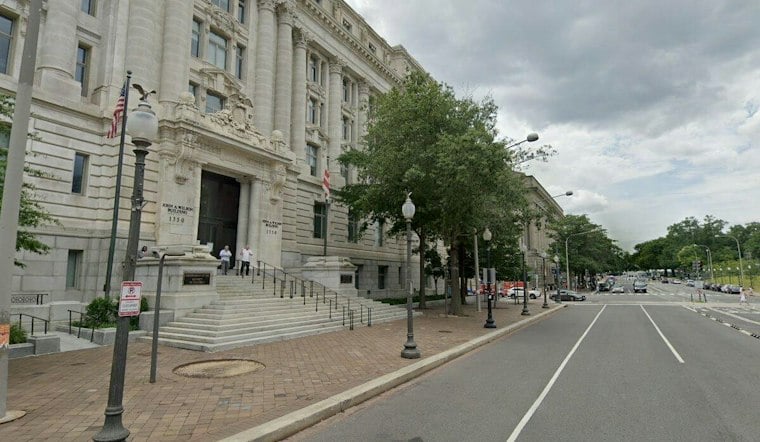
The District's agencies blew past their Council-approved budgets by a record $396 million in fiscal year 2024, and when the D.C. Council finally sat down Thursday to ask why, nobody from Mayor Muriel Bowser's administration showed up to answer. The hearing on agency spending problems, held in Washington, D.C., was supposed to put police, public works and human services officials in the hot seat. Instead, lawmakers were left questioning a watchdog and a numbers man while the executive branch's chairs sat empty.
The D.C. Council had requested that executive-branch officials responsible for police, public works and human services testify at Thursday's hearing, according to reporting from WJLA. The hearing notice itself reported that the executive branch declined to send a witness, and WJLA reported that Mayor Bowser's administration declined to send the agency representatives lawmakers had asked for. Council Chairman Phil Mendelson said he was shocked the mayor withheld witnesses from the budget hearing, per the station's account, while the mayor's office offered no comment at this time.
In their place, D.C. Auditor Kathy Patterson and Chief Financial Officer Glen Lee appeared before lawmakers to discuss spending practices and the District's financial outlook, the station reported. Patterson raised concerns about agencies repeatedly needing extra funding after budgets are approved, telling the Council, in the station's telling, that agencies overspend year after year — a dynamic that, she said, raises questions about whether expenses are accurately estimated in annual budgets in the first place. She said she questioned why recurring costs are not adequately budgeted from the beginning, and acknowledged she did not know whether there had been consequences for agencies that repeatedly exceed their original budgets.
Two Decades of Red Ink, Documented
The Office of the D.C. Auditor published a sweeping review on November 20, 2025, titled “Twenty Years of D.C. Agency Overspending”; the review examined budget and expenditure data from fiscal years 2005 through 2024. The auditor's office found that of the District's 97 operating agencies, 83 — or 86% — spent more than their Council-approved local-source budget at least once over that span, and 21 did so in at least 10 of the 20 years, according to the auditor's data brief.
The overspending has gotten worse, not better, in recent years. Total local-funds spending beyond what the Council had approved hit its highest levels in the last two fiscal years reviewed — $303 million in FY 2023 and $396 million in FY 2024 — per the auditor's findings. Local-source spending overall has nearly tripled over two decades, growing from $4.22 billion in FY 2005 to $11.71 billion in FY 2024, the same report found. D.C. Public Schools alone overspent its approved budget in 17 of the 20 years examined.
The auditor's office pointed to overtime, negotiated and discretionary pay raises, and consistently higher-than-anticipated energy costs as pressures behind the pattern. To paper over the gaps, the District has leaned on reprogramming, reserve funds and supplemental budgets — tools the D.C. Office of the Inspector General has described as mechanisms meant to keep agencies within their appropriated budgets. The auditor's brief also describes reprogrammings as a way to address overspending.
Reprogramming Rules Under Scrutiny
Patterson suggested changing how the Council reviews certain interagency and program money transfers, floating a requirement for affirmative Council approval on reprogrammings above a certain dollar amount, according to WJLA. Under the current process, she noted, certain reprogramming requests simply take effect unless the Council moves to stop them. Reprogrammings allow agencies to receive additional funding during the fiscal year, and D.C. budgets can also be adjusted through approved transfers and other funding changes — tools the station reported are intended to ensure agencies stay within their final authorized budgets.
Still, Patterson and Mendelson were careful to note that an agency exceeding its original budget does not necessarily mean it spent more than what was legally authorized, and that additional funding requests are not automatically evidence of improper spending, per WJLA's reporting. Mendelson said known recurring agency or program costs should simply be reflected accurately in budgets from the start. He also noted that agency overspending declined significantly compared with the previous year, even though the station reported it remains a problem involving tens of millions of dollars.
A Separate Warning: D.C.'s Finances May Be Headed for the 1990s
Glen Lee delivered a blunter message, telling lawmakers the District is facing fiscal stress not experienced since the 1990s, according to WJLA's account of the hearing. Separately, Lee's written testimony on budget execution oversight is dated October 29, 2025, according to a copy posted by the Office of the Chief Financial Officer. He maintained, per WJLA, that D.C. has a balanced four-year financial plan and that elected officials retain the ability to choose different spending and revenue paths going forward.
The scale of the challenge ahead is significant. Mendelson estimated the District faces a roughly $650 million funding challenge in fiscal year 2028, a figure he attributed partly to the District's budget relying on one-time funding to maintain programs, the station reported. Patterson said the financial plan assumes a $552 million reduction in local funding between fiscal years 2027 and 2028, and that the four-year financial plan includes substantial funding reductions for fiscal year 2028. Mendelson, on October 16, said additional money will be needed to continue funding programs at existing levels, and warned that inflation and rising operating costs could widen the gap further.
Projected Cuts Could Hit Schools and Safety Programs
Among the projected fiscal year 2028 reductions WJLA reported from the hearing: D.C. Public Schools faces a $95 million funding cut, D.C. Public Charter Schools faces a $78 million reduction, and the Department of Energy and Environment faces a cut of nearly $40 million. The Office of Victim Services and Justice Grants could see funding fall by 35%, while the Office of Neighborhood Safety and Engagement could see a 50% reduction, according to the station's reporting. Mendelson questioned whether the planned reductions affecting public education are realistic.
Officials were careful to frame these figures as projections rather than decisions. The projected reductions are not final cuts and may change during development of the fiscal year 2028 budget, per WJLA's report. But the station noted that maintaining current program funding could require lawmakers to find savings elsewhere or generate additional revenue, potentially through higher taxes — an option Mendelson said he is not enthusiastic about pursuing, saying he prefers avoiding tax increases.
Human services programs, which account for a significant share of the District's budget, could face particular funding pressure, while public education broadly could confront difficult funding decisions, according to the station's reporting. WJLA also reported that the mayor's administration and the Office of the Chief Financial Officer operate separate systems for monitoring agency spending that do not always work effectively together — a structural wrinkle that may help explain why the same agencies keep showing up in the overspending numbers year after year.
What Happens Next
Thursday's session was not the Council's last word on the subject. The Council will have additional opportunities to question individual agencies about spending, according to WJLA's reporting, and the hearing notice indicates the Council is accepting additional testimony on the subject through 5:30 p.m. on November 12. For now, the District's $22 billion budget remains under a cloud, with its chief financial officer warning of fiscal stress unseen in decades and its own watchdog unable to say whether years of overspending have carried any real consequences.





