

























































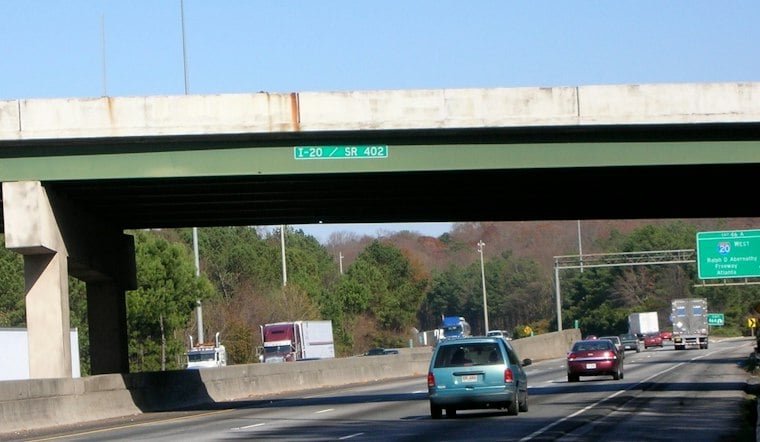
Drivers crawling through DeKalb County's infamous I-285/I-20 East Interchange have a reason to celebrate: the Georgia Department of Transportation says major construction there is complete after three years of work. The interchange, long notorious as one of the nation's worst freight bottlenecks, now carries traffic over new flyover ramps and rebuilt bridges that GDOT says were designed to finally untangle one of metro Atlanta's most punishing commutes.
Three Years, Eight Bridges, One Battered Interchange
The project, which began in late 2023, rebuilt eight bridges and added two flyover ramps, auxiliary lanes and connecting lanes, according to a Georgia Department of Transportation news release cited by FOX 5 Atlanta. Crews also built two overpass bridges at Fairington and Miller roads and four mainline bridges on I-20 and I-285, work that elsewhere has been described as replacing the Miller Road and Fairington Road bridges over I-20 along with the I-20 bridge over Snapfinger Creek, according to Dixie Contractor. The interchange sits roughly 15 miles east of downtown Atlanta in DeKalb County, a corridor where I-285 alone carries more than 200,000 vehicles every day.
Work on the rebuild was handled by East Interchange Builders, a joint venture led by Archer Western Construction and E.R. Snell Contractor, per Engineering News-Record. The trade publication notes the agency used design-build-finance delivery under its Major Mobility Investment Program, and that crews relied on single drilled-shaft foundations as large as 10 feet in diameter, sunk to depths of up to 116 feet, to support the new bridge piers. The same outlet also reported the project installed more than 30,600 linear feet of concrete girders and 10,000 linear feet of steel girders.
From a 26 MPH Crawl to Nearly 56
GDOT officials say the numbers tell the story of why the rebuild mattered. Average peak rush-hour speeds through the corridor had fallen as low as 26.1 mph when construction began, and reached 55.7 mph earlier this year as the work progressed, according to the agency's release carried by FOX 5 Atlanta. The interchange had also been flagged repeatedly as a freight chokepoint, with outdated ramp geometries and climbing traffic volumes on both interstates no longer able to keep pace with demand, per Engineering News-Record.
Just how bad the bottleneck ranked depends on who's counting. Engineering News-Record reported the interchange placed 14th on the American Transportation Research Institute's 2025 list of the nation's top 100 truck bottlenecks, while the Atlanta Journal-Constitution described the same junction as 17th-worst in the country, with rush-hour speeds there averaging 37 mph and the interchange running more than 10% slower than the year before. Separately, CBS Atlanta reported that an ATRI analysis placed four metro Atlanta interchanges among the nation's 10 worst bottlenecks overall.
Freight Traffic Pushed the Corridor to Its Limits
Trucking demand was a central pressure point. As of 2023, annual average daily traffic in the I-20 corridor approached 200,000 vehicles, with trucks making up nearly 22% of ramp traffic, Dixie Contractor reported. The project ultimately widened ramps to two lanes and added two new flyover bridges and three ramps, the trade outlet noted, while GDOT's own figures describe the work as creating more than 11 lane miles of improvements — a total Dixie Contractor put higher, at 18 additional lane miles, in its own account of the same project.
Cost estimates likewise diverge depending on the source. Engineering News-Record described the work as a four-year, $692 million reconstruction effort, while Dixie Contractor put the price tag at $691.7 million. GDOT's own release did not disclose a final overall project cost, according to the agency's statement relayed by FOX 5 Atlanta.
Officials Tout Long-Term Payoff, Cleanup Work Continues
GDOT project manager Beau Quarles said the redesigned layout was built to handle regional growth and relieve daily congestion, according to the agency's release. P3 Division Director Tim Matthews added that the project advances long-term infrastructure benefits, GDOT said in the same release.
The interchange is now open to drivers using the main travel lanes and flyover ramps, but the project isn't entirely finished. GDOT says median and shoulder cleanup along with punch-list work will continue through spring 2027, and the agency is urging drivers to stay alert, watch for roadside workers and follow posted signs until that remaining work wraps up. GDOT had earlier projected that by the end of 2026, the long-troublesome junction would rank among the safest and most efficient interchanges in the state, per Engineering News-Record.





