

























































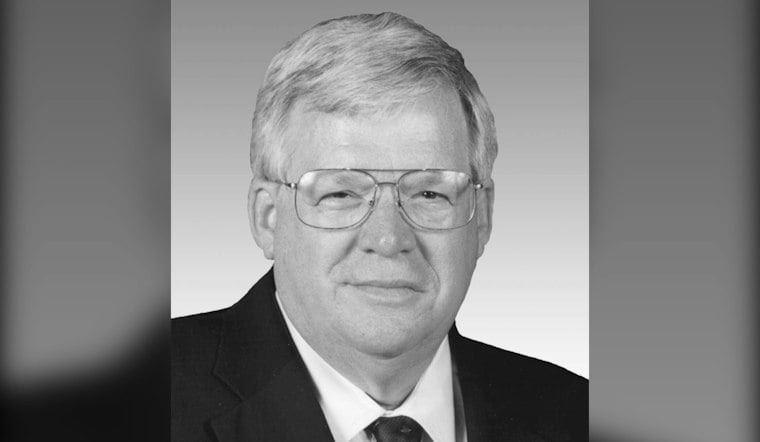
Dennis Hastert, the former U.S. House Speaker whose eight years atop Congress gave way to a stunning public collapse over the sexual abuse of teenage wrestlers he once coached, has died at his home in Kendall County, Illinois, at age 84. The Kendall County Coroner's Office said he died over the weekend of natural causes.
Coroner Jacquie Purcell confirmed the death and the cause, according to CBS News, though the coroner's office said no further information was available for release, per FOX 32 Chicago. Hastert was born in Aurora, Illinois, in 1942 and represented the state in Congress from 1987 until his resignation in 2007, after rising from the Illinois House of Representatives and, before that, from a classroom and wrestling mat at Yorkville High School. CBS News noted that his death leaves behind a singular and uncomfortable distinction: he was both the longest-serving Republican House Speaker in U.S. history and the highest-ranking elected official in U.S. history to serve a federal prison sentence.
From Gym Teacher to Speaker of the House
Before he ever set foot on the House floor, Hastert spent 16 years, from 1964 to 1980, teaching and coaching wrestling at Yorkville High School, leading the team to an Illinois state championship in 1976, according to Britannica. He won election to the Illinois House in 1980 after the original Republican nominee withdrew due to illness, launching a political career that would carry him to Washington in 1987. He became Speaker in 1999 after Newt Gingrich resigned, and went on to serve during the 106th through 109th Congresses, making him, at the time, the longest-serving Republican speaker, per FOX 32 Chicago.
Hastert's speakership spanned some of the most consequential moments in recent American history. He presided over the House during the September 11, 2001, terrorist attacks and the anthrax attacks that followed weeks later, the station reports. His tenure also produced major legislative wins, including the Medicare Prescription Drug, Improvement, and Modernization Act of 2003, which created Medicare Part D and established prescription drug coverage for Medicare beneficiaries, according to Britannica. During this period he also popularized what became known as the “Hastert Rule,” an informal doctrine under which a Speaker declines to bring a bill to the floor unless it is backed by a majority of his own party's members — a practice that, per Wikipedia, continues to shape how Congress controls its legislative agenda today.
Scandal, Resignation, and a Hidden Past
Hastert's final year as Speaker was consumed by a different kind of crisis. Revelations surfaced in 2006 that his office had failed to act on earlier warnings about Rep. Mark Foley sending sexually inappropriate messages to teenage House pages, a scandal that, as SFGATE reported at the time, contributed to Republicans losing control of the House that November. The House Ethics Committee later issued a report criticizing leadership's handling of the warnings.
What the public did not know then was that Hastert was concealing a far older and more serious history. Federal investigators eventually examined large cash withdrawals tied to Hastert, the thread that would unravel decades of silence. Prosecutors said Hastert had paid $3.5 million to a person identified in court papers as Individual A to keep allegations of sexual abuse secret, per the station's reporting. Because the statute of limitations had expired on the physical abuse Hastert committed between 1965 and 1981 while coaching at Yorkville, prosecutors were legally restricted to charging him with financial crimes — structuring cash withdrawals to evade federal banking reports and lying to the FBI — rather than the underlying abuse itself, according to Courthouse News Service.
A Judge Calls Him a Serial Molester
Hastert pleaded guilty to violating banking laws. At his April 2016 sentencing, former Yorkville wrestler Scott Cross delivered victim impact testimony describing abuse carried out under the guise of giving athletic massages, prompting U.S. District Judge Thomas Durkin to call Hastert a “serial child molester,” Courthouse News Service reported. Durkin said the abuse had devastated victims and their families, and he imposed a 15-month sentence, exceeding the six months prosecutors had recommended. Prosecutors said at the time that Hastert had abused at least four students while at Yorkville High School; Hastert himself acknowledged mistreating athletes he had coached, though he said he did not remember abusing one former wrestler who spoke in court, according to the station. He was also ordered to undergo sex-offender treatment, serve two years of supervised release, and pay a $250,000 fine.
Hastert was released from federal custody in July 2017 after serving 13 months of his sentence at the Federal Medical Center in Rochester, Minnesota — a specialized facility tied to a stroke and health complications he suffered before sentencing — completing the remainder of his term in a Chicago halfway house and home confinement, according to Wyoming Public Media.
Civil Fight Over Hush Money Dragged On for Years
The financial fallout from Hastert's cover-up did not end with his prison term. He had halted the hush-money payments after FBI agents questioned him in 2014 about the illegal cash withdrawals, leaving $1.8 million of the promised $3.5 million unpaid. The man identified in court papers as James Doe sued Hastert in 2016 to recover that remaining balance, and the breach-of-contract case was not finalized until September 2021, when Hastert reached an out-of-court settlement, according to CBS News Chicago. The long civil battle meant the legal consequences of Hastert's actions as a coach decades earlier followed him almost to the end of his life.
FOX 32 Chicago, along with the Kendall County Coroner's Office, the U.S. House of Representatives history website, and the Associated Press, are listed among the sources documenting his death and career. Hastert's story remains one of American politics' starkest reversals: a Speaker who helped steer landmark legislation and set rules that still govern Congress today, undone by secrets from a high school gymnasium that took decades to surface.





