

























































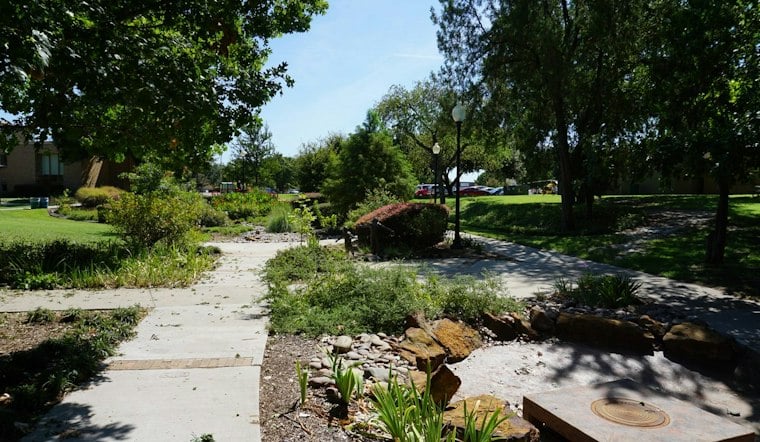
Texas Woman's University will hold two ribbon-cutting ceremonies next Tuesday for the Quakertown Memorial and a new outdoor trail system, marking a long-awaited public tribute to a Black community that was forcibly displaced from the land nearly a century ago. The Quakertown memorial ceremony is set for 10 a.m. at 700 E. University Drive in Denton, just south of the university's athletic fields.
According to Community Impact, TWU officials will first celebrate the opening of the East Campus outdoor facilities on the eastern side of the main campus before moving to the Quakertown ceremony. Those new facilities include fitness trails and a pavilion, creating a recreational space ahead of the more solemn dedication that follows.
What the Memorial Looks Like
Per the same report, the Quakertown Memorial will include a symbolic amphitheater with residents' names imprinted in stone alongside a map of Denton as it looked in 1920 — a direct nod to the community erased from that map soon after. TWU describes the space as an amphitheater surrounded by shade trees, built around a walking path and an augmented-reality exhibit exploring Quakertown's history, according to Texas Woman's University.
The university says the path will feature images tied to the Quakertown story, including the rocking chair once sat in by Mary Ellen Taylor and lilac bushes displayed in a neighbor's garden. TWU's own project timeline lists the memorial as completed in 2024, though the public ribbon-cutting is only now taking place in 2026.
A Forced Removal in the 1920s
Quakertown was a predominantly Black community whose residents were forcibly relocated to southeast Denton by the local government in the 1920s, as previously reported by Community Impact. The exact scale of that displacement is described differently across historical sources: TWU's own materials cite the forced sale of nearly 60 Quaker residences in 1922, while a Denton Public Library history says the 1920 city directory recorded 64 mostly African American households in an area spanning roughly 32 acres, and separately states that more than 60 families lost their homes. City documents cited by Community Impact put the figure at roughly 70 homes destroyed during the process.
The Denton Public Library's history lays out how the displacement unfolded. Denton voters approved establishing a park system by a vote of 367 to 240 on April 5, 1921, and the city began purchasing Quakertown residents' homes and land in May 1922 after selling $75,000 in bonds. Condemnation proceedings began that December to secure title to the three remaining tracts at the park site, according to the Denton Public Library history.
University Leaders Reflect on the Memorial's Purpose
TWU Chancellor Carine Feyten described the memorial as a permanent place to remember the past and help future generations learn, reflect and connect. She has said she hopes the memorial will bring the community closer together, deepen understanding of shared history and underscore the idea of moving forward together, per the university's news release.
TWU's engagement with Quakertown's history stretches back years before the October 20 ceremonies. The Quakertown Committee was formed in 2017 when Feyten tasked it with recommending ways for the university to acknowledge its role in the displacement and promote racial unity, according to TWU. The university has also drawn on more than $99,000 in National Endowment for the Humanities grant funding to help students dig into Quakertown's history, reports the Denton Record-Chronicle, with that work supporting student documentation, town hall forums and a planned digital humanities archive.
Film Screening and a Conservation Planting
Tuesday's events will also include a screening of the documentary “Quakertown, USA” at 1 p.m. in the Phyllis J. Bridges Auditorium inside Hubbard Hall, with TWU working alongside the Denton Black Film Festival to present it. The two-part documentary series on Quakertown's forced removal and relocation was jointly produced by the Denton Black Film Festival Institute and Southroad Pictures, which received $250,000 from the city of Denton toward production. The film premiered at the 2026 Denton Black Film Festival and later drew another sold-out screening, per the Record-Chronicle's earlier coverage.
Event attendees are also expected to sow native wildflower and grass seed in a designated conservation zone as part of Tuesday's festivities. The gesture echoes earlier city planning efforts: Denton Parks and Recreation had previously floated ideas including a healing therapeutic garden with a sculpture, in-ground markers and augmented-reality features, with a plan calling for temporary signage at Quakertown Park ahead of a permanent memorial years later, according to the Record-Chronicle's prior reporting.
The city renamed the site Quakertown Park in a vote by the Denton City Council on Feb. 6, 2007, a step the library's history marks as an early turning point in public acknowledgment of the community's story — one that has since grown from historical research and renaming efforts into the memorial construction and educational programming now reaching its public unveiling.





