

























































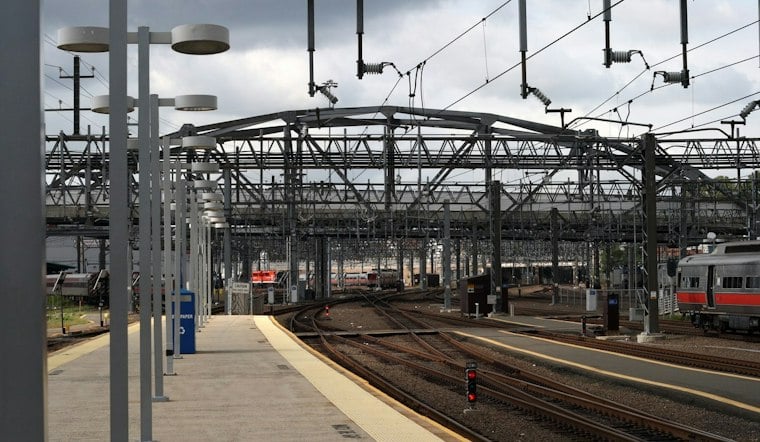
Amtrak riders heading to and from Rhode Island spent Monday staring at ever-changing arrival boards after a downed power line near New Haven, Connecticut, triggered hourslong delays across the Northeast Corridor. Some Northeast Regional and Acela trains serving Providence, Westerly and New London ran nearly eight hours behind schedule before service began recovering later in the day.
Trains Stacked Up From Stamford to Westerly
Northeast Regional train 1087 was listed as nearly eight hours late approaching Stamford, Connecticut, according to WJAR. Acela train 2148 trailed by 6 hours and 35 minutes as it approached Providence, while Northeast Regional train 1135 was running nearly six hours late heading into New London. Further delays stacked up on trains bound for Westerly, with Northeast Regional train 1165 listed at 4 hours and 37 minutes behind and train 1167 at 3 hours and 31 minutes behind, the outlet reported. Not every train was caught in the backlog — the station noted that some services were running on time even as others crawled.
Amtrak identified the source of the trouble as a catenary, the overhead line that supplies electricity to trains, which went down near New Haven, the WJAR report said. The disruption rippled outward, affecting both Acela and Northeast Regional trains across the corridor, including several runs serving Rhode Island, per the outlet's review of Amtrak's live tracking map.
A Separate Power Problem Near Mystic
Adding to the day's headaches, Acela train 2150 ran into a separate power issue near Mystic, Connecticut, before eventually arriving in New London. The outlet reported that Amtrak did not say whether that problem was connected to the downed catenary near New Haven, leaving the relationship between the two incidents unclear. While train 2150 sat delayed, crews brought passengers beverages and additional water, and Amtrak moved some of those customers onto another train as space allowed, according to the same report.
By Monday evening, Amtrak said trains were moving again, though the company cautioned that lingering delays should be expected as service recovered, the station reported. The company apologized to customers and said it appreciated their patience, and it directed riders to check Amtrak's live tracking map for the latest arrival estimates.
An Aging Power System Under Growing Strain
Monday's outage landed in the middle of a stretch of major construction work already squeezing the Northeast Corridor. Trains reported that a series of Northeast Corridor construction projects, most staged concurrently starting in October, were expected to significantly affect Amtrak operations from Connecticut down to south of Washington Union Station. That included a nine-day full shutdown of service south of Washington Union Station from Oct. 16 through Oct. 26 for First Street Tunnel interlocking work, and Portal North Bridge cutover work in New Jersey running from Oct. 9 through Nov. 16 that was expected to force a 62 percent reduction in Amtrak and NJ Transit service, according to the same outlet. Amtrak has also listed reduced weekend service between New York and Boston for infrastructure improvements running from Sept. 12 through Nov. 1, per the company's own service alerts.
Trains also reported that Amtrak's chief operations officer told the company's board that limited equipment supply leaves little room to absorb incidents without cascading delays, warning that equipment is in tight supply across all service lines with no extra trains sitting in reserve. That bottleneck helps explain why a single downed catenary near New Haven could leave trains running nearly eight hours late as far away as Westerly and New London.
Decades-Old Wires Keep Failing
The equipment strain sits on top of a power infrastructure problem that predates this week's outage by decades. Most of the Northeast Corridor's catenary system is about 80 years old, according to Curbed, which reported that an Amtrak regulatory filing found none of the overhead wiring between Washington, D.C., and New York's Pennsylvania Station was in a state of good repair. That same reporting put Amtrak's catenary maintenance backlog at an estimated $829 million, up from less than $100 million in 2018, with another $2.9 billion needed to replace or repair the poles and structures that hold the wires.
The aging wires also limit how fast trains can run. Curbed reported that the older catenary between New York and Washington throttles Acela trains to a peak of roughly 125 to 135 miles per hour, while the newer power system between New Haven and Boston lets Acela trains hit up to 150 miles per hour on stretches through New England. Separately, Amtrak and NJ Transit have said they are jointly investigating recent disruptions and pursuing fixes to the electric traction system, catenary, signals and switches, along with NJ Transit's pantograph equipment, according to a statement from Amtrak Media.
A Familiar Pattern of Outages
Monday's episode is far from the first time a power or debris problem has snarled Northeast Corridor service. A fallen tree once stopped an Acela train carrying 184 passengers in New Haven after it struck overhead wires, NBC Connecticut reported. In another earlier incident, structural debris from an I-95 on-ramp crashed onto the tracks, and WJAR reported that only one track had reopened while repairs continued. A separate downed-catenary incident temporarily suspended all Amtrak service in and out of Boston, causing extended delays and cancellations, according to WHDH. Together with Monday's delays, the incidents point to a power system that keeps buckling under pressure even as Amtrak works through a packed fall construction calendar.




