

























































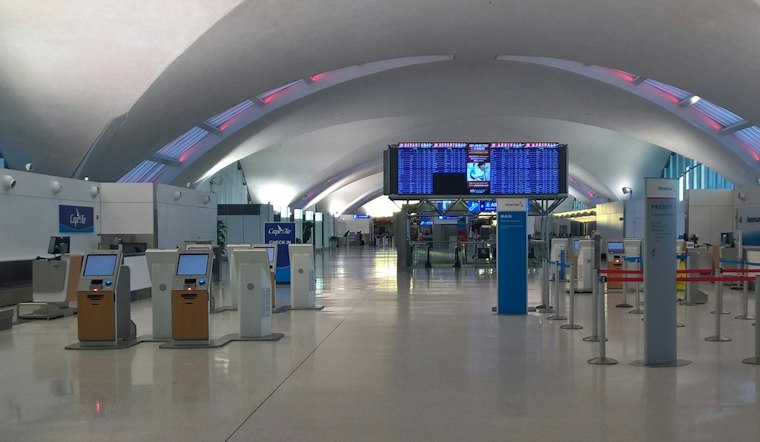
U.S. Transportation Secretary Sean Duffy stood at St. Louis Lambert International Airport and said the facility was in grave need of dollars, telling reporters it could use a facelift funded by proposed federal money. He made the comments alongside U.S. Sen. Eric Schmitt of Missouri at a news conference Thursday promoting a sweeping aviation infrastructure bill that could funnel billions toward airports just like Lambert.
Duffy joined Schmitt at the news conference to push the Modern Skies Act, a bill Schmitt introduced that would spend up to $30 billion on air traffic control tower improvements and other aviation infrastructure, according to Spectrum News. Of that total, $10 billion is earmarked specifically to modernize or rebuild aging terminals nationwide, per the same report. Schmitt said the legislation is tailor made for places, not just St. Louis, but added he considers Lambert among the most deserving airports for the proposed infrastructure funding.
Schmitt estimated that somewhere between 12 and 16 airports nationally could fit the category the bill addresses, the station notes. That category lines up closely with language in the bill itself: the Modern Skies Act sets aside $10 billion for a new pilot grant program aimed at so-called transitional airports, defined as those serving between 5 million and 25 million passengers a year and lacking direct capital access, according to the U.S. Department of Transportation. Lambert's passenger volumes fall squarely within that bracket.
Lambert's $3 Billion Terminal Overhaul Is Already Moving
Lambert isn't waiting around for Washington to act. The airport has related projects to consolidate into one modern terminal that have already broken ground, Spectrum News reports, and officials plan to accelerate major phases of the consolidation project next year with a target completion of late 2031 or early 2032.
The terminal project carries a budgeted cost of at least $3 billion, according to the station's report, and would be paid for through a mix of airline fees, FAA grants, ticket-sale fees, and higher costs for parking, concessions, and retail purchases. On the design side, Lambert selected the AECOM Hunt-Clayco Joint Venture as construction manager at risk and tapped HOK as lead architect, as reported by ENR. The single-terminal concept would consolidate two existing passenger terminals into Terminal 1 while expanding gate capacity from 54 to 62, per the same outlet.
Site prep is already visible on the airfield. Lambert broke ground in October 2025 on a $114 million Airfield Maintenance and Snow Removal Equipment Facility, a 285,000-square-foot project that ENR describes as a prerequisite step before main terminal construction begins. That new facility will replace nine scattered maintenance buildings, some of which are more than 50 years old, according to the outlet. Separately, more than $7 million is designated for passenger boarding bridge replacements at Lambert, according to KSDK.
A Bill With Industry Backing and a Lame-Duck Deadline
Schmitt said he plans to seek any legislative vehicle possible to pass the Modern Skies Act once Congress returns for a lame-duck session after the midterm election, Spectrum News reports. The bill arrives with institutional muscle behind it: nearly 60 aviation organizations, including carriers represented by Airlines for America, the Air Line Pilots Association, and the National Air Traffic Controllers Association, have formally backed the measure, according to the Transportation Department.
The push also follows years of strain on the nation's air traffic system. Flight-delay minutes attributed to FAA equipment failures surged by roughly 300 percent in 2025 compared with prior levels, according to Forbes Advisor. Forbes Advisor reported that Transportation Secretary Sean Duffy described air traffic control system technology as 40- to 50-year-old in a post on X, while transportation officials have noted that critical airspace communications still rely on copper-wire telecommunications infrastructure. The FAA separately projects commercial air travel will expand by more than 40 percent by 2046, according to the Transportation Department, a forecast officials cite as justification for urgent investment in terminal and airspace capacity.
The $30 billion request represents the second and larger phase of federal air traffic modernization, following an initial $12.5 billion down payment Congress approved in 2025 for the FAA's Brand New Air Traffic Control System, according to AirGuide. Whether lawmakers approve the full amount remains uncertain given the history of federal aviation megaprojects: the FAA's prior NextGen system has faced scrutiny over its costs and delays, according to AirGuide. It is also unclear when airlines serving Lambert will cast a final binding vote on the airport's overall terminal financing plan.
Hoodline previously reported on Schmitt's bill introduction at Reagan National Airport alongside Duffy and FAA Administrator Bryan Bedford, where the senator laid out the broader $30 billion framework and execution timeline through 2028. Thursday's stop in St. Louis marked an effort by both men to translate that national pitch into a concrete local case, with Lambert standing in as the kind of mid-sized airport the bill's backers say has been stuck without the capital to modernize.





