

























































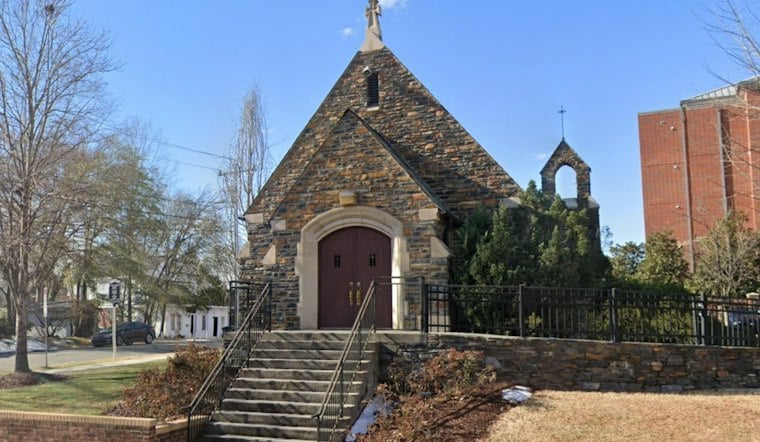
Nearly 75-year-old wooden windows at North Carolina Central University's Centennial Chapel got a careful second life this month, as volunteers, students and craftspeople spent five days removing, repairing and reinstalling them along Fayetteville Street. The effort combined hands-on preservation training with a chance to protect one of Durham's more unusual pieces of architectural history.
The project was hosted in partnership between Hayti Promise Community Development Corporation and the National Trust for Historic Preservation's HOPE Crew, according to CBS 17. Hope Renovations and Lynco Restoration also took part, helping crews remove, repair and reinstall multiple windows over the course of the project. Organizers hosted a training event alongside the physical work, giving participants direct experience fixing up a piece of local history.
A Chapel With a Long, Layered History
Centennial Chapel was originally completed in the early 1950s and once served as home to one of North Carolina's first African American Catholic congregations, per the same CBS 17 report. NCCU later purchased the structure and moved it to its campus, and the university rededicated the building — formerly known as Holy Cross Church — as Centennial Chapel in 2010. Today the chapel sits along Fayetteville Street, in the heart of a neighborhood with deep ties to Durham's Black history.
NCCU archivist Andre Vann said the chapel anchors its neighborhood and community, according to the station's report. Ondin Mihalcescu, NCCU's director of planning, design and construction, said the HOPE Crew and Hayti Promise are joining forces with the university to restore the chapel's historic wood windows, and added that having community members learn historic preservation skills locally carries real meaning.
Training Ground for Durham's Next Tradespeople
Hope Renovations describes itself as a nonprofit that equips women and gender-expansive students with construction trade skills, part of workforce-development programs designed to create career opportunities while addressing a labor shortage in the construction industry, according to Hope Renovations. The organization's Construction Fundamentals Pre-Apprenticeship runs 13 weeks, and it separately leads a seven-week training program at Durham Technical Community College that prepares women for trades careers through classroom instruction and hands-on practice, as reported by ABC11. Graduates earn industry certifications that can open doors to construction jobs across the region, the outlet notes.
That kind of training reflects a broader shift in the field. Women represented 11.2% of the U.S. construction workforce in 2024, according to the National Association of Home Builders figures cited by ABC11, and the number of female construction workers has increased every year since 2012.
Part of a Larger Fayetteville Street Push
The chapel restoration is one piece of a longer-running effort along the corridor. In November 2025, Hayti Promise Community Development Corporation and the National Trust for Historic Preservation launched a service-learning partnership focused on preservation work in the area, according to the National Trust for Historic Preservation. That partnership is scheduled to continue throughout 2026 with additional preservation projects and workforce development along Fayetteville Street. The nonprofit was also awarded $10 million in federal American Rescue Plan Act funding in 2024 for community-centered revitalization efforts in the corridor, per the same account.
Project organizers say further restoration of additional chapel windows and other parts of the building could be in store for 2027, CBS 17 reports. For now, the newly repaired windows stand as a small but visible marker of a congregation's past and a university's present — restored, as preservation advocates often argue, rather than replaced, a philosophy Preservation North Carolina says can offer long-term savings and benefits for historic properties.





