

























































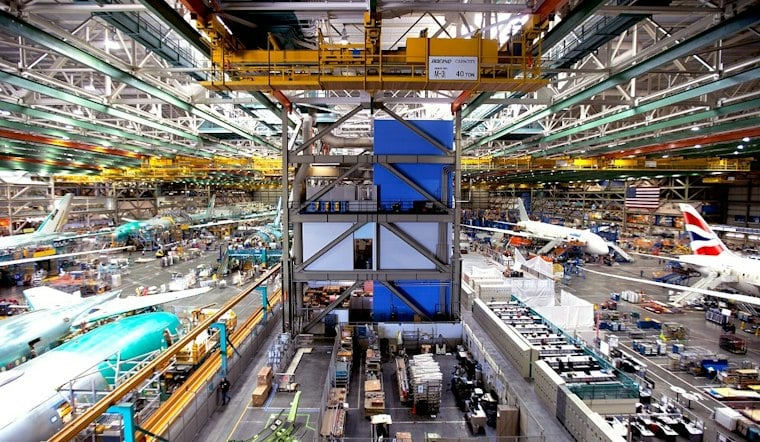
The Federal Aviation Administration is certifying Boeing's largest 737 Max jet, the Max 10, clearing a path for the planemaker to finally start delivering an aircraft that airlines have been waiting on for nearly a decade. Transportation Secretary Sean Duffy planned to announce the certification decision Tuesday afternoon at Boeing's manufacturing plant in Everett, Washington, according to a Transportation Department official who spoke on condition of anonymity because they were not authorized to discuss the matter publicly before the announcement.
The Associated Press reported the certification news, citing an unnamed Transportation Department official. The FAA's sign-off caps a long and bumpy road for the Max 10, which seats up to 230 passengers and was first introduced at the Paris Air Show in 2017 as Boeing's answer to Airbus's dominant single-aisle lineup. Technical and safety-related concerns repeatedly delayed certification of the largest Max variant, pushing the aircraft years past its original timeline.
A Final Review Board Meeting Set the Stage
The regulatory endgame moved quickly in the past few days. The FAA's Type Certification Board held a final review meeting on October 16, completing the last formal administrative safety assessment required before agency leadership could grant type certification, according to Air Data News. That meeting came after Boeing wrapped its flight-test campaign on July 28, logging 976 test flights, more than 2,060 flight hours, and over 1,040 hours of ground testing, the outlet reported separately.
Even in its final weeks, the certification process hit one more scare. Boeing disclosed a navigation software computer glitch in late September, and on October 2 the FAA formally determined the anomaly did not present a flight safety concern and would not need to be fixed as a condition of certifying the Max 10, according to Aerospace Global News.
Nine Years, Two Crashes, and a Redesigned Anti-Ice System
FAA authorization allows Boeing to begin delivering the Max 10 to airline customers, though Boeing expects the first deliveries won't happen until 2027, per the News4JAX report. That timeline reflects just how long this plane has been in limbo: it missed its original target of entering commercial service in 2020 by seven years, the same Air Data News report noted.
Much of that delay traced back to a 2023 problem with the 737 Max engine anti-ice system, which could overheat and cause structural damage to engine inlet cowlings during prolonged operation in dry air, Air Data News reported. Boeing also had to build in an Enhanced Angle of Attack system under congressional safety legislation passed after earlier Max accidents — a feature the company plans to retrofit across its entire Max lineup, the outlet said.
The broader shadow over this certification has always been Boeing's safety record. Two crashes involving 737 Max 8 jets killed 346 people in 2018 and 2019, and more recently, an Alaska Airlines Max 9 experienced a panel separation midflight in 2024. Hoodline has also reported on punitive damages tied to that incident. In a separate episode, a FlyDubai copilot allegedly stabbed another pilot; passengers and crew subdued the attacker, and the plane landed safely in Tabuk, Saudi Arabia — an episode Hoodline covered as passengers and crew subdued the attacker.
Regulators Have Been Easing Boeing's Leash
In response to the earlier crashes, the FAA overhauled its process for certifying Boeing aircraft, then gradually loosened restrictions over the past 18 months — raising the limit on how many planes Boeing can produce. In July 2026, the agency said Boeing could again take responsibility for certifying all of its own 737 Max and 787 planes, and in August 2026 it cleared the smaller Max 7 for airline operations, according to the News4JAX report. Approval of the Max 10 now completes Boeing's full lineup of four 737 Max models.
Boeing's safety culture remains under separate legal scrutiny even as certification moves forward. A Chicago judge certified a shareholder class alleging the company misrepresented Max safety standards, while LOT Polish Airlines has pressed its own civil claims in a Seattle courtroom. Meanwhile, an appeals court shut down a challenge from families of the 2018-2019 crash victims over criminal prosecution decisions.
Nearly 1,500 Orders Are Riding on the Decision
The financial stakes for Boeing are enormous. Airlines have placed nearly 1,500 firm orders and commitments for the Max 10, representing roughly 30% of Boeing's total unfilled 737 backlog as of October 2026, according to Quartz, with major customers including United Airlines, Ryanair, Delta Air Lines, Alaska Airlines, and American Airlines. The Max 10 is designed to carry more passengers while burning less fuel than older aircraft, positioning it against the Airbus A321neo family, which entered service in 2017; the largest A321neo variant can still carry more seats and fly farther without refueling than the Max 10, per News4JAX.
To keep pace with that order book, Boeing opened a new assembly line at its Everett, Washington facility in July 2026, aiming for an overall narrowbody production rate of 52 jets per month in 2027, Quartz reported. United Airlines has also pursued an A321neo Coastliner strategy.
Even with Tuesday's certification, passengers won't be boarding a Max 10 anytime soon. Boeing isn't expecting first deliveries until 2027, with passenger operations anticipated in early 2027 for the jet designed to out-muscle the A321neo.




