

























































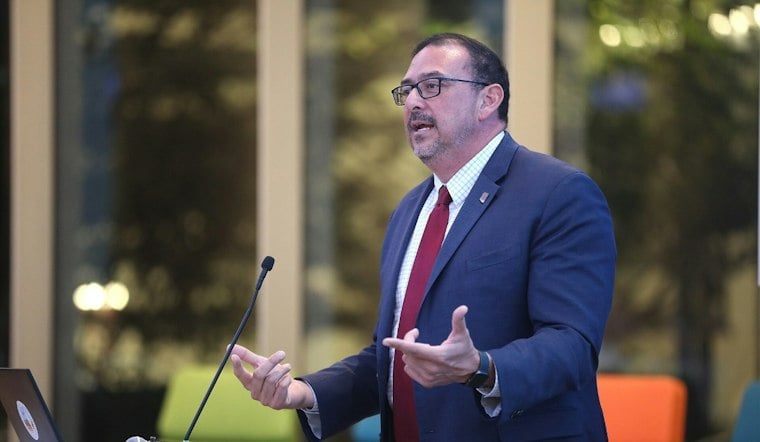
Arizona Secretary of State Adrian Fontes and Republican state Rep. Alexander Kolodin offered sharply different views of mail voting and election-night results during their final debate before the Nov. 3 election, held Wednesday night in Phoenix. Their disagreement over election administration turned personal when Fontes warned Kolodin that repeating a claim linking him to the Sinaloa cartel would create what Fontes called a personal problem.
The nearly hour-long faceoff, hosted by Clean Elections and the Arizona Media Association, took place at Sneaky Big Studios, according to azcentral.com. Fontes, the Democratic incumbent, is facing Kolodin, a Republican state representative, in a race that will decide who oversees Arizona elections. KTAR reported that Kolodin called Fontes a lawyer for the Sinaloa cartel, referring to Fontes’s representation of Manuel Fabian Celis-Acosta in a 2011 case. Celis-Acosta was described as an alleged drug trafficker with ties to a Mexican cartel. Fontes called the accusation a lie and warned Kolodin, “If you say Sinaloa cartel lawyer one more time, we're going to have a personal problem.”
A Cartel Accusation Repeated, Then a Warning
Kolodin repeated the Sinaloa cartel lawyer claim roughly 22 minutes after Fontes’s warning, according to Phoenix New Times’ debate reporting. Fontes called the accusation false and criticized Kolodin’s character. Kolodin said Fontes had threatened to jump him; Fontes denied making that threat.
Fontes also directed voters to alexlies.com as part of his response. He invoked the long history of hard-fought American politics, while Kolodin accused him of not following the law and called Arizona’s elections a national embarrassment.
Mail Voting and Proposition 144 Divide the Candidates
The sharpest policy split of the night centered on Proposition 144 and the future of mail voting, per the same ktar.com account. The measure would require voters to show government-issued identification every time they vote, including by mail, and would ban foreign money in Arizona elections. Kolodin argued the proposition would make voting easier for all Arizonans, produce faster election results and ban foreign funding of elections.
Fontes argued that Proposition 144 would effectively end mail voting, which he said roughly 80% of Arizonans currently use. He also said sharing unredacted voter data with the federal government, as some election-reporting proposals would require, would violate voters’ privacy rights. On the federal SAVE system, Kolodin said it would expand voter access and that he would use the system while developing it internally; Fontes countered that it would eliminate Arizona’s mail-in voting system as currently used.
Mail voting and registration records
Early-ballot use has grown over time: AZPM, citing the Arizona Secretary of State’s office, reported that the share of Arizona voters casting an early ballot rose from 61% in 2012 to 79% in 2018. The registration process also has distinct federal and state paths. NPR explained that applicants using the federal form must swear they are U.S. citizens but do not have to provide documentary proof of citizenship; Arizona’s state form has different requirements. A record without documentary proof under the federal-form process alone does not establish that a person is a noncitizen or voted unlawfully.
Election Night Results: Projection or Promise
Kolodin promised Arizona voters would have results on election night if he is elected: “We're going to have election results on election night. That's what I'm going to deliver for Arizona voters.” Fontes called that unrealistic under the state’s current system, saying faster results would require more state funding and that election-night numbers are projections, not final counts.
From election-night returns to certified results
For the 2024 general election, state leaders canvassed the results nearly three weeks after Election Day, following certification by all 15 counties, AZFamily reported.
Despite their disagreements, the two candidates found common ground on at least one point, agreeing that cybersecurity threats and artificial intelligence agents pose dangers to election security. The debate over the SAVE system also connects to a broader fight playing out at the federal level. The House approved the SAVE America Act, but the bill has stalled in the Senate despite what cronkitenews.azpbs.org described as intense lobbying by Trump, and the expanded database now includes Social Security data along with an option for bulk searches.
Noncitizen Voter Reviews Remain Unresolved
Maricopa County began using the expanded SAVE database to review voter rolls in August 2025, and in February officials announced the database had identified 137 potential noncitizens, including 60 people who had previously voted, though county officials did not say whether any were confirmed noncitizens. A more recent review by the Maricopa County Attorney's Office found eight noncitizens, all legally in the country, who had voted, with no decision on charges made, according to the ktar.com report.
Backgrounds Under Scrutiny
The candidates' backgrounds also came under scrutiny. The Arizona State Bar placed Kolodin on 18 months of probation for his involvement in the so-called fake electors case stemming from challenges to the 2020 election, according to kjzz.org. Fontes criticized Kolodin’s professional record during the debate.
For his part, Fontes has his own history with law enforcement from decades earlier. As a 19-year-old college student, Fontes was involved in a high-speed chase with Arizona State University police; he was initially charged with unlawful flight and endangerment, both felonies, but pleaded guilty to a single misdemeanor count of resisting arrest in 1989, according to the Phoenix New Times. Fontes also referred to protecting the Fourth, Fifth and Sixth Amendments in discussing his past work as a federal public defender.
A Rematch After an Earlier Clash
The candidates had previously faced off in a televised debate, according to azfamily.com. In that earlier encounter, Kolodin answered no when asked whether he was an election denier, though the station reported he evaded questions on whether he believed Arizona's current election system was fair and secure, while Fontes defended the existing system. Kolodin spoke with reporters after the earlier debate but skipped post-debate media availability Wednesday after the second debate.
The general election is Nov. 3. Early voting starts Oct. 7, and the voter registration deadline is Oct. 5, according to ktar.com.





