

























































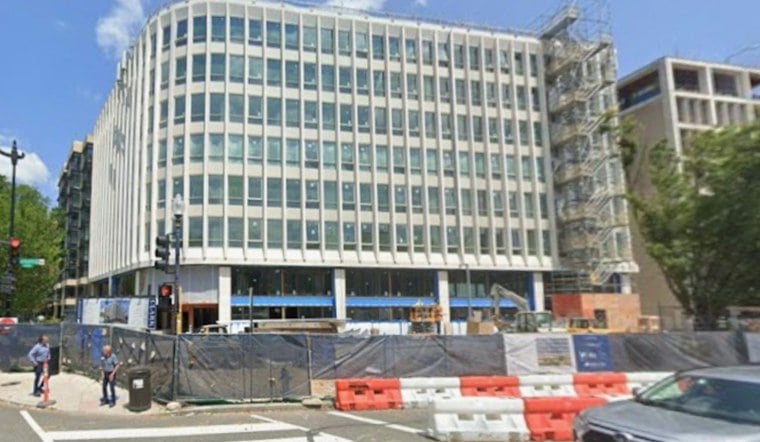
A travertine-clad office tower built in 1972 for the Air Line Pilots Association has reopened its doors at 1625 Massachusetts Avenue NW as Aviator House, a 157-unit apartment building and the first completed project to use Washington D.C.'s 20-year tax break for office-to-residential conversions. The building's debut marks a milestone for a city betting heavily on turning empty office towers into housing.
As reported by CoStar News, Aviator House is the first project to be fully delivered under the District's Housing in Downtown program. The eight-story, 114,000-square-foot building was originally designed by architect Vlastimil Koubek and kept its concrete frame and signature travertine exterior fins while adding a new penthouse residential level, according to the Washington DC Economic Partnership. National Real Estate Development, a division of National Real Estate Advisors, developed the conversion with general contractor Clark Construction, lead architect Eric Colbert & Associates, facade consultant DXA Studio, and interior designer Gaëtane & Co. Design, per National Real Estate Advisors.
The project's 157 studio, one-bedroom, and two-bedroom apartments include at least 15 designated affordable units to satisfy District tax abatement requirements, UrbanTurf reports. Financing came together in September 2024 through a $62.8 million construction loan from Bank of America, arranged through Cushman & Wakefield brokerage advisors — a debt structure that reflected just how tight traditional commercial construction lending had become.
How DC's Tax Incentive Works
Washington's Housing in Downtown initiative grants a 20-year property tax abatement to commercial conversions that set aside either 10% of units at 60% Area Median Income or 18% at 80% Area Median Income, according to a Ballard Spahr analysis of the program. The incentive also waives First Source hiring requirements during construction and grants a 10-year exemption from Tenant Opportunity to Purchase Act restrictions, easing some of the regulatory friction developers face when repurposing office buildings.
The District designed the program to support office-to-residential conversions.
Part of a Bigger Downtown Recovery Push
Mayor Muriel Bowser’s “Comeback Plan” set a goal of adding 15,000 new residents to Downtown Washington in the first five years of the strategy.
By mid-2026, the Housing in Downtown program had conditionally approved 10 office conversion projects representing 2,563 planned residential units, according to an ArcGIS StoryMaps accounting of the pipeline. That list includes Post Brothers' 532-unit “The Geneva” project at 1825–1875 Connecticut Avenue NW, which Hoodline covered in February, and a 435-unit project at 1990 K Street NW.
Office Conversions Add Downtown Housing
Office conversions such as Aviator House are part of the District's effort to add housing downtown.
Aviator House is not the only D.C. property leaning on the incentive. Hoodline reported in September that Carr Properties secured $92 million in financing for a 299-unit Foggy Bottom conversion under the same tax abatement framework, and Douglas Development's August sale of a Georgetown building was unrelated to Bowser's downtown housing targets; the property was outside the initiative's boundaries. Whether the Housing in Downtown program ultimately pays off for the city's tax base remains an open question among policy analysts even as its first finished building welcomes residents.





