

























































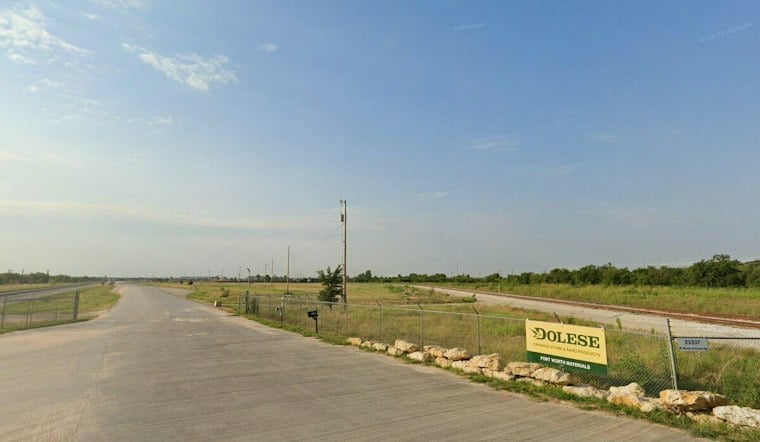
A concrete airplane silhouette dug into the North Texas prairie more than a century ago, used by World War I pilots to practice shooting at targets from the sky, now has legal protection against the bulldozers reshaping the neighborhood around it. Fort Worth City Council approved zoning on Oct. 13 to shield the 0.39-acre site at the western end of the 2700 block of Muscogee Drive, clearing the way for what officials describe as a future neighborhood park built around the relic.
A Target Hidden in Plain Sight
According to Fort Worth Report, the council added a Highly Significant Endangered overlay to the existing one-family residential zoning covering the fenced-off parcel, which sits within an emerging housing development southwest of Bonds Ranch Road and North Saginaw Boulevard. The outline is a remnant of Taliaferro Field No. 1 and the only known World War I gunnery target remaining in the United States. The field was one of three Fort Worth-area airstrips established in early 1917 after the United States entered World War I, and it was later referred to as Hicks Field. The site sits nearly two miles from present-day Hicks Field, and a current private airport is located less than two miles to the northeast, per the same report.
The gunnery target itself measures 32 feet long with a 40-foot wingspan, according to a Fort Worth Aviation Museum document, and it was one of several concrete-lined, water-filled targets built on the range for air-to-ground gunnery training. Trainees dug the silhouette into the ground and covered it with concrete, and crews sprayed water onto it so pilots overhead could see where their bullets struck. Jim Hodgson, executive director of the Fort Worth Aviation Museum, told the Fort Worth Report that the water helped pilots see bullets bouncing off the target. The museum document says the target was discovered in 2006, and the Fort Worth Report adds that the site was initially recorded during a U.S. Army Corps of Engineers project in 2002.
From Hicks Ranch to a Royal Flying Corps Training Ground
Taliaferro Field No. 1 was originally part of Hicks Ranch, according to the Fort Worth Report, before the U.S. Army Air Service built the airfield in 1917 to train 300 Royal Flying Corps Canada pilots. Fort Worth was selected as a location for training airfields after cities nationwide competed for the designation, Hodgson told the outlet, and the resulting complex eventually grew into three separate training fields — Taliaferro No. 1 at Hicks, No. 2, which was renamed Everman, and a third that became known as Carruthers. Comparable WWI training sites in the region, Barron Field and Carruthers Field, were also used by Royal Flying Corps Canada for training between November 1917 and April 1918, per the aviation museum, and building foundations for as many as four hangars and several other structures may still remain near the center of Barron Field.
Sources differ on exactly when flight training began at the Fort Worth fields. The Fort Worth Aviation Museum dates Royal Flying Corps Canada training at Taliaferro Field to between November 1917 and April 1918, while Wikipedia states that Taliaferro Field No. 1 was used by the Royal Flying Corps from October 1917 to April 1918 for both American and Canadian pilots. Separately, Abandoned & Little-Known Airfields notes that the three fields were formally designated Taliaferro Field No. 1 at Hicks, No. 2 at Everman and No. 3 at Benbrook in September 1917, with the first training flights occurring on Nov. 19 of that year. The Fort Worth Report separately states the airfield’s first flight occurred in November 1917. Taliaferro Field No. 1 was later referred to as Hicks Field; the Fort Worth Aviation Museum records that the field was reopened and renamed Hicks Field again in July 1940.
New Homes Rising Around a Century-Old Relic
The Fort Worth airfields once included 18 hangars along with prairie trenches and pilot-training ziplines, and the Fort Worth Report notes that some current buildings in the area were constructed on the foundations of those old hangars. Today, the ground around the surviving target looks far different: hundreds of new homes are being developed nearby, a short distance from Eagle Mountain High School. Hodgson told the outlet that many new residents are unfamiliar with the area’s aviation history, a gap the planned park is meant to help close.
City staff designated the site a Highly Significant Endangered landmark following a historical survey in 2023, according to a city staff report cited by the Fort Worth Report, and the Historic and Cultural Landmarks Commission later recommended the overlay that council approved this month. Citizen Portal reports that the commission voted 9-0 to recommend the designation to council. The Fort Worth Aviation Museum has led years-long efforts to preserve the site, the Fort Worth Report notes, and the plan calls for a developer-initiated park for sharing Fort Worth’s World War I aviation history. Once built, families will be able to visit the airplane silhouette for inspiration, Hodgson said.
A Preservation Milestone for a City Marker
Jerre Tracy, executive director of Historic Fort Worth, said the airfield’s preservation is welcome and that it merits the highest level of historic-site protection. The site joins other locally protected historic properties, including the TXU North Main power plant, which the Fort Worth Report also identifies as an endangered historic site under city council protection. Fort Worth’s preservation framework, administered by the City of Fort Worth, is intended to conserve the city’s historic, architectural and aesthetic heritage and provide continuity for future generations. Under the city’s adopted preservation ordinance, properties can receive Highly Significant Endangered, Historic and Cultural Landmark, or Demolition Delay designations, with additional provisions covering historic site tax exemptions and certificates of appropriateness for demolition, relocation or exterior changes.
The gunnery target’s protection also comes as local preservationists continue flagging threatened historic sites across the city; Historic Fort Worth’s 2026 Most Endangered Places list spotlights resources threatened by circumstances such as extremely deferred maintenance. For now, the fenced silhouette off Muscogee Drive remains visible largely through satellite imagery on the North Texas prairie — a faint outline of a training exercise from more than a century ago, soon to be formally folded into the neighborhood growing up around it.





