

























































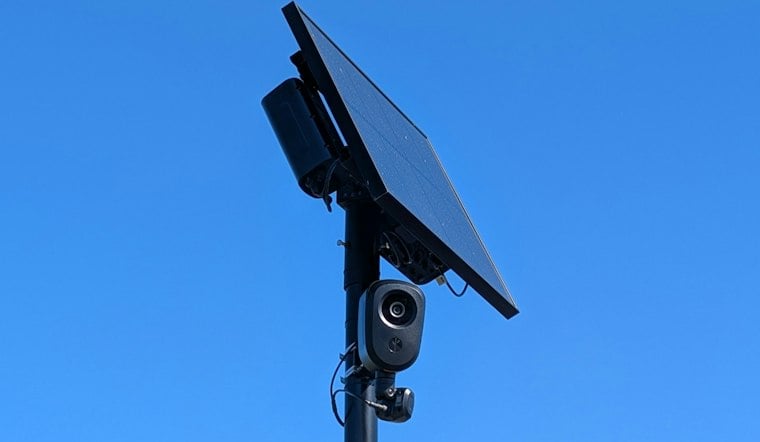
Charles Brownlee is asking a federal appeals court to throw out his armed-robbery conviction and 60-year prison sentence, arguing that police illegally tracked his movements using a network of license-plate-reading cameras without ever getting a warrant. His case has become a test of how far law enforcement can go with the rapidly expanding Flock Safety camera system before it crosses a constitutional line.
Brownlee was convicted of armed robbery and firearm charges and sentenced to 60 years in federal prison, according to the Texas Tribune. Police used Flock cameras to link him to five armed robberies across Dallas-Fort Worth suburbs in 2024, the Tribune reports. According to FOX 4 Dallas-Fort Worth, those robberies hit Cash Store locations in Grand Prairie, Fort Worth, Euless, Hurst and Grapevine between May 9 and May 21, 2024, and a jury convicted Brownlee in March 2025 on robbery, firearm and felon-in-possession charges.
Investigators searched Flock records for vehicles matching an eyewitness description of the getaway car, identified an SUV near multiple robbery scenes and later located it, Courthouse News Service reports. Police compiled what amounted to a pattern of life tracing Brownlee's travels on North Texas roads monitored by the cameras, the Tribune's reporting states. Attorney Michael Weisbuch has said the vehicle searched in the database query actually belonged to Brownlee's sister, and he has argued that Brownlee lacked standing to challenge the search because he was a passenger, not the owner or driver, of the tracked car.
Lawyers Say No One Has Ever Had This Kind of Power
Brownlee's attorneys argue that Flock camera surveillance hands law enforcement more power than the Constitution allows, and that police should have been required to get a judge-approved search warrant before searching the data. Public defender Matthew Wright told the Fifth Circuit that police can use the Flock network to “reconstruct your pattern of life,” per the courthouse news outlet's account of the arguments. Wright went further, telling the court that no human has ever possessed the ability to reconstruct a person's movements so effortlessly, and that the full capabilities of these systems may not yet have been revealed or litigated in court.
Brownlee's lawyers have also argued that the scale of Texas vehicle tracking is far more extensive than the single-camera search addressed in an earlier Fifth Circuit ruling, and they have described the Flock network as more inescapable in Dallas-Fort Worth than cell phone location tracking — a form of tracking the U.S. Supreme Court has already found protected by the Fourth Amendment. U.S. District Judge Terry Means had earlier declined Brownlee's request to block prosecutors from using the Flock data as evidence at trial, the Tribune notes.
Federal prosecutors counter that publicly observable vehicle movements generally are not protected by the Fourth Amendment and that the Flock system only allows for “episodic” monitoring when a vehicle happens to pass a camera, according to Courthouse News. Weisbuch has argued that Flock data is episodic, consists of images taken by individual cameras, and that motorists have no legal expectation of privacy while driving on public roads. Prosecutors have also argued that other evidence — including conventional surveillance footage and cell phone data — was equally useful in identifying Brownlee, and they have characterized his warnings about future mass surveillance as hyperbolic.
Judges Press on Where Episodic Monitoring Becomes Constant Surveillance
During oral arguments in New Orleans on Oct. 5, the Fifth Circuit panel pressed both sides on how many cameras it would take to turn scattered, episodic captures into something closer to constant surveillance. Circuit Judge Jennifer Walker Elrod raised that exact question, and the panel more broadly questioned whether the sheer density of Flock's deployment could amount to constitutionally significant tracking, per Courthouse News, with one exchange capturing the panel's concern over a system that is becoming nearly ubiquitous. Weisbuch responded that pinpointing how many cameras constitute constant surveillance is a task better suited to legislators than judges, the outlet reports.
The court has no deadline to issue its ruling, the Tribune notes. An earlier Fifth Circuit decision recognized that retrospective roadside camera data can help police retrace a person's whereabouts, and the same appeals court previously ruled that a single Flock camera alert and vehicle stop in a Mississippi case, decided in March, did not violate the Fourth Amendment.
An Oklahoma Ruling Raises the Stakes, Without Settling Them
Brownlee's appeal lands just weeks after a different federal judge reached the opposite conclusion in an unrelated case. U.S. District Judge Sara Hill ruled on Oct. 1 that a Tulsa County sheriff's deputy violated the Fourth Amendment by searching a month's worth of Melisa Kyle's location history through Flock's database without a warrant, according to Military.com. The deputy had tracked Kyle's travels between Missouri and California using the camera images, and the query returned more than 50 sightings of her vehicle across multiple states over roughly a month, the outlet reports. Kyle was pulled over for following another car too closely, and police found marijuana in her car; Judge Hill suppressed that evidence, finding the accumulated location history intruded on Kyle's reasonable expectation of privacy in a way that required a warrant. That ruling has not been appealed, Military.com notes, though as a trial-court order it is not binding precedent on the Fifth Circuit or any other judge.
Flock's reach has grown enormously since the company began selling its service to police departments, and that scale is central to the legal fight. The company's cameras can be found alongside roads in every U.S. state but Alaska, with contracts covering 40 percent of the country's law-enforcement agencies, according to The New York Times. In Texas alone, an estimated 13,000 cameras log every vehicle that passes, per the Tribune's reporting, with the state's Department of Public Safety maintaining data-sharing partnerships with more than 200 local agencies. Some police officials have praised the technology as a potential game-changer for public safety on par with DNA testing, while similar federal litigation in Norfolk, Virginia, alleging unconstitutional tracking of residents has survived a standing challenge and a motion to dismiss, according to the Electronic Privacy Information Center.
Texas Lawmakers Signal They May Step In
The backlash has already reached the Texas Capitol. Several state lawmakers intend to file bills restricting or banning Flock cameras and similar automated license plate readers during the 2027 legislative session, the Tribune reports. State Sen. Lois Kolkhorst promised in late August that she would pursue legislation to rein in unregulated camera use, saying any legislative action she takes would be grounded in the Fourth Amendment. At the federal level, U.S. Rep. Keith Self has proposed legislation that would require federal agencies to obtain warrants before accessing Flock camera data.
Whatever the Fifth Circuit decides, the ruling could shape how police across Texas and beyond are allowed to use one of the fastest-growing surveillance tools in American law enforcement. For now, Brownlee remains convicted and sentenced while the appeals court, under no deadline, weighs whether a camera network that can quietly map a person's movements across an entire region needs a judge's permission first.




