

























































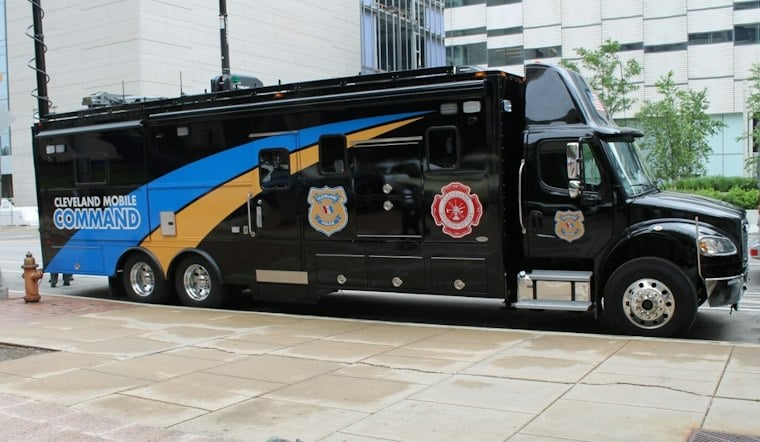
A four-hour standoff on Cleveland's East Side ended Tuesday in tragedy after 20-year-old Ke'Yon Sanchez Moore, wanted on an aggravated robbery warrant, fired on police robots and officers before shooting himself inside a home on East 120th Street. Medical personnel confirmed he died of a self-inflicted gunshot wound to the head. No other injuries were reported.
The confrontation began when U.S. Marshals arrived at a home in the 3500 block of East 120th Street to arrest Sanchez Moore, who was wanted by the Cleveland Division of Police for aggravated robbery, according to FOX 8 Cleveland WJW. Officers confirmed Sanchez Moore was holed up on the home's second and third floors and deployed chemicals, robots and drones into the house in an attempt to force him out, the outlet reported. He responded by firing multiple rounds at the robots and twice toward officers as negotiators tried to persuade him to surrender.
At about 1 p.m., a gunshot was heard inside the home. Sanchez Moore had shot himself, and medical personnel on scene confirmed he died of the self-inflicted wound, per the same report. A Cuyahoga County SWAT team had been deployed to assist during the standoff.
Aggravated robbery, the charge that drew marshals to East 120th Street, carries serious weight under Ohio law. The offense is classified as a felony of the first degree under Ohio Revised Code § 2911.01, punishable by a state prison term ranging from three to eleven years and fines up to $20,000, according to FindLaw.
The Task Force Behind the Arrest Attempt
The arrest was carried out under the umbrella of the Northern Ohio Violent Fugitive Task Force, a federal-local partnership with roots tracing back more than two decades. The task force was created in June 2003 in memory of Cleveland Police Patrolman Wayne Leon, who was shot and killed in the line of duty by an escaped fugitive, according to Richland Source. As of April 2025, the task force had surpassed 60,000 violent fugitive arrests since its founding, including more than 2,400 homicide suspects and 4,800 robbery suspects, along with the seizure of more than 2,900 guns, the outlet reported.
The tactics used Tuesday — chemicals, robots and drones sent into the home ahead of officers — reflect a broader shift in how Ohio police handle barricaded suspects. Law enforcement agencies across the state have increasingly deployed remote-controlled tactical robots, aerial drones, and non-lethal chemical agents during high-risk standoffs specifically to evaluate interior threats and limit direct physical exposure for officers, per WOSU 89.7 NPR News.
Echoes of Recent Cleveland Standoffs
This is not the first time this year that the same task force has faced a barricaded suspect in Cleveland. In August, members of the Northern Ohio Violent Fugitive Task Force were involved in an attic standoff that ended in arrest on Cleveland's West Side, when a suspect wanted for felony strangulation barricaded himself before ultimately being taken into custody. And in February 2025, an 18-year-old suspect wanted in connection with two Cleveland shootings barricaded himself in an upstairs bedroom during a U.S. Marshals task force arrest attempt on East 124th Street before surrendering, Hoodline reported at the time.
Investigations into violent crime on Cleveland's East Side frequently draw on coordination between police district officers, specialized SWAT units, and the city's Real Time Crime Center to locate suspects and monitor scene safety, according to WKYC. Cuyahoga County, where Tuesday's standoff unfolded, is Ohio's most populous county, with roughly 1.25 million residents spread across Cleveland and 58 surrounding suburban municipalities.
Anyone in crisis or experiencing thoughts of suicide can call or text 988 to reach the Suicide & Crisis Lifeline.





