

























































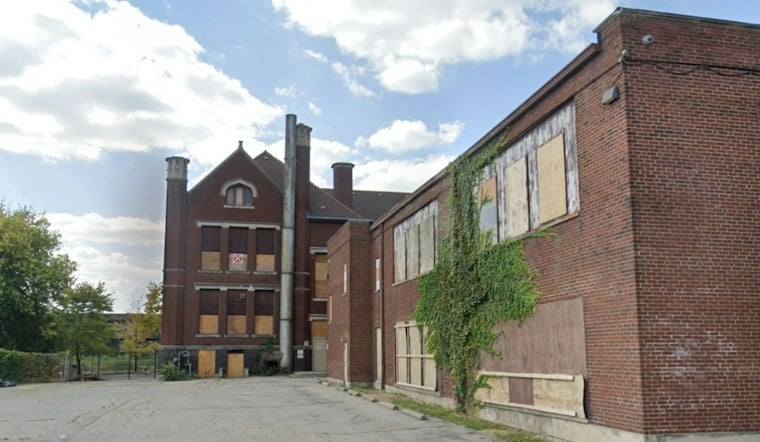
A more than century-old school building in Franklinton that once sheltered flood victims and later fed hundreds of people a day is now staring down the wrecking ball, and a local nonprofit is fighting to stop it. The former Holy Family School at 57 S. Grubb Street now houses the Holy Family Soup Kitchen and Food Pantry. The Jubilee Museum, which once occupied the building, has moved downtown and become the Museum of Catholic Art and History. The Catholic Diocese of Columbus, which owns the building, recently applied to have it torn down.
Demolition company S.G. Loewendick & Sons filed the application on Sept. 21 to demolish the more than 45,000-square-foot building, according to NBC4 WCMH-TV. The building features Romanesque Revival architecture and ornamental parapets, hallmarks of its age and craftsmanship. According to Columbus Landmarks, an addition was completed in the 1930s to accommodate growing enrollment, and the school's basement flooded during the Great Flood of 1913 even as the building provided refuge for Franklinton residents fleeing lower ground.
A Building With a Long History of Service
Holy Family School closed in the 1960s, Columbus Landmarks notes, but the building didn't sit empty for long. It went on to house the Holy Family Soup Kitchen and Food Pantry. The Jubilee Museum also occupied the building before moving downtown and becoming the Museum of Catholic Art and History, as NBC4 WCMH-TV reported. The soup kitchen alone has served up to 300 people in need daily, per Columbus Landmarks, underscoring just how embedded the building has been in Franklinton's social fabric.
That legacy is central to why Tonia Vargas, executive director of Just Believe Personal Enrichment Corp., is urging officials and the diocese to reconsider demolition. Vargas created Just Believe after experiencing homelessness herself, and the nonprofit now advocates for preserving Holy Family School rather than tearing it down. She said her goal is to stop demolition until further research into the building's potential can be completed.
A Vision for Reuse as the Clock Runs Down
Vargas envisions converting the property into a centralized hub for supportive services, resource navigation, workforce development and education. She said she wants agencies to operate out of one location so case managers can bring clients there to receive needed services, rather than scattering them across the city. Just Believe hopes to acquire the building through a charitable donation, discounted sale or low-cost long-term lease, and Vargas has said she loves the building and values its history and significance.
The Catholic Diocese of Columbus, which submitted the demolition application, has said demolition is necessary because the building poses a safety hazard, requires heavy and costly repairs, is subject to repeated forced entry and criminal activity, and because funding to rehabilitate the space is unavailable. The diocese declined NBC4's request for an interview on the matter. The dispute boils down to a core tension described by NBC4: whether the property is truly a safety hazard beyond saving, or whether it can still be repurposed.
What Happens Next in Franklinton
The Franklinton Area Commission is scheduled to discuss the proposed demolition at its Tuesday afternoon meeting. Under the review process, the commission has 60 days to support the demolition request or work with the applicant toward another solution, though commission support for the project could shorten that window.
Holy Family School's predicament isn't an isolated case. Columbus Landmarks previously included the building on its 2020 Most Endangered Sites list. The site's demolition threat was reported by NBC4 WCMH-TV, and Columbus Landmarks also notes that development activity in Franklinton is putting pressure on the site, which sits adjacent to several vacant parcels. Fairwood Elementary, a Tudor Revival building designed by Howard Dwight Smith, was set to close at the end of the 2025-26 school year; Fairwood and Courtright School are the two Smith-designed school buildings at risk of demolition, according to The Columbus Dispatch.
Other Columbus Schools Have Avoided the Wrecking Ball
Not every threatened school in Columbus has met the same fate. Courtright School was marketed for sale in 2025 with materials indicating it was expected to be razed, but it was later purchased by St. Michael Ethiopian Orthodox Tewahedo Church instead. And in a case that shows what adaptive reuse can look like in practice, Starling Yard transformed a 117-year-old, long-vacant school building into modern apartments, according to Woda Cooper Companies. That project created 97 affordable housing units in total, with 45 inside the historic school building and 52 more in two new three-story walk-up buildings, funded in part through federal historic tax credits from the National Park Service and state historic tax credits from the Ohio Department of Development.
The Columbus Board of Education has taken a more mixed approach elsewhere in the city. The board voted to demolish several initially listed school buildings once they are vacated, with one exception: West Broad Elementary, whose closure depends on securing replacement funding, according to Columbus Underground. For now, Holy Family School's future rests with the Franklinton Area Commission and whatever path the diocese and preservation advocates can, or cannot, agree on in the weeks ahead.





