

























































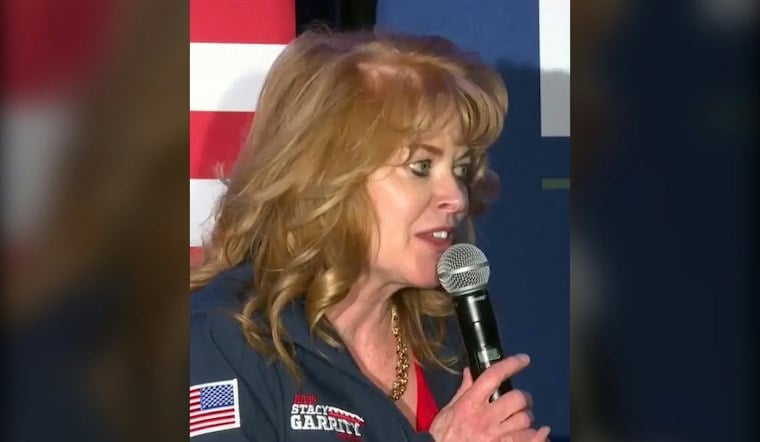
Pennsylvania Treasurer Stacy Garrity is defending an AI-generated campaign ad that revives a 2023 sexual harassment settlement tied to one of Gov. Josh Shapiro's former aides, even as Shapiro's campaign dismisses the spot as dishonest content from a candidate it says was handpicked by President Trump. The clash, playing out in the campaign's closing days, has turned a years-old personnel scandal and the ethics of AI in political advertising into fresh flashpoints in the race for governor.
Garrity, the Republican challenger and sitting state treasurer, made her case during a campaign stop in Pittsburgh, where she discussed the economy, her stance on data centers and her vision for the state's future, according to WTAE. Asked about the ad, Garrity said Shapiro's team criticized it but never disputed anything in it, insisting, she said, that it was all true. She also claimed Shapiro said during a debate that he did not know about the harassment settlement at the time it happened.
The ad itself, generated with artificial intelligence by Garrity's campaign, says taxpayer dollars were used to make a young woman sign a nondisclosure agreement and that emails were subsequently deleted, per the same account. The ad refers to a sexual-harassment complaint against a Shapiro aide, not against the governor himself, WTAE reports. Garrity put the settlement figure at $295,000.
The 2023 Settlement That Won't Go Away
The episode at the center of the ad dates back to a $295,000 settlement agreement signed on September 5, 2023, under which Shapiro's administration agreed to pay public funds to resolve a sexual harassment complaint against Mike Vereb, then his secretary of legislative affairs. Vereb resigned shortly before the settlement and its nondisclosure clause became public, according to Spotlight PA. The fallout prompted a bipartisan group of female state senators to introduce legislation that November restricting NDAs in taxpayer-funded harassment settlements across state agencies, as City & State Pennsylvania reported at the time.
Manuel Bonder, a spokesperson for Shapiro for Pennsylvania, pushed back hard on the ad itself. Bonder said Garrity was Trump's hand-picked gubernatorial candidate who trafficked in dishonest AI content, and added that AI might comfort Garrity in the closing days of her campaign, according to WTAE's reporting.
Data Centers Become Another Flashpoint
Garrity also used the appearance to criticize Shapiro's approach to data-center development, accusing him of prioritizing political contributions over transparency. She said Shapiro encouraged and allowed data centers into Pennsylvania without guardrails or transparency, per WTAE's account.
Shapiro for Pennsylvania countered that Garrity has a record of supporting unregulated data-center development and cannot be trusted, with the campaign saying she wants aggressive deregulation and hundreds more data centers built across Pennsylvania communities, and vowing to hold her accountable, the station reported. Shapiro has taken a different public posture: in August he signed Executive Order 2026-05, instituting Responsible Infrastructure Development standards for data centers exceeding 25 megawatts, stripping speculative projects of fast-track permitting and explicitly banning NDAs for state data center applications, according to the Commonwealth of Pennsylvania.
Garrity's campaign platform, by contrast, calls for a moratorium on new data center developments to give municipalities time to update zoning codes, prioritize brownfield sites and require developers to supply their own power and water infrastructure, according to MultiState. The stakes are considerable: regional grid operator PJM Interconnection has projected that summer peak electric demand across its territory will surge by 74 gigawatts through 2045, driven largely by hyper-scale data center construction, per the Commonwealth's August filing. Pennsylvania's sales and use tax exemption for data center equipment, meanwhile, is projected by state fiscal analysts to cost up to $1.9 billion in forgone revenue through 2031, according to City & State Pennsylvania.
Public opinion on the issue is lopsided. A Quinnipiac University poll conducted between October 1 and 5 found 64% of likely Pennsylvania voters believe AI data centers will do more harm than good, compared with just 24% who see them as beneficial, according to PoliticsPA.
AI Ads Sit in a Regulatory Gray Area
The fight over Garrity's ad also surfaces a legal gap heading into Election Day. Pennsylvania's Act 35, signed by Shapiro in July 2025, created third-degree felony penalties for using artificial intelligence to generate non-consensual forged likenesses or voice clones meant to deceive or harm someone, per the Commonwealth. Pennsylvania has no dedicated political-ad deepfake law, but Act 35 may apply to political campaigns if a deepfake meets the law's fraud-or-injury intent requirements. A separate measure, House Bill 811, would require campaigns to disclose AI-generated deepfakes in political ads or face daily fines up to $50,000; it passed the state House unanimously in June 2025 but has not become law, according to the Associated Press.
That leaves AI-generated attack ads like Garrity's without a dedicated political-ad deepfake law for now, even as both campaigns accuse each other of eroding transparency. Garrity's campaign has used AI-generated content in its digital advertising.
WTAE, which has been tracking the back-and-forth between the two campaigns, said it will continue covering both as the election nears. The exchange adds to a string of recent flashpoints between the candidates, including their lone debate earlier this month, where data centers, AI and taxpayer spending all came up, and a Quinnipiac poll that showed Shapiro leading Garrity by 25 points.





