

























































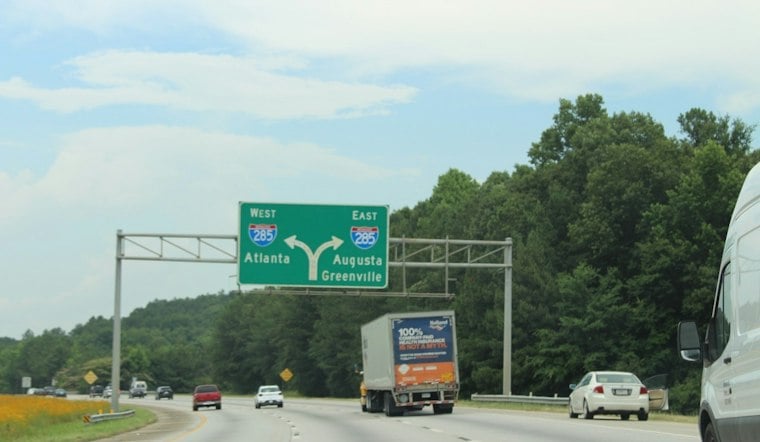
Georgia has picked a private team to build new toll lanes along the top end of I-285, a project expected to cost $8.9 billion for its first phase and reshape commutes across metro Atlanta for decades to come. The state transportation board approved the selection of the Ferrovial-led Top End Mobility Group on October 15 to design and build the I-285 East Express Lanes project, moving a long-discussed plan closer to breaking ground.
The project calls for two new barrier-separated express lanes heading west, in the outer-loop direction, from Henderson Road near Tucker to Northside Drive near Sandy Springs, according to Axios. Those lanes would connect to I-85 and Georgia 400, part of what Top End Mobility Group describes as roughly 21 miles of new express lanes linking I-285, I-85 and SR 400, per Ferrovial. Top End Mobility Group is a consortium of international infrastructure companies, Axios reports, and under the proposed deal it would design, build, finance, operate and maintain the lanes for 50 years while collecting all toll revenue generated during that span, according to WSB-TV.
In exchange for that half-century concession, Top End Mobility Group would pay the state a $23.6 billion concession fee in six annual installments, plus reimburse Georgia $515 million for project costs, the station's report notes. The arrangement reflects the broader structure of Georgia's toll-lane program: a private development group designs, finances and builds the lanes, then operates them in exchange for retaining toll revenue, while the state oversees the project overall, per Axios.
How Much Drivers Could Pay
The lanes will remain optional, running alongside — not replacing — the existing general-purpose lanes on I-285, according to Atlanta News First. Tolls will be dynamic, capped at a maximum of $2.06 per mile, with the toll-lane operator setting rates within contractual limits established by the State Road and Tollway Authority, Axios reports. The system will use the existing Peach Pass program, the same report notes.
Rates will fluctuate with traffic, and the toll company can raise prices whenever express-lane speeds dip below 45 miles per hour, according to a report from Yahoo News. Public transit buses and state-registered vanpools will be allowed to use the lanes for free, per Axios, even though the project's scope does not include building additional transit infrastructure such as stations. GDOT has said it is working with other agencies to advance express-lane transit service and create more regional connectivity, according to the same report.
Officials are betting the investment is necessary given how bad the corridor already is. I-285 currently carries roughly 250,000 vehicles a day and sits in congestion for an average of eight hours daily, Atlanta News First reports, and GDOT forecasts traffic will climb another 25% over the next 15 years.
Timeline, Property Impacts and Lingering Questions
GDOT and Top End Mobility Group are expected to sign a comprehensive agreement in December and will then spend the next year finalizing the design, according to Axios. Construction could begin in late 2027 or 2028, with Phase 1 targeted to open in 2034 — though accounts of the broader buildout diverge. WSB-TV reports the larger project could stretch to 2041, while the Atlanta Journal-Constitution has reported the inner loop specifically is projected to open in 2042; Axios separately reports an estimated 2040 completion date for a later I-285 east-side extension to I-20. A subsequent phase would add two inner-loop express lanes running the opposite direction, and a west-side sister project on I-285 is also planned to include toll lanes, per Axios.
GDOT officials have acknowledged the project will require some property acquisition and vegetation removal in addition to general construction effects, Axios reports. Residents of the Montreal Woods and Lindmoor Woods neighborhoods have raised concerns about noise and the prospect of elevated express lanes becoming eyesores, according to the same report. GDOT spokesperson Natalie Dale said right-of-way acquisition needs can change as the project develops, and that the agency recognizes the importance of community communication, telling Axios that GDOT is “committed to ongoing updates and engagement through final design and construction.” GDOT plans to minimize construction-related impacts where feasible, per the same account, though the expansion could still mean years of construction and disruption for nearby communities.
The selection is part of a broader pattern in Georgia's toll-lane program, which lets drivers pay a premium to bypass gridlock on some of the region's most congested corridors, according to the Georgia Department of Transportation. Similar congestion-based pricing already governs the I-75 South Express Lanes, where tolls rise as demand increases, per GDOT's own trend reporting. For now, the I-285 project remains in its early stages — selected, but not yet under construction — with the comprehensive agreement and a year of design work still ahead before shovels hit the ground.





