

























































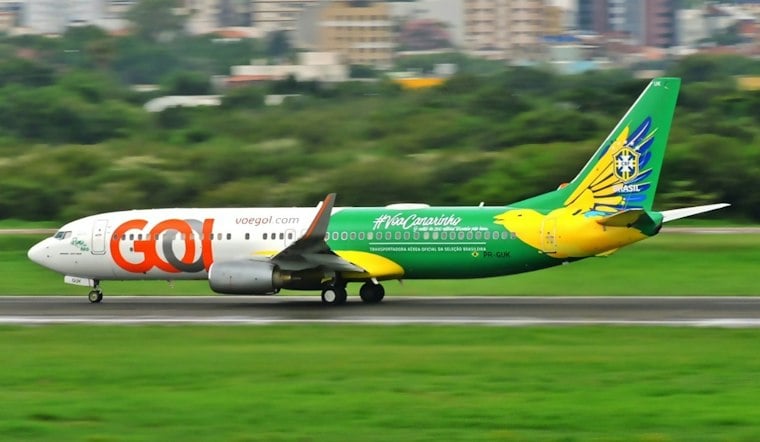
GOL Linhas Aéreas is walking away from Florida entirely. Starting in February 2027, the Brazilian carrier will suspend its Brasília-Orlando, Fortaleza-Orlando and Brasília-Miami flights, along with sixteen other domestic and international routes, as rising jet-fuel costs prompt network reductions.
The cuts, first detailed by Aviacionline, also eliminate Belém-Miami, Rio de Janeiro (Galeão)-Montevideo, Fortaleza-Montevideo, Galeão-Asunción, and São Paulo (Guarulhos)-Punta Cana service, along with shorter domestic hops including Congonhas-Ribeirão Preto, Congonhas-Palmas, Brasília-Goiânia, Salvador-Aracaju, Fortaleza-Foz do Iguaçu, Galeão-Ilhéus, Goiânia-Cuiabá, Salvador-Campina Grande, Porto Velho-Cuiabá, Petrolina-Salvador and Aracaju-Salvador — 19 routes discontinued in total, per aeroin. GOL has told passengers the adjustments stem from successive jet-fuel increases that have doubled the fuel price and now push fuel costs to nearly 40% of its total operating expenses, according to the airline's own statement reported by the outlet. The carrier added that its network planning is dynamic and continuous, responding to operation-wide needs without prioritizing any particular region.
Among the routes being cut is the Brasília-Orlando flight, a 3,778-mile nonstop that had been the world's longest scheduled commercial route flown on a narrowbody Boeing 737 MAX 8, according to Simple Flying. The route was among those suspended as jet-fuel costs rose.
Petrobras Price Hikes Keep Coming
The immediate trigger traces back to Brazil's state oil company. Petrobras raised its average jet-fuel price by 11.8% on October 1, lifting the average refinery price from 5.585 to 6.242 reais per liter, per Aviacionline's reporting. That single hike capped a run that has seen jet-fuel prices climb 74% since March 1 and 49% through August, according to figures from Brazilian airline association Abear cited in the same report.
Abear now estimates jet fuel eats up more than 45% of Brazilian airlines' operating costs, and the sector as a whole spent roughly 7.6 billion reais more than it had budgeted for fuel in 2026, the association reported. Petrobras sets those wholesale prices through an import-parity formula that converts a moving average of U.S. Gulf Coast benchmarks into reais; distributors add airport handling fees after Petrobras publishes its ex-refinery price, a mechanism detailed in Petrobras investor disclosures, which means global oil swings and currency moves pass straight through to Brazilian carriers. Industry group IATA has previously pegged jet fuel at roughly 40% of Brazilian airlines' total operating expenses versus a 30% global average, blaming Petrobras's refining monopoly and state-level fuel taxes for the gap.
This is not an isolated shock. Earlier this year, escalating Middle East tensions involving the U.S., Israel and Iran pushed global jet-fuel benchmarks up 40% to 95%, prompting GOL to postpone its planned June 2026 launch of direct Asunción-Miami flights, a delay Paraguay's aviation authority DINAC confirmed under Resolution 315/2026, as reported by Asunción Times. The volatility has also rippled into Brazilian households: mid-month consumer price data for September showed domestic airfares jumped 9.82% in a single month as carriers tried to pass the fuel costs on to travelers, according to el fondo.
Tourism Officials in Fortaleza Push Back
The cuts land hardest on Fortaleza, which loses three routes in the shakeup. Gustavo Montenegro, Ceará's tourism secretary, lamented the suspensions, saying the Fortaleza routes had good load factors but lower profitability than other segments in GOL's network, per the Aviacionline report. Montenegro emphasized that geopolitics affects tourism more broadly, pointing to how global instability ripples down to regional air links.
That dynamic is already reshuffling who flies where. Iberia has withdrawn flights in the Middle East while expanding toward northeastern Brazil, the outlet noted, a shift that could partially offset the loss of GOL's Fortaleza connections even as it changes which carriers dominate the region.
Only JFK Remains for U.S. Service
Once the February cuts take effect, GOL's only remaining U.S. destination will be New York's JFK airport. The airline serves that route with an Airbus A330-200 wet-leased from Wamos Air, a sister carrier within parent company Abra Group that it began flying from Rio de Janeiro on July 8. The widebody jet carries 280 seats, including 20 in business class.
Abra Group completed its acquisition of the Spanish charter and wet-lease specialist in October 2024, a deal reported at the time by Aviation Week, giving GOL access to widebody capacity without owning the aircraft outright. Wamos operates an all-widebody fleet built for ACMI and wet-lease work with international airlines. GOL also plans to operate a Galeão-Lisbon route with a second Wamos A330-200 beginning September 16, and the carrier's broader long-haul ambitions had once included New York, Lisbon, Orlando and Paris.
Abra Group's own fleet moves suggest where GOL's long-haul strategy may be headed next. The holding company expanded its order book in October 2025 by exercising options for 50 additional Airbus A320neo narrowbody jets and arranging lease commitments for up to seven A330-900 widebodies through Avolon. Separately, GOL is set to add five A330-900neos, according to Engine Cowl. GOL's reliance on wet-leased widebodies for its one surviving U.S. route hints that the airline may eventually shift its American strategy away from narrowbody MAX jets and toward widebody capacity managed through Abra Group.
Rivals Hold Their Ground in Florida
GOL's retreat reshapes the balance of power on the Brazil-Florida corridor, according to Aviacionline. LATAM continues running high-frequency Guarulhos-Miami and Guarulhos-Orlando service on Boeing 787s, while Azul serves Orlando and Fort Lauderdale from Campinas and Confins using A330s — both carriers using widebody jets on long-haul routes, unlike GOL's single-aisle MAX fleet. American Airlines continues serving its Miami hub from São Paulo and Rio de Janeiro, while Copa Airlines, Avianca and Arajet compete to a lesser extent through connections and aggressive fares.
Travelers in Brasília, Fortaleza and Belém hoping to reach the United States will now need to connect through São Paulo or Rio, or look at alternatives routed through Panama, once GOL's direct flights end. GOL says it will offer affected passengers alternatives through its own or partner-airline connections, drawing on more than 60 codeshare and interline agreements. Under rules from Brazil's National Civil Aviation Agency, airlines that cancel or alter flight schedules must notify passengers immediately and provide material assistance, including meal vouchers after two hours of waiting and hotel accommodation after four hours, with ANAC rules also guaranteeing reaccommodation or a full refund for those affected.
Crew Face Unpaid Leave as Costs Mount
Behind the route map, the cost pressure is also hitting GOL's workforce. GOL had reopened its voluntary unpaid-leave program, known as LNR, for flight crew by October 14, 2026. The program allows crew members to take three to six months of unpaid leave while retaining their employment relationship and benefits, and participants are permitted to work outside GOL during that time.
The pressure on GOL is not unique in Brazilian aviation. All three of the country's major carriers — LATAM, GOL and Azul — went through formal debt restructurings between 2020 and 2025 as pandemic-era debt, currency devaluation and volatile fuel costs collided, according to ch-aviation. GOL now appears to be under strict financial discipline to cut unprofitable segments rather than absorb sustained losses as fuel costs climb.





