

























































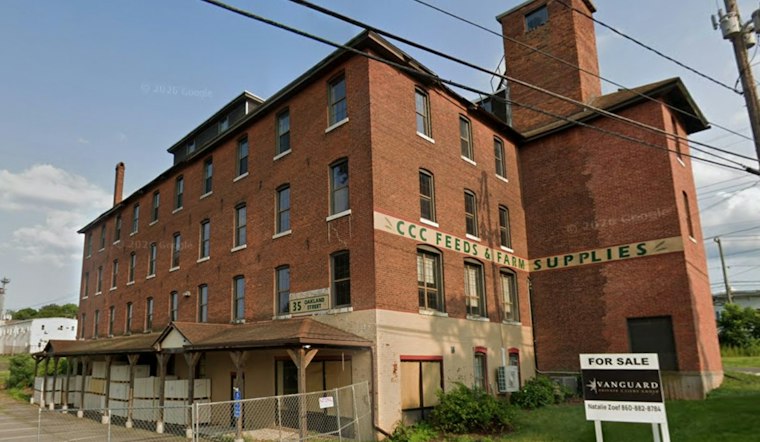
A four-story mill building that once held a basement undertaking parlor, a furniture showroom and an opera house hosting silent Edison films has changed hands again in Manchester, this time for $1.35 million. The buyer, Manchester Oaks LLC, is controlled by Moshe Grossbard, a name Hartford officials flagged just two years ago as a principal behind properties cited for housing code violations.
According to deed records reviewed by CT Insider, Manchester Oaks LLC purchased the 1.57-acre property at 35 Oakland St. in August, picking up the already-approved plan for 26 apartments, including 22 one-bedroom and four two-bedroom units, three of which are deed-restricted as affordable. The building had been listed for $1.35 million in late June after the prior owner, OTB Acquisitions, advertised it as a “shovel ready development opportunity.” That listing came roughly eight months after a limited liability company controlled by John Mariolis paid $770,000 for the property in a deed recorded Dec. 11, 2025, according to Hartford Business Journal — a jump the Hartford Business Journal earlier pegged at $580,000 in under nine months after OTB secured municipal approval for the conversion in October 2025, per the Hartford Business Journal.
A Landlord With a Hartford Paper Trail
Grossbard’s arrival in Manchester comes with baggage from across the river. In December 2024, Hartford Mayor Arunan Arulampalam publicly named Grossbard among the city’s top “problem landlords,” identifying 10 Grossbard-affiliated LLCs — including 1080 Broad Street LLC, Brick Realty LLC and Hartford Brick LLC — cited for housing code infractions, unpermitted work and unpaid fine liens, according to FOX 61. Hartford officials also issued citations to those entities and filed liens against multiple properties over the unpaid fines, with violations that included work performed without permits.
Grossbard told CT Insider he was frustrated that Hartford grouped him with landlords facing criminal charges over tenant neglect and more serious violations, arguing that something as minor as changing a window without a permit still counts as a violation under the city’s enforcement standards. He said he has since resolved the past Hartford code violations and acknowledged he received citations for work performed without permits, telling the outlet he understood that his actions were wrong. Hartford officials, for their part, said Grossbard came forward to address violations referenced on the earlier landlord list.
Connecticut Secretary of the State records list 33 active, locally registered entities with Grossbard as principal, and Manchester property cards indicate none of his entities currently own other properties in town, according to CT Insider’s reporting. Grossbard described the Manchester project in more flattering terms than his Hartford record might suggest, saying rents would be reasonable for the market and calling the project very nice, adding that Manchester is a good area.
From Silent Films to Livestock Feed
Apel’s Opera House has worn many identities since German immigrant Bernard C. Apel built it around 1888. The 27,548-square-foot building originally combined an undertaking parlor in the basement with a furniture showroom on the ground floor and an opera house upstairs that hosted silent Edison films, burlesque shows and traveling theatrical acts, according to Preservation Connecticut. A fire gutted the building in 1899, and though Apel rebuilt it, he never restored the opera gallery, permanently erasing the upper-floor theater space even as the structure retained its historic exterior.
The Apel family sold the property in 1911, and it eventually passed to the Central Connecticut Cooperative Farmers Association, which bought it in 1977 after arriving in Manchester in 1942. The co-op ran a feed manufacturing plant on the site, producing livestock feed, and operated a retail store there from 2009 until it shut down in 2016, per Preservation Connecticut. MSL Group then purchased the opera house and feed plant out of foreclosure in 2017, leasing the ground floor to commercial tenants while planning housing for the upper floors. Those housing plans never materialized before the property was foreclosed on again in 2025.
The building is designated a contributing structure within the Union Village Historic District on the National Register of Historic Places, a status that shapes facade preservation requirements and historic tax credit eligibility for any redevelopment. The prior owner before OTB Acquisitions, Apel Manchester I LLC, had defaulted on a $612,500 mortgage issued by a California lender in early 2022, triggering foreclosure proceedings by trustee U.S. Bank National Association ahead of the late-2025 auction, the Hartford Business Journal reported. That earlier owner, Long Island investor John Mariolis, had budgeted between $2.5 million and $3 million for the apartment conversion, planning to tap state and federal historic tax credits before the project changed hands.
What Comes Next for the Conversion
Grossbard told CT Insider he plans to proceed with the previously approved 26-unit conversion and preserve the building’s historic facade, with permits sought the week of Oct. 14. Redevelopment work can begin once those permits clear, according to the outlet’s reporting.
The sale lands amid a broader reckoning over historic preservation in Manchester. Connecticut’s Historic Preservation Council voted this month to ask the state attorney general to block the town’s proposed demolition of an 1886 duplex on Eldridge Street, which officials wanted torn down to build library parking, as Hoodline previously reported. Property owners across Manchester, meanwhile, must account for municipal taxes when budgeting for renovations as work on Apel’s Opera House moves forward.





