

























































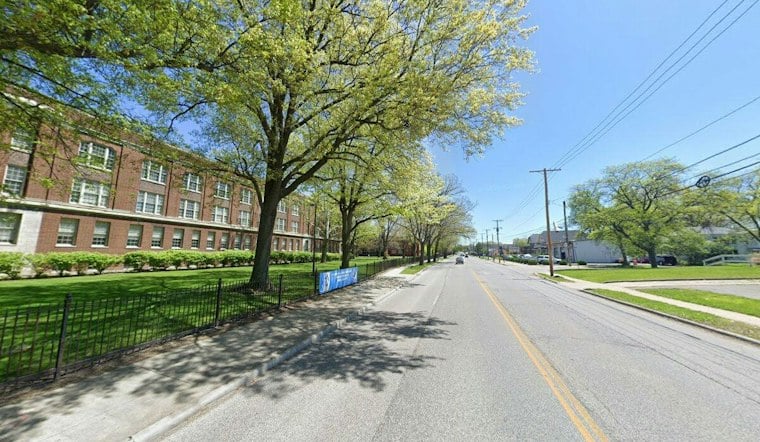
The sale of Nela Park puts a practical question before East Cleveland: what can a new owner do with a mostly vacant campus built for a different industrial era? The 95-acre property, with 26 buildings constructed largely between 1911 and 1924, was General Electric’s famed “University of Light.” Its next use could bring investment to the cash-strapped suburb, but the site’s future remains uncertain.
Mayor Sandra Morgan, who took office in January, has said East Cleveland is “open for business” and hopes a new owner will invest in the community, according to News 5 Cleveland, which first reported the listing. The station reported that East Cleveland has new leadership in the mayor’s office and city council, while state lawmakers and economic development officials are looking for ways to help the suburb find its footing.
Phoenix Investors, the Milwaukee-based firm that acquired Nela Park, is marketing the campus through Cushman & Wakefield-Cresco Real Estate. Managing director Bryce Sylvester told News 5 that the first year of marketing will be used to introduce prospective buyers to the unusual property and assess market interest. Phoenix took full control of the buildings in early May 2023, more than a decade after GE’s lighting research operation began winding down, according to Phoenix Investors.
A $5 Million Deal and a Historic Campus
Records show Phoenix Investors bought Nela Park for $5 million in 2022, according to Crain's Cleveland Business. The campus has more than 1 million square feet across more than two dozen buildings, along with underground tunnels, a central heating plant and an electric substation. It is listed on the National Register of Historic Places and is eligible for federal and state historic tax credits, considerations that may affect redevelopment plans.
General Electric developed Nela Park as a lighting research and development facility; it later became the longtime home of GE Lighting. The City of East Cleveland says the campus is now the headquarters for Savant Systems' GE Lighting, after Savant bought GE Lighting in 2020. Savant leases one building, while a public charter school and a children's autism rehabilitation facility are the campus's other tenants; Phoenix Investors says it brought both to the property. Published acreage figures differ: the city describes a 71-acre historic campus, News 5 cites 95 acres, and Phoenix describes more than 90 acres and, on its listing, 94 acres. Nela Park Management describes the campus as 92 acres. The available record does not explain the variation.
What Could Replace an Aging Lighting Empire
The redevelopment pitch spans several possible uses, including offices, research space, education and housing. About 20 acres are zoned for single-family homes; most of the rest is zoned for industry, including medical and laboratory uses. The campus also extends into neighboring Cleveland Heights. Phoenix Investors has floated converting some historic buildings to apartments, and its property listing describes 25 acres as available for future expansion.
The electric substation could suit small manufacturers seeking quick access to power, Sylvester told News 5, but he does not see Nela Park as a major data center site; at most, he said, a small data hall might fit inside an existing building. The broker has said the goal is to attract good-paying jobs, while noting that redevelopment would require cooperation with East Cleveland. City officials have said they are open to discussing incentives with a future buyer.
A City Still Climbing Out of Fiscal Emergency
East Cleveland’s fiscal history is not one uninterrupted emergency dating back to 1988. The Ohio Auditor of State says an earlier fiscal-emergency declaration ran from September 1988 through February 2006. More recently, the city’s budget projected about $1 million more in spending than revenue, according to Ideastream Public Media, which also reported that Morgan won a full four-year term in November 2025 with about 84% of the unofficial vote. The Auditor of State has described a process that could refer the city to the Ohio Attorney General’s Office to request a receiver; that description is not a final legal determination.
Against that financial backdrop, city officials have also been pursuing other redevelopment efforts, including the Circle East District, a Cuyahoga Land Bank-led project aimed at turning vacant or underused land into more than 200 new homes, and a broader Land Use Strategic Plan meant to guide growth over the next 10 to 20 years, per the city's economic development office. Morgan has said she does not expect Nela Park's old holiday light shows or family driving tours to return, but she has said the campus's future occupant will contribute to East Cleveland in its own way.
Circle East is a separate housing effort
The Cuyahoga Land Bank announced in July 2024 that it was renovating 10 homes in Cleveland and East Cleveland within the Circle East District, a 30-acre neighborhood redevelopment area. On December 1, 2025, the Cuyahoga Land Bank announced a commitment from the district’s first new-home buyer. Those milestones concern a neighborhood housing project, distinct from the potential reuse of Nela Park’s large, multi-building campus.
Lessons From Other Industrial Sites Nearby
Nela Park's uncertain path mirrors what has happened at other large industrial properties across Cuyahoga County. Former auto plants in the region have been redeveloped into health care, warehouse and industrial uses, but as cleveland.com reported, that redevelopment model generally puts fewer workers under one roof than the factories it replaces. The former Ford stamping plant in Walton Hills, which once employed nearly 4,000 people before closing in 2014, is now the site of a planned $140 million Cleveland Clinic operations center spanning nearly 650,000 square feet. The former Parma General Motors transmission plant now houses a roughly 400,000-square-foot U.S. Postal Service operation and a Pitt Ohio trucking terminal, while redevelopment of Brook Park's roughly 210-acre former Ford property remains underway more than a decade after that plant closed in 2012.
Whether Nela Park follows a similar trajectory remains to be seen. For now, the listing marks the start of what Sylvester has described as a yearlong process of testing the market, leaving East Cleveland to wait and see what kind of tenant — or tenants — eventually fills the gap left by one of the region's most storied industrial campuses.


