

























































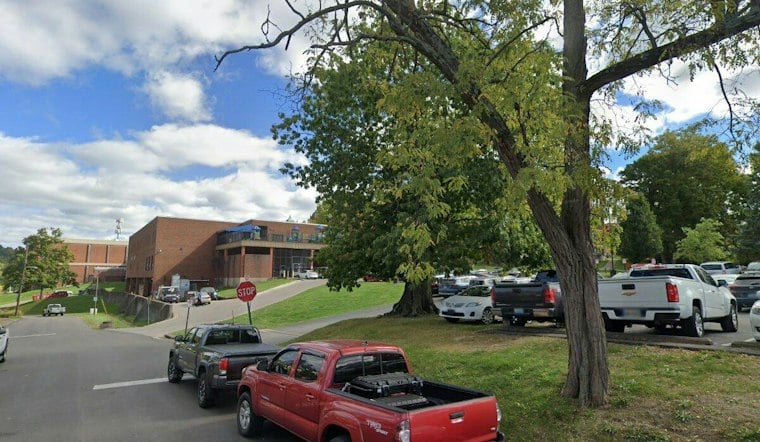
Students at Holmes High School in Covington are now running CNC machines and learning to weld, and will design robot parts, thanks to a new manufacturing and engineering program that launched at the school this week. The program, called SME PRIME, arrived through a partnership with philanthropist Charles L. Shor, who funded it through his own foundation with the goal of teaching what he calls “jobs that AI cannot take.”
A Foundation Built On Family Ties To Covington
Shor was at Holmes to launch SME PRIME at the school through his Charles L. Shor Foundation, according to the Northern Kentucky Tribune. He explained that Holmes was chosen in part because his family attended the school, and because Duro Bag once operated a Covington plant at 14th and Madison. Shor said he grew up in a manufacturing environment himself, and the Charles L. Shor Foundation aims to help people enter, sustain, and advance within the middle class through skilled trades, manufacturing careers, and economic mobility pathways.
Shor framed the stakes in broader terms during the launch, noting that the U.S. middle class declined from 62% in 1976 to below 50% today, while China’s middle class now makes up more than 75% of its population, per the same report. SME PRIME builds manufacturing and engineering programs inside high schools, supplying industry-grade equipment, aligned curriculum, teacher training, STEM extracurricular support and student scholarships.
Four Pathways And A Packed Welding Shop
At Holmes, PRIME supports four instructional pathways: metrology and quality, CAD/CAM, additive manufacturing, and machining and fabrication. The program supplies CNC machines, 3D printers, welding systems and industrial robotic arms, giving students hands-on access to tools used across modern manufacturing floors, according to the Northern Kentucky Tribune.
Donny Roundtree, a 17-year Holmes instructor who now teaches Intro to 3D Print Technology, said his class currently has 23 students, mostly freshmen and sophomores. “We have 23 students,” he said, describing a group that studies Auto Fusion and earns a certificate through the course. Their next step will be to design and print their own robot parts, with plans to compete against other state schools, usually in the spring, as reported by the Northern Kentucky Tribune. “We’ll design our own parts for the robots,” per the same account.
Ninth-grader Tanner Rowe said he joined the program and learned to design a robot without the usual design restrictions. Down the hall, welding instructor Sarah Bier — on just her second day in the role when the Tribune visited — said her shop already draws a wide mix of students. “I have about 30-40 – and yes some young girls — in my program,” Bier said, adding that people from any background can participate in welding. Bier studied welding at Gateway Community and Technical College before moving into structural welding work, as noted by the Northern Kentucky Tribune.
Carpentry, Credentials And A Principal's Big Goal
Not every student in the building is headed for a 3D printer or welding torch. Thomas Burke, a senior in advanced carpentry, said he plans to join the workforce after graduation, possibly in construction. SME PRIME students across the program's pathways earn industry-recognized certifications intended to lead to skilled jobs, and Holmes has set up a sign-up process along with a planned survey to gauge student interest and aptitude for the various tracks.
Holmes Principal Angela Turnick, in her first year as principal after 23 years at the school, said SME PRIME approached Holmes and that students have been eager to learn with the new technology. “My goal is for Holmes to become the best high school in the country,” Turnik said. The facilities were still unfinished during the dedication event this week, a sign of a program very much in its early stages. Covington Independent Public Schools Superintendent Cortnei Flucas said the district aims to build an expanding pathway to technical skills, industry connections, credentials and career options for students districtwide.
Outcomes, Scale And A Neighboring School's Head Start
National figures for SME PRIME graduates paint a picture of strong outcomes. The Tribune reported that 91% of SME PRIME graduates intend to pursue a career in manufacturing or engineering, while more than half plan to continue their education through a related two- or four-year college degree.
Reported network size also varies by source: the Tribune's October report put SME PRIME at 136 schools across 28 states, including six schools supported by Shor, while an earlier Tribune report cited 133 schools in 27 states serving more than 15,000 students, and an SME Education Foundation press release from December 2024 put the figures at 111 schools across 23 states serving 10,000 students. SME, a nonprofit formerly known as the Society of Manufacturing Engineers, was founded in 1932. Shelley Wooley, the SME Foundation's director of education programs, has noted the foundation awarded $1.5 million in scholarships last year, and PRIME stands for Partnership Response in Manufacturing Education.
Holmes is not the first Northern Kentucky school to bring SME PRIME on board. Ludlow High School became the first school to receive the Charles L. Shor Foundation's support for the program, according to the SME Education Foundation. Shor donated $500,000 from his foundation to support that program, which enrolled 26 students in fall 2025 and partners with eight regional manufacturing companies. Those Ludlow students had already earned multiple industry certifications, per a report from the Northern Kentucky Tribune. The program's curriculum spans computer-aided design and manufacturing, metrology and quality, and additive manufacturing, with room to add robotics, industrial maintenance, machining, fabrication and welding.
The push to fill classrooms with CNC machines and welding booths reflects a wider labor gap the SME Education Foundation has flagged nationally: about 481,000 U.S. manufacturing positions currently sit unfilled, a shortage the foundation projects will grow to 1.9 million jobs by 2034. For now, at Holmes, that national shortfall looks like a class of 23, mostly freshmen and sophomores, preparing to design robot parts, a welding shop already drawing 30 to 40 students in its first days, and a principal with her sights set on turning a 23-year tenure into something bigger for the school.





