

























































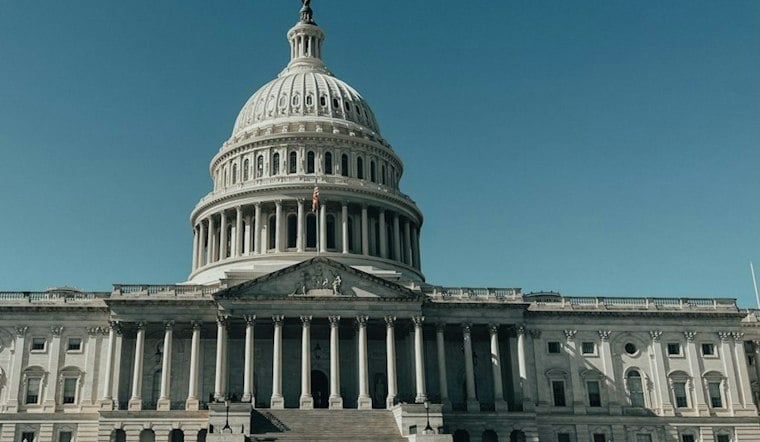
House Democrats have quietly built a playbook for more than 150 things that could go wrong on Election Day and in the weeks after, from intimidation near polling places to a potential floor fight on Jan. 3 over whether newly elected members get seated at all. The effort, led by Rep. Joe Morelle of New York, reflects a level of institutional anxiety rarely seen heading into a midterm election.
Morelle, the top Democrat on the House Committee on Administration, has outlined more than 150 possible threats, according to CNN. A separate account from Talking Points Memo describes the same task force identifying about 150 threats, which it evaluates by likelihood and potential damage — a discrepancy in the exact count that underscores just how fluid and fast-moving the planning has become. Those scenarios reportedly include intimidation by federal agents near polling places, misinformation campaigns aimed at voters, attempts by executive branch agencies to purge voter rolls or seize local election infrastructure, interference with state certification of congressional races, and the floor fight on Jan. 3, 2027, that has Democrats most unsettled.
Senate Democrats Build Their Own Safety Net
The House isn't the only chamber bracing for trouble. Sen. Chuck Schumer has convened Democratic senators, legal experts and former officials to discuss hypothetical election-interference scenarios, per CNN's reporting, while Sen. Alex Padilla has launched what CNN describes as the first-ever bipartisan Senate election observer program to monitor polling, vote counting and certification. Democratic leaders and allies have also filed a lawsuit seeking to block the deployment of ICE or other federal law enforcement officers at or near polling places and ballot-counting locations, and lawyers have prepared advance court pleadings asking judges to protect the chain of custody for voted ballots if federal agents try to seize them, CNN reports.
That legal groundwork is running alongside a separate fight already playing out in California. The Justice Department is demanding California take the unprecedented step of segregating ballots tied to 20,000 people it has identified as likely noncitizens, according to NPR. California has pushed back in a court filing, arguing the request would be unfeasible this close to the election and would likely break both federal and state election laws, the same NPR report notes. Separately, the Justice Department has charged 28 people in California with alleged election crimes, including allegations that 23 of them cast 34 illegal ballots since 2020, according to a White House spokesperson cited in the San Francisco Chronicle; the spokesperson said the 28 people charged are legal residents of California.
A Grijalva-Style Delay Looms Large
Democrats' fears are shaped partly by recent history. House Speaker Mike Johnson delayed swearing in Rep. Adelita Grijalva for more than a month after her 2025 special-election victory, the Chronicle reports. Accounts of exactly how long that delay lasted differ: the Chronicle's sourcing describes it as more than a month, the New York Times reported Johnson planned to swear her in 50 days after her election, and the Arizona Mirror put her wait at 36 days. Grijalva and Arizona's attorney general eventually filed a federal lawsuit arguing Johnson had no authority to keep stalling, according to the New York Times.
California Sen. Scott Wiener, in a social media post, said Justice Department threats against California lay the groundwork for a coup by refusing to seat House Democrats based on voter-fraud allegations, per the Chronicle's reporting. Rep. Jared Huffman told the Chronicle that Democrats are monitoring Trump allies' voter-fraud claims in California as a possible pretext to invalidate midterm results, and that those allies are curating a conflict that could be used to avoid seating California's delegation. Voters are encouraged to cast ballots early.
What Happens on the House Floor
Under House rules, the clerk is required by law to assemble the roll of members-elect using credentials showing a regular election, and the House elects its clerk every two years at the start of a new Congress, according to the Chronicle. The clerk's duties include managing House operations and preparing the roll of members-elect based on state election certificates. The Chronicle reports that Johnson could replace House Clerk Kevin McCumber with a loyalist who refuses to seat elected Democrats when the new Congress convenes on Jan. 3.
Political scientists quoted in the Chronicle offer competing reads on how likely that scenario actually is. Election law scholar David Becker said on a virtual call that the House cannot continue beyond Jan. 3 without seating new members, while George Washington University's Sarah Binder said the idea that Johnson and Republicans would deny Democrats a majority does not pass the sniff test. Historian Jeffery Jenkins noted that Congress has historical precedent for contesting election legitimacy around the turn of the 20th century, but added that no comparable event has occurred in more than a century.
Precedent Points Both Ways
History offers Democrats some reassurance, and some reason for caution. In 2021, Rep.-elect Chip Roy challenged the seating of 67 members-elect from battleground states where Donald Trump had focused voter-fraud claims, according to the Philadelphia Inquirer. The last time the House actually refused on the first day of a new Congress to seat a member whose victory had been certified was in 1985, the Inquirer reports. And on Jan. 3, 2021, after an objection to seating members from six states, the House passed a resolution directing that members-elect be sworn in by a vote of 371-2, with the challenged members themselves permitted to vote, according to Protect Democracy.
A bipartisan group of GOP lawmakers has signed a letter urging colleagues to accept election results and reject efforts to block members from taking their seats, the Chronicle reports. Still, the memory of Jan. 6, 2021 — when protesters stormed the Capitol to stop certification of Joe Biden's election victory — continues to color how seriously Democrats are taking even long-shot scenarios. House Minority Leader Hakeem Jeffries, in an interview with Aaron Parnas, said Democrats must assume Republicans will try to prevent a free and fair November election, according to the Chronicle.
The Political Backdrop
The stakes extend beyond the House. If an election were somehow postponed or canceled, Democrats would control two-thirds of the continuing U.S. Senate, the Chronicle notes. California alone has had more than 13 million ballots cast, according to the University of Florida Election Lab, cited by the Chronicle, while the Chronicle also cites a total of 94 million ballots counted nationally since 2020. Those numbers sit against a bruising political climate for the White House: three national polls found Trump's approval rating between 33% and 36%, with Democrats leading Republicans by eight to 10 percentage points among registered voters, according to Spectrum News.
Speaker Johnson, for his part, spoke at a get-out-the-vote rally for Derek Merrin in Defiance, Ohio, on Oct. 8, the Chronicle reports. On the ground in San Francisco, the political anxiety has translated into action: Bay Resistance organizers said they were coordinating with a national network to prepare members for possible mass street action if the federal government tries to overturn election results, with organizer Jane Martin saying the group would issue another mass call seeking thousands of participants. The Chronicle also reports that San Franciscan Peter Hosey submitted his ballot following a No Kings protest on Oct. 17, and notes that Trump issued an executive order in March 2026 aimed at limiting people's ability to cast mail ballots.
Whether any of the 150-plus scenarios Morelle's team has gamed out actually materializes remains to be seen. What's clear is that both parties are treating the period between Election Day and Jan. 3, 2027, as a live front in the fight over control of Congress, with lawsuits, task forces and contested voter rolls all still unresolved.


