

























































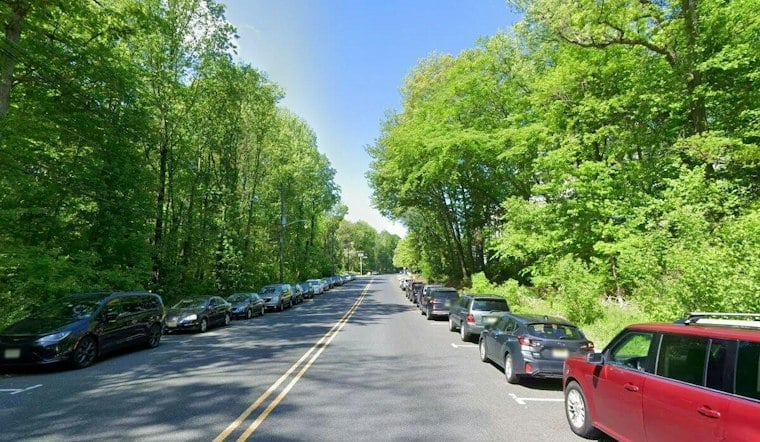
More than 200 American beech trees inside Saddler's Woods, the 25-acre preserve tucked along MacArthur Boulevard in Haddon Township, have been infected with a fast-spreading disease. Rutgers identifies thiabendazole as currently the most effective treatment option. The trees make up most of the forest's densest canopy, and their decline threatens an ecosystem that has supported hundreds of plant and animal species for generations.
The culprit is beech leaf disease, caused by a microscopic nematode known as Litylenchus crenatae subsp. mccannii, according to Rutgers New Jersey Agricultural Experiment Station. The worm burrows into leaf and bud tissue rather than roots or trunks, and it has been shown to spread by wind, humidity, and rain at least 38 feet from an infected tree, per the same source. Janet Goehner-Jacobs, executive director of the Saddler's Woods Conservation Association, told The Philadelphia Inquirer that her team counted more than 200 infected American beech trees on the preserve.
That survey, conducted by a volunteer identified as Holland in reporting from The Retrospect, likely represents about 90% of the beeches on the township-owned portion of the parcel. Saddler's Woods itself is a patchwork of ownership, with roughly 15 acres belonging to Haddon Township and another 10 acres owned by the Diocese of Camden, according to the same outlet.
A Disease With No Easy Fix
Beech leaf disease is recognized by opaque or dark banding between leaf veins, and as it progresses, leaves can become smaller, curled, and discolored, the station's report notes. Severe infection leads to thinning canopies, branch dieback, and eventually death, per the same account. Goehner-Jacobs said the disease's impact on Saddler's Woods could be devastating.
Rutgers researchers point to thiabendazole, the active ingredient in a product called Arbotect 20-S, as currently the most effective treatment option available. That designation does not mean the disease can be cured, and it is unclear whether any such treatment has actually been applied at Saddler's Woods.
The timeline for tree death also varies by source. The Inquirer reports that infected trees typically die within four to five years of initial infestation, while Rutgers says mortality can occur anywhere from two to 10 years depending on the size of the tree. Either way, the disease affects trees differently based on age, health, and site conditions, and beeches near wetter ground and the preserve's creek appeared to be more heavily affected, per The Retrospect.
A Statewide Spread Since 2020
Beech leaf disease was first discovered in the United States in Ohio in 2012, Rutgers reports. The disease has been reported in American, European, Oriental, and Chinese beech. Infected nursery stock is considered an important means of long-distance spread, though wind, rain splash, wildlife, and infected plant material may also play a role, The Retrospect notes.
Nationally, the disease has moved from Michigan into Canada and Maine and as far south as Virginia as of December 2024, per Rutgers. A study tracked by the Holden Forests & Gardens found that beech leaf disease had killed 30% of beech trees.
American beech trees are part of the broader forest ecosystem.
The loss of beeches could affect the ecosystem at Saddler's Woods. The preserve is home to centuries-old ferns and numerous other plant and animal species now at risk, and it isn't the first invasive threat the forest has weathered.
Volunteers Document the Forest
The Saddler's Woods Conservation Association, whose team is composed entirely of volunteers, is documenting what currently exists in the forest and identifying mature beech trees that could benefit most from fungicide treatment. Fungicide applications have been shown to boost some trees' defenses against the disease.
The group's mission, as always, is to preserve Saddler's Woods in perpetuity, even as it confronts a threat with no quick fix.





