

























































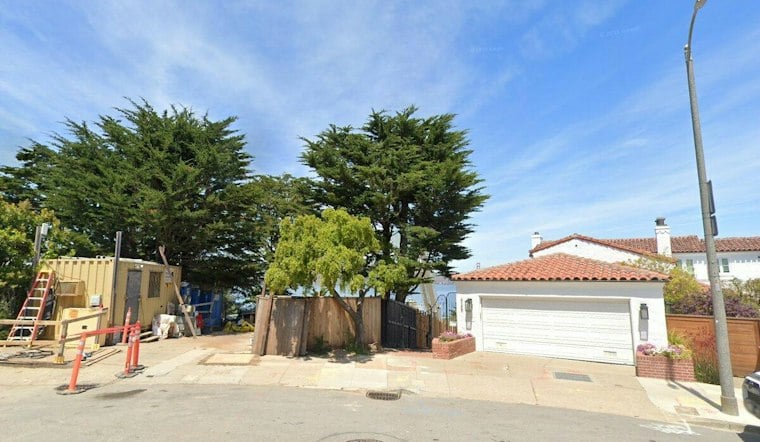
Jack Dorsey bought his first Sea Cliff property in February 2012 for $9.99 million, and in the time since, the San Francisco home has barely gone a stretch without scaffolding, a permit filing, or a crew on site. Nearly 14 years later, work is still happening in some form on the two adjoining lots the tech entrepreneur now owns on El Camino del Mar, a stretch of street perched above the Pacific Ocean with sweeping views of the Golden Gate Bridge.
Dorsey, a Twitter co-founder who now heads the financial technology company Block, purchased 830 El Camino del Mar through an LLC for $9.99 million, according to a report citing SFGATE's reporting on the property. Construction on that home began within months of the purchase and continued, in one form or another, for nearly 14 years, the same reporting notes. Six years later, in November 2018, Dorsey added the neighboring parcel at 840 El Camino del Mar for $21.9 million, bringing his combined investment in the two lots to roughly $31.9 million across approximately 1.21 acres.
The second property, built in 1962, spans about 3,588 square feet and is classified as a detached one-family residence under the city's RH-1(D) zoning, according to PropertyShark records, which confirm the home last sold on November 15, 2018 for $21.9 million.
A Redevelopment Timeline Stretching Back to 2013
City records cited in the report show Dorsey's major redevelopment application for the original home was filed in December 2013, with proposed work valued at $3.7 million. That application included seismic strengthening, a new lower level, roof decks, and a planted roof — the kind of comprehensive overhaul that typically takes years to wind through city review. The permit wasn't issued until June 2017, the report notes.
Work didn't stop there. A substantial redesign filed in February 2020 proposed removing a pool and a large roof structure, enlarging windows, raising a glass roof over a courtyard, and altering rooms and exterior finishes. The city issued that permit in July 2022 — two years after it was filed. More applications followed for retaining walls, driveway changes, landscaping, solar panels, fire sprinklers, an outdoor chiller, batteries, an underground cistern, and a plunge pool, according to the same account.
What's Actually Being Built
Taken together, the filings sketch out an ambitious residential project: structural reinforcement, expanded living space, extensive landscaping, water storage infrastructure, and plans for recreational amenities including a plunge pool and sauna complex. The filings include multiple applications over a period spanning more than a decade.
San Francisco's own permitting system offers some insight into why approvals take so long. The city's permit-performance dashboard tracks the median number of days it takes for a Planning Application to be approved or a Building Permit to be issued, according to sf.gov, but that clock only starts once the city confirms an application is complete and all filing fees are paid — meaning the true span from an owner's first proposal to a finished build can run considerably longer.
Scaffolding in One of the City's Most Exclusive Enclaves
During a visit to the block in October, the street showed unmistakable signs of ongoing work: truck traffic, diesel fumes, scaffolding, an excavator, and workers occupying the street, with more construction personnel visible than residents, per the same reporting.
San Francisco renovations of this scale aren't unusual in generating friction. Neighbors have multiple opportunities to raise formal objections to major home renovations in the city, and some disputes escalate all the way to the city's top governing body, according to reporting from The New York Times on San Francisco's renovation approval process.
Since 2013, Dorsey's project has involved successive applications and ongoing construction, in a process that has stretched across more than a decade.





