

























































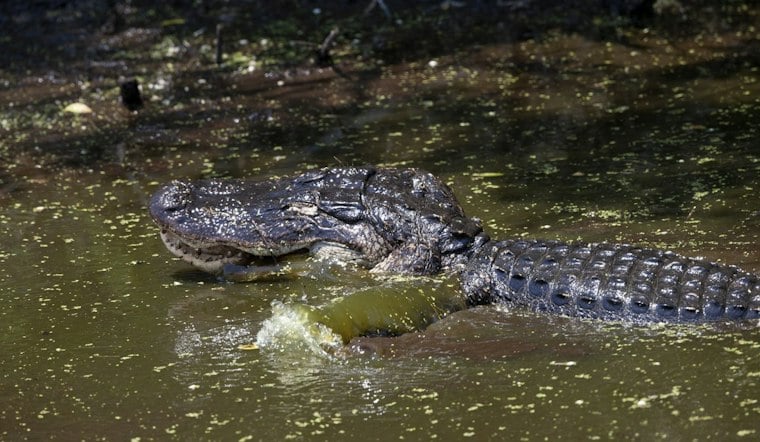
A West Palm Beach-area business owner is facing multiple felony charges after Florida Fish and Wildlife Conservation Commission officers found a dead alligator with a hammer lodged in its forehead in Jupiter. Desmond Keogh admitted to shooting the animal once in the head and then striking it repeatedly with a hammer, according to investigators.
FWC officers received an anonymous report about the dead alligator on Sunday in Jupiter, as reported by KABB. When officers arrived, they found the animal with a hammer protruding from its skull. Investigators determined that Keogh had no active alligator tags at the time, meaning he had no legal authorization to take the animal.
Keogh is identified elsewhere as the president and owner of Haifa Limestone, a West Palm Beach-based natural stone and limestone import business, according to Passport Publications & Media. That background places him as a known figure in Palm Beach County's building materials industry rather than a first-time offender hiding from public life.
Felony Wildlife Charge Carries Years in Prison
Under Florida Statute § 379.409, intentionally killing, injuring, capturing or possessing an alligator or its eggs without FWC authorization is a third-degree felony; § 379.401 classifies the violation as a Level 4 wildlife violation, according to Online Sunshine. A conviction on that charge would be for a third-degree felony under Florida law.
Keogh also faces compounding weapons charges tied to the incident. The report notes that he unlawfully discharged a firearm in public and now faces a charge for using or displaying a firearm during the commission of a felony, in addition to a separate charge for discharging a firearm on public or residential property.
Under Florida Statute § 790.07, displaying, using or threatening to use a firearm during an underlying felony constitutes its own distinct third-degree felony, per Online Sunshine. Separately, Florida Statute § 790.15 classifies knowingly discharging a firearm in a public place as a first-degree misdemeanor.
Why Florida Treats Alligator Killings So Seriously
Florida is home to an estimated 1.3 million wild alligators spread across all 67 counties, according to the Florida Fish and Wildlife Conservation Commission's estimate cited by Backwoods Airboat Adventures. That widespread population is part of why the state maintains strict rules governing who can legally take an alligator and under what circumstances.
Beyond prison time and fines, a conviction for illegally taking or killing an alligator triggers a mandatory five-year ban on obtaining a Florida alligator harvest or trapping license, under Florida Statute § 379.3015 and FWC administrative rules, as outlined by the Association of Fish & Wildlife Agencies. Florida law provides that equipment used in the violation is to be confiscated by FWC upon conviction, with the arresting officer reporting any seizure.
State Protocols Exist for a Reason
FWC runs the Statewide Nuisance Alligator Program, known as SNAP, specifically so residents do not have to take matters into their own hands. The program dispatches licensed, contracted trappers when an alligator over four feet long poses a threat, and residents can reach it through a toll-free hotline at 866-FWC-GATOR, according to FWC.
Fatal alligator encounters remain statistically rare even with the state's large gator population. FWC tracking data shows 205 reported alligator-bite incidents in Florida, with 16 resulting in human deaths, per FOX 35 Orlando. That data underscores why state officials discourage private residents from attempting to trap or kill alligators themselves, even when an animal is perceived as a nuisance.
Keogh now faces the full slate of charges stemming from the Jupiter incident, including the wildlife felony, the firearm-during-a-felony count, and the public discharge charge. The case remains with Florida Fish and Wildlife Conservation Commission investigators.




