

























































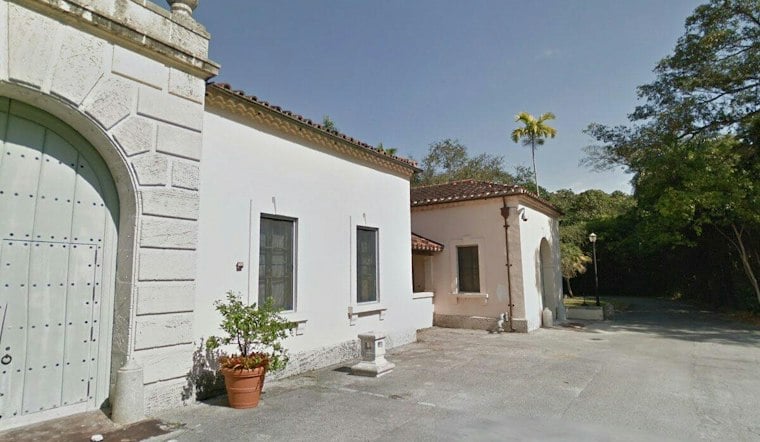
Billionaire Ken Griffin's plan to uproot a 113-year-old Coconut Grove mansion and plant it on the grounds of Vizcaya just cleared a major hurdle. The Miami-Dade County Commission voted to let Mayor Daniella Levine Cava or her designee begin negotiating with Griffin over relocating Villa Serena, the Mediterranean-style home built for William Jennings Bryan, to Vizcaya Village.
There is no announced timeline for how long those negotiations will take, according to the Miami Herald, which first reported the vote. Villa Serena currently sits on Griffin's four-acre bayfront estate, which he bought from Adrienne Arsht in 2022 for nearly $107 million, a purchase that was, at the time, the most expensive home sale ever recorded in Miami-Dade County. Arsht had meticulously restored Villa Serena and used it as a guest house while living in a larger mansion she built at 3031 and 3115 Brickell Ave.
Griffin began planning to move the house shortly after he acquired the property, and last year announced plans to relocate it roughly half a mile to Vizcaya's grounds. The hedge-fund magnate, whose net worth is estimated at $56.9 billion, also pledged $20 million to Vizcaya Museum & Gardens to help revitalize its historic farm village, where Vizcaya hopes Villa Serena would eventually be open to the public.
Vizcaya Village was built in 1916 as the estate’s working campus, with staff quarters, workshops, barns, greenhouses and fields that supplied food and flowers. The 12-acre site includes 11 historic buildings; its current revitalization plan includes a learning center with a teaching kitchen, art-making space and conservation lab. Moving Villa Serena there would place the house within a former working landscape now being adapted for public programs and community use, as outlined in Vizcaya’s plans for the Village.
Why Vizcaya Wants the House
Villa Serena was home to William Jennings Bryan, the progressive-era politician and three-time presidential candidate who began spending winters in Miami in the early 1910s and lived there year-round by the end of his life in 1925. Historian Paul George told the Miami Herald that Bryan was one of Miami's most famous residents during that era, describing him as a skilled orator and devout Christian who preached and taught Sunday school to large Miami crowds.
Bryan’s Miami home is tied to a national political career that extended well beyond his three presidential campaigns. He won the Democratic nomination in 1896 after his “Cross of Gold” speech, was nominated again in 1900 and 1908, and later served as secretary of state under President Woodrow Wilson from 1913 to 1915. Those roles help explain why the house’s significance reaches beyond local history, as detailed in the State Department’s history of Bryan.
Charlotte Donn, speaking for Vizcaya, said additional regulatory agency approvals remain among the steps still to come, and that the institution is thrilled the relocation effort is advancing. She added that Vizcaya looks forward to working with its partners, the county and others on the project. Vizcaya is owned by Miami-Dade County and operated by the nonprofit Vizcaya Museum and Gardens Trust. David Millar did not comment on the upcoming negotiations, per the same Herald report.
A Preservationist's Caution
Paul George, who generally opposes moving historic buildings such as Villa Serena or the Jackson Cottage from their original sites, said he hopes the county will handle Villa Serena carefully during any move. He has said he opposes removing historic buildings from their original locations because location is part of their context, the Herald reported.
Historic-building relocation is also a preservation review category under Miami-Dade County’s ordinance: plans involving the relocation of a designated property must be reviewed and approved by preservation staff or the board, and a building permit affecting a designated property cannot be issued without a Certificate of Appropriateness. Which approvals apply depends on the property’s designation and jurisdiction, but the county code shows why the remaining review is more than a question of physically moving the house. The requirements are set out in Miami-Dade’s historic-preservation ordinance.
That tension isn't new to Miami-Dade. In 1984, part of the Charles Munroe Brown House collapsed on the MacArthur Causeway while being moved from Omni toward Watson Island, according to This Day in Miami History. The Vizcaya proposal is separate from, but echoes, another Griffin-linked relocation now moving through city channels: the 121-year-old Jackson Cottage in Brickell.
The Jackson Cottage Parallel
The Miami City Commission approved Griffin's roughly $3 million purchase of the Jackson Cottage this year, giving him the entire city block once the deal closes, according to the Herald's separate report on that sale. The cottage, currently located at 190 S.E. 12th Ter. and home to the offices of the Dade Heritage Trust, originally stood in downtown Miami and once housed the medical practice of James Jackson, namesake of Jackson Memorial Hospital. It sits across the street from the Brickell Bay Drive site of Citadel's new global headquarters, part of hundreds of millions of dollars in land Griffin has bought between Southeast 12th and 13th streets in Brickell since 2022.
Plans call for moving the Jackson Cottage to Coconut Grove, where it would remain the Dade Heritage Trust's office. That relocation was pending approval by Miami's Historic and Environmental Preservation Board, and if the board rejects the project, the proposal would return to the city commission for further review, according to CBS Miami.
District 7 Commissioner Raquel Regalado represents the area that includes Griffin's estate and Vizcaya. No further details on the negotiating timeline or final placement of Villa Serena within Vizcaya Village have been released.



