

























































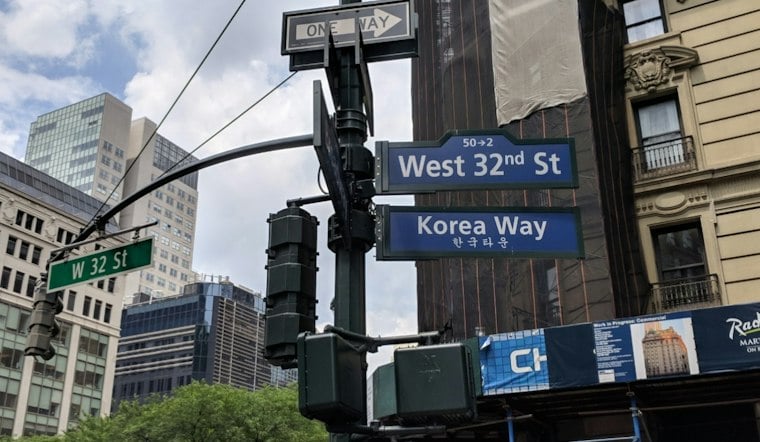
An 11-block stretch of Sixth Avenue shut down last Saturday as the 42nd Annual Korean Parade and Festival marched from West 38th Street down to West 27th Street, filling Midtown with floats, K-pop anthems and the smell of bungeoppang fresh off the griddle. The Korean American Association of Greater New York kicked off the day's festivities at 10 a.m. at 32nd Street and Sixth Avenue, with the parade itself stepping off near 38th Street and Sixth Avenue and running from noon to 2 p.m.
The scale of the event reflects its organizer's reach. According to KAAGNY, which was founded in 1960, the association serves as the central advocacy organization for roughly 500,000 Korean Americans across the New York metropolitan area, and event organizers say the annual parade and street festival typically draws about 100,000 participants and spectators. As amNewYork reported, this year's gathering brought autumn cheer to K-Town through music, cultural activities, food and Korean pride.
Floats, Food Stalls and a Full Day of Programming
Festivalgoers browsed hanboks for sale and sampled bungeoppang, kimbap, bulgogi and banchan along the route, per the same amNewYork account. Traditional games including yutnori, gonggi, tuho and ddakji gave families something to do between performances, while floats and marchers wound their way through Koreatown as part of the procession.
A small stage hosted a rotating lineup that spanned generations of Korean culture: traditional Korean music and dance, K-pop sets, taekwondo demonstrations, a children's choir and a hanbok model contest. The crowd also got a dose of BTS classics, including Dynamite and Arirang, the outlet noted. The daylong festivities wrapped up at 6 p.m.
A Regional Draw, Powered by Tri-State Shuttles
A Regional Draw, Powered by Tri-State Shuttles KAAGNY coordinated dedicated shuttle buses for participants whose transportation had been confirmed with the organization in advance; unconfirmed participants could not board. Routes originated at Hannam Mart in Fort Lee, New Jersey, and Hanyang Mart in Flushing, Queens, according to KAAGNY. Fort Lee and Flushing hold two of the largest concentrations of Korean residents in the tri-state region, underscoring that while Korea Way is the commercial showcase, much of the crowd commutes in from the suburbs and outer boroughs.
Corporate backing also expanded this year's footprint. Global beauty firm KISS Group served as a major sponsor, contributing a large custom parade float and distributing 20,000 gift bags.
How Korea Way Became Koreatown
How Korea Way Became Koreatown The festival's home base carries its own history. West 32nd Street between Fifth and Sixth Avenues is known as Korea Way. Korean importers and wholesalers settled near the Garment District in the late 1970s, before the area developed into retail storefronts.
Sociological research from New York University describes Manhattan's Koreatown as a commercial “transclave,” packing more than 150 businesses into multi-story office buildings on a single block with no permanent residential population, a layout shaped by Midtown real estate costs that pushed Korean restaurateurs and retailers to build upward rather than outward. That density traces back to demographic shifts following the 1965 Immigration and Nationality Act, which removed national-origin quotas.
More Than a Parade
KAAGNY's role extends well beyond the annual street festival. The organization also runs a Korean American Hate Crime Hotline and led a food voucher campaign that raised more than $1.2 million during the pandemic, City & State New York reports, pointing to the group's broader civic function connecting Korean American communities with local government and social services.
The autumn timing of the parade lines up with Chuseok, the Korean harvest holiday marked worldwide with family feasts, traditional games and folk performances, a seasonal backdrop that gives the Midtown festivities added resonance for the communities that filled Sixth Avenue on Saturday.



