

























































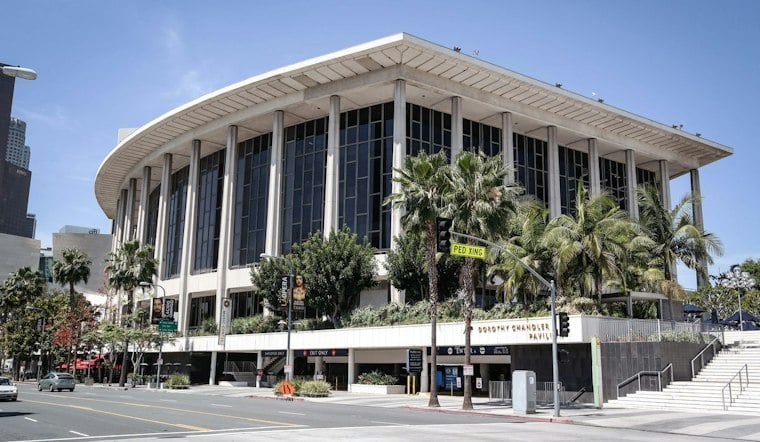
For 63 years, a starburst-pattern curtain greeted audiences at the Dorothy Chandler Pavilion before every Los Angeles Opera performance. That curtain is gone now, replaced by a 70-foot-wide hand-painted artwork titled “The Things We Know,” created by Cuban-born, L.A.-based artist Enrique Martínez Celaya for the company's new season.
The scale of the change is hard to overstate. According to the Los Angeles Times, the curtain depicts a pensive-looking boy and girl beneath a halo of light, rendered in black-outlined figures against an off-white background. The boy holds a caged bird; the girl holds a fish tank. Martínez Celaya and his team hand-painted the entire piece on canvaslike fabric laid across the floor of the stage itself, the paper reports.
In Spanish-language coverage, La Opinión describes the finished canvas as roughly 20 meters wide, covering more than 450 square meters — numbers that roughly track the Times's 70-foot measurement. The curtain will begin rising four minutes before conductor Domingo Hindoyan raises his baton, and as it lifts, it reveals a completely different image than what the audience saw while waiting, La Opinión notes.
A Decade-Long Conversation Comes to Life
The idea for the commission didn't happen overnight. A discussion about collaborating on a project between Martínez Celaya and L.A. Opera Chief Executive Christopher Koelsch began roughly a decade before the curtain's unveiling, per the Times. Koelsch first encountered the artist's work at an L.A. Louver fundraiser and reportedly wanted something radically large-scale for the company's stage.
That ambition is reflected in how OperaWire frames the finished piece: the outlet reports that L.A. Opera commissioned “The Things We Know” as a visual centerpiece of the 2026-27 season, with the artwork installed at the Dorothy Chandler Pavilion for all mainstage performances. Koelsch, quoted by the outlet, said the work transforms the curtain from a boundary into a kind of visual prelude. OperaWire also reports the piece is underwritten by Mei-Lee Ney.
A Family Story Painted in Acrylic
Martínez Celaya told the Times he wanted an image that would not be related to any opera — a deliberate choice to let the curtain stand as its own artwork rather than a backdrop tied to a specific production. The top half of the piece relates directly to his own family history: the girl is based on his daughter Natalia, while the caged birds reference his grandfather, who kept a collection of birds as pets, according to the Times.
The artist described his interest in both the coming-of-age quality of the children and the containment suggested by the birds and fish. La Opinión reports he explained the figures as representing the transition from childhood to youth. Unlike the original studio canvas, which was painted in oil, the opera curtain itself was rendered in acrylic and water-based paint, better suited to its scale and the demands of a working stage, the Times notes.
OperaWire reports that Martínez Celaya wanted the curtain's movement — its rise before the music begins — to function as part of the work itself, rather than simply something that happens to it.
An Artist Shaped by Physics and Exile
Martínez Celaya's path to the easel was unconventional. Per the Times, his family traveled from Havana into exile in Spain, and he entered a painter's apprenticeship at age 12. He later earned a degree in applied physics with a minor in electrical engineering from Cornell University and a master's degree in quantum electronics from UC Berkeley before completing a Master of Fine Arts at UC Santa Barbara. Today, the Times reports, he serves as provost professor of humanities and arts at USC.
This isn't his first large-scale commission tied to a performing-arts institution. In 2004, he created a sculptural installation for the Berlin Philharmonic called “Schneebett,” inspired by the final days of Ludwig van Beethoven in Vienna in 1827; that piece is now held in the collection of Pérez Art Museum Miami, according to the Times. La Opinión notes his work sits in more than 60 public collections, including the Metropolitan Museum of Art, the Whitney Museum and LACMA.
What Happens to the Old — and New — Curtain
L.A. Opera had planned to cut the retired 63-year-old curtain into pieces and sell sections to raise funds, but the Times reports that plan is now in flux, while La Opinión describes an intended auction — accounts that diverge on where things currently stand. Koelsch has said he wants to preserve legible portions of the curtain rather than see it disappear entirely, according to the Times.
Looking ahead, Koelsch hopes to commission an entirely new curtain for the 2027-28 season, the Times reports, suggesting “The Things We Know” may be one chapter in an evolving tradition rather than a permanent fixture. For now, audiences arriving for L.A. Opera's 2026-27 season — which La Opinión reports opens October 17 with “Carmen” — will watch Martínez Celaya's children, bird and fish tank rise away before the music even starts.


