

























































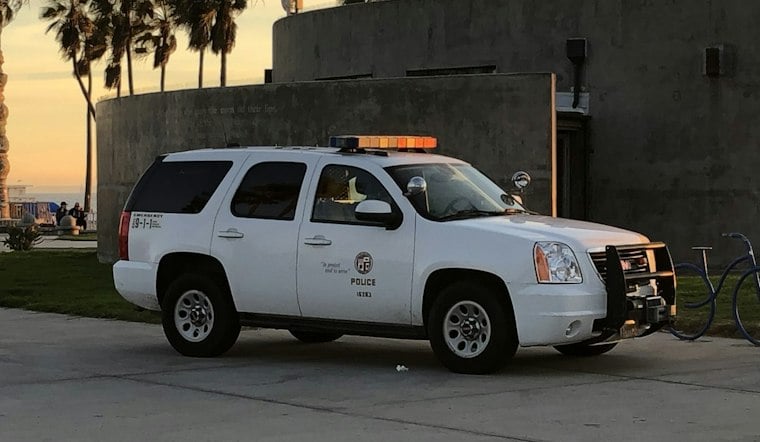
Los Angeles City Council is weighing whether to override the Board of Police Commissioners' approval of a 10-year, $235 million contract with Axon Enterprise that would outfit LAPD patrol cars with license plate readers, roll out AI-generated police reports, and pilot a network of streetlight-mounted surveillance cameras across the city. Councilmembers Hugo Soto-Martinez and Marqueece Harris-Dawson introduced a motion seeking to assert jurisdiction over the deal, which the police commission approved on a 3-0 vote in September.
Section 245 of the Los Angeles City Charter gives the council authority to review decisions made by appointed boards and commissions, generally within five meeting days of the action. As reported by MyNewsLA.com, the council may refer the camera contracts to committee or assert jurisdiction outright, even though the streetlight pilot agreement itself does not require council approval to take effect.
The contract bundles more than 1,600 patrol-car cameras equipped with automated license plate reader technology, thousands of replacement body-worn cameras, Tasers, cloud video storage, and an AI feature called Draft One that generates first-draft police reports from body-camera recordings. Per a LAPD memo cited by the outlet, Draft One is set for a phased rollout to officers beginning in January, using body-worn camera audio and transcripts to produce narratives for officer review.
Streetlight Cameras and a Free Three-Month Trial
Separately, the Board of Police Commissioners approved an Axon pilot program that clamps surveillance cameras onto the tops of streetlights around Los Angeles, drawing power from the streetlight's own electricity. Ubicquia Inc. will install the devices, and Axon will run the three-month pilot at no cost to the city, per the same MyNewsLA.com account. Ubicquia says its AI systems can identify vehicles, license plates, pedestrians and other objects in view, and the streetlight cameras are expected to collect more license plate data than current systems.
The hardware behind that pilot mounts an Axis Q1800-LE camera inside a streetlight-attached Ubicquia Hub capable of scanning plates at speeds up to 155 mph and streaming live video directly into Axon's Fusus platform, according to Axon Enterprise. LAPD officials said the Axon contract would serve as the template for all ALPR vendors moving forward, and the department says it has updated its data-retention and data-sharing policies to strengthen civil liberties and privacy protections.
Why Councilmembers Are Pushing Back
Soto-Martinez and Harris-Dawson described ALPR use as a matter of significant public interest and concern in their motion, which seeks an additional public opportunity to learn about proposed guardrails and for councilmembers to engage the department about the technology. The motion cites cases in other states where officers used ALPR technology to stalk former romantic partners, cases where the technology was used to investigate women seeking reproductive health services, and aggressive stops based on partial or incorrect data involving people not suspected of crimes. The councilmembers argue the council should review the safeguards and policies written into the proposed memorandum of understanding and LAPD's internal policy before the contract moves forward.
Those concerns echo a track record with LAPD's prior vendor. The department had operated 138 pole-mounted cameras from Flock Safety, the Atlanta-based company that works with roughly 5,000 law enforcement agencies nationwide, before the Board of Police Commissioners suspended that system in July 2026. The three-year Flock Safety contract had expired that same month, and LAPD is now working on a new agreement with the vendor featuring stronger data-security and privacy protections, per MyNewsLA.com's reporting.
A National Pattern of Agencies Pulling Back From Flock
Former LAPD chief Jim McDonnell said ALPR technology helps locate violent offenders, identify stolen vehicles and generate investigative leads, but added that the technology must come with strong individual privacy and information-security protections. Flock Safety has said it complies with California laws restricting information sharing with federal authorities, but the University of Washington Center for Human Rights reported in October 2025 that Flock tested an information-sharing program allowing federal agencies to access local license plate data without local agencies' knowledge or consent.
That mirrors a trend Hoodline has tracked showing nearly 150 local governments nationwide have deactivated cameras or canceled Flock contracts amid unauthorized data access concerns. Separately, San Francisco reduced its data-retention period from a year to 30 days.
State Law Looms Over Any New Contract
Any new ALPR system LAPD adopts will operate under California statutes that predate this fight. Senate Bill 34, enacted in 2015, requires agencies running license plate reader systems to maintain public usage and privacy policies and bars sharing plate data with out-of-state or unauthorized entities, according to the California Attorney General. Senate Bill 54, the California Values Act passed in 2017, separately prohibits state and local law enforcement from using public funds, equipment or data systems to assist federal immigration enforcement.
The Attorney General's Office reported in September that it had contacted 18 state law enforcement agencies over potential ALPR statute violations and sued the city of El Cajon to halt unlawful data sharing, according to CalMatters. A February 2026 appellate ruling in Bartholomew v. Parking Concepts, Inc. further found that operating an ALPR system without a publicly posted, statutorily compliant privacy policy can constitute actionable legal harm, per Flock Safety's own account of the decision.
Questions About Whether the AI Reports Hold Up
Independent research has also raised doubts about the AI report-writing piece of the Axon deal. A May 2026 study evaluated by criminologists and the American Civil Liberties Union, involving 92 senior police supervisors, found that reports generated by Axon's Draft One tool were not superior in quality to officer-written reports. The ACLU also attributed poorer performance in loud environments and certain complex situations to earlier customer reports.
Another agency's experience adds to the skepticism. The Anchorage Police Department ran a three-month trial of Draft One that ended in March 2025 and ultimately declined to adopt the tool, according to the Electronic Frontier Foundation, after finding that time officers spent verifying and editing AI drafts canceled out any expected time savings.
LAPD already has a substantial relationship with Axon predating this contract. The department entered a five-year, $6.87 million agreement with Axon in 2022 to install Fleet 3 in-car camera systems across nearly 1,500 patrol vehicles, according to Knock LA. Axon Enterprise and Motorola Solutions both currently provide automated license plate reader technology or related services to LAPD, which uses the systems to identify stolen vehicles and vehicles tied to wanted suspects.





