

























































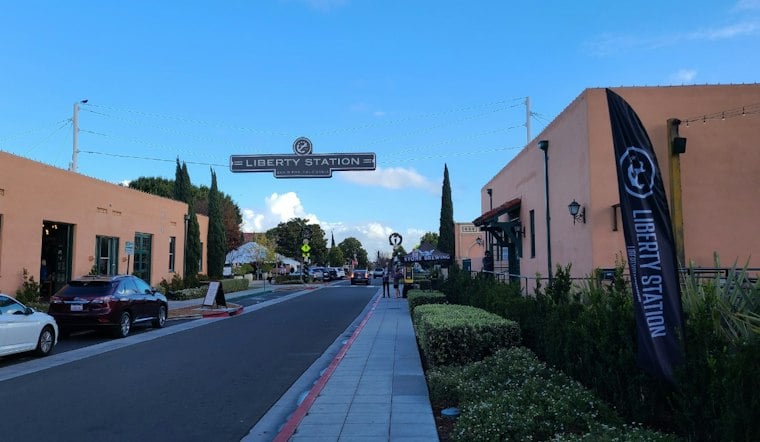
Heat didn't keep the crowds away from Liberty Station on Saturday, as San Diego hosted its first-ever Ukrainian Heritage Celebration at Ingram Plaza, drawing families, vendors and performers for a daylong tribute to Ukrainian culture. The free, one-day event ran from noon to 6 p.m. and filled the plaza with music, food, artwork and workshops meant to celebrate a community whose homeland remains at war.
The inaugural celebration was hosted by the Slavic Refugee and Immigrant Services Organization, known as SRISO, a registered 501(c)(3) nonprofit, according to SRISO. As The San Diego Union-Tribune reported, the organization was founded by Krystsina Shchelkunova in 2022, the same year Russia launched its invasion of Ukraine. Shchelkunova said the event was designed to celebrate Ukrainian history and culture while raising support against that invasion, and she said she wants to bring more Ukrainian culture and language to the United States.
Admission was free and open to the public, with organizers advertising live music and cultural performances, a Ukrainian Heritage Village and Artisan Market, authentic cuisine, interactive workshops and a Kids Village in the lead-up to the festival. The celebration, which took place at Liberty Station in San Diego, featured foods and desserts, artwork, live musical performances, a children's village, talks, workshops and an artisan village, per the same Union-Tribune account. Vocalists Tetiana Stypnitska and Albina Lykhogliad both performed Ukrainian songs during the celebration.
A Taste of Home for Longtime Expats
For some attendees, the food carried as much weight as the music. Iryna Bershadska, an airbrush artist from Vista who has lived away from Ukraine for 10 years, said she came to the celebration simply to eat. She said plov, a traditional dish similar to pilaf and served with lamb, reminded her of an earlier time in her life.
Other attendees described more personal reasons for showing up. Gary Hirsh, a retired orthodontist from La Jolla who has Ukrainian ancestry through his father and all four grandparents, said he attended to feel camaraderie with Ukrainians. Hanna Shutieieva, who works as a hair stylist in Point Loma and emigrated to the United States two years before the event, said Ukrainian culture is worth fighting to preserve.
A Community Still Growing in San Diego and Beyond
The turnout reflects a broader demographic shift. The number of Ukrainian immigrants in the United States grew from 404,000 in 1990 to 905,000 by 2000, with slower but persistent increases pushing that figure to 1.3 million by 2020, according to the Public Policy Institute of California. California itself was home to almost 60,000 Ukrainian immigrants during that period, the second-highest total of any state after New York, the institute found. Most Ukrainian immigrants in California speak Russian or Ukrainian at home, though nearly all — 96% — speak at least some English, per the same research.
Organizers had anticipated a large crowd well before the gates opened. SRISO said it expected to welcome approximately 5,000 to 7,000 guests from across San Diego County, according to a volunteer listing posted on HandsOn San Diego. Ingram Plaza itself has a stated capacity of up to 3,000 people, according to Liberty Station's venue listing.
Part of a Wider Pattern of Local Solidarity
Saturday's celebration follows a similar gathering just over a year earlier, when the House of Ukraine hosted its 65th anniversary festival at Balboa Park's international cottages complex, organized by immigrants, refugees and their allies, as NBC 7 San Diego reported. That event, too, doubled as a celebration of the culture and community Ukrainians are determined to preserve while their home country remained at war with Russia.
Many of the entrepreneurs who set up booths at Saturday's celebration came to San Diego after being displaced by that same war, according to a KPBS event listing. The festival's stated mission, as described by SRISO, was to celebrate and preserve Ukrainian cultural heritage while building bridges between communities through education, arts, music, cuisine and shared cultural experiences — a mission that, for attendees like Shutieieva and Hirsh, felt personal as much as public.





