

























































Defense Secretary Pete Hegseth has handed Elon Musk and Palmer Luckey a direct seat at the table shaping how America fights its future wars, and the congressman representing the heart of Silicon Valley wants answers. Project Meridian, formally commissioned on September 30, gives the two tech executives — alongside former House Speaker Newt Gingrich — 120 days to study everything from subterranean warfare to cislunar space, with a public report and classified annex due by January 28, 2027.
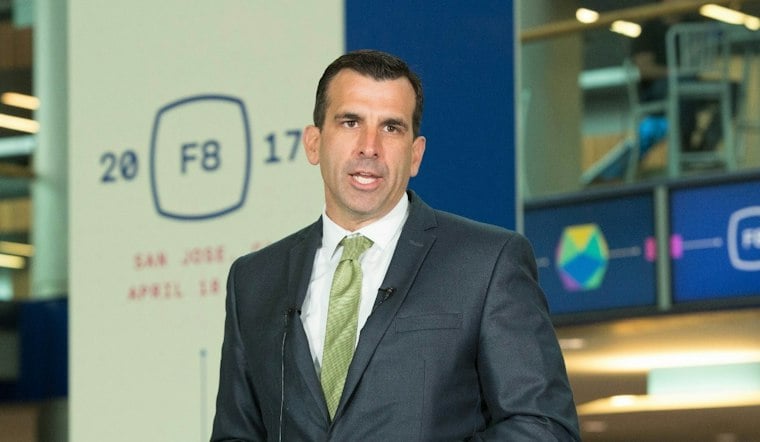
The study's stated mission is to examine how artificial intelligence, autonomy, directed energy, robotics, and biotechnology should be woven into future U.S. military operations, according to the U.S. Department of War. Hegseth discussed the project in an address focused on developing and fielding future weapons. As Sam Liccardo
noted in a social media post pointing to coverage of the announcement, Musk and Luckey are now positioned to help decide the military's technology priorities — a role that has drawn scrutiny given both men's deep financial stakes in defense contracting.
Musk's SpaceX holds more than $6.4 billion in active Pentagon contracts, including a $4.16 billion satellite deal and a $2.29 billion communications contract, while Luckey's Anduril Industries holds a Marine Corps counter-drone contract worth up to $642 million along with missile and autonomous aircraft awards, per the TechCrunch reporting cited in connection with the announcement. Critics argue that Project Meridian may align the two men's business interests with their new official advisory roles, according to that same reporting on the initiative.
MITRE Brought In to Police Conflicts of Interest
To address those concerns, the Department of Defense assigned the MITRE Corporation — a federally funded research nonprofit that manages research and development centers for the federal government — to administer Project Meridian and conduct conflict-of-interest evaluations for outside advisers, according to WVIK. The arrangement includes conflict-of-interest reviews for outside advisers.
But scrutiny has also landed on Pentagon official Emil Michael, whom Hegseth directed to commission the study through MITRE. Michael, the Defense Department's chief technology officer, earned up to $24 million in profit on January 9, 2026, from selling private stock in Musk's xAI — after the Pentagon signed a December 22 agreement paving the way for xAI's Grok chatbot to be deployed on GenAI.mil, according to The Guardian. Michael had originally disclosed holding between $500,000 and $1 million in xAI stock when he joined the administration in 2025, the outlet reported.
Michael also disclosed selling between $5 million and $25 million in Perplexity AI stock in June 2026, a firm from which he had previously accepted a personal loan of up to $500,000 before entering federal service, according to Decrypt. Michael served on Perplexity's advisory board before stepping down upon joining the Department of Defense in May 2025, the same report notes.
Plans for a Four-Star Command
Project Meridian isn't the only piece of Hegseth's autonomy push. The Pentagon also outlined plans to establish the Autonomous Warfare Command, or AUTOWARCOM, as a four-star functional combatant command by October 1, 2027, according to Defense One's reporting on the plan.
To build the operational framework ahead of that command, the Pentagon has established what it calls Project Agincourt, led by Defense Innovation Unit Director Owen West and Navy SEAL Senior Chief Max Strasiser — the first enlisted SEAL to graduate from Navy Test Pilot School, per the Department of War. The initiative is designed to prototype acquisition models that connect frontline troops directly with drone developers.
Liccardo's History With Musk's Ventures
Liccardo, who represents California's 16th District covering much of Silicon Valley, has not been shy about challenging Musk's government ties before. He co-led a letter in March 2026 with 21 House Democrats demanding a federal review of $700 million in broadband subsidies earmarked for SpaceX's Starlink, and he voted against the $1.15 trillion Fiscal Year 2027 National Defense Authorization Act in July 2026, according to the Office of Congressman Sam Liccardo.
The relationship between Liccardo and Musk's companies isn't new. Back in 2019, while serving as Mayor of San José, Liccardo consulted with Musk's tunneling venture, The Boring Company, to evaluate building an underground tunnel connecting Mineta San José International Airport to Diridon Station, according to KQED's reporting at the time — part of his search for lower-cost underground transit options for the region's main transit hub.
Project Meridian was just one piece of a six-initiative rollout Hegseth announced during his Quantico address, which also included ‘FORTRESS America,’ a plan for military base power grid independence, an expansion of officer commissioning pipelines at five universities, and a new Office of Religious Affairs, according to Army.mil's account of the speech. The address was delivered to junior officers and enlisted personnel, underscoring how the Pentagon is framing the technology overhaul as part of a broader restructuring of the department.
Hoodline has previously reported on local fallout from Hegseth's announcement, including an Atlanta council member's push to ban police robot weapons following the Autonomous Warfare Command reveal, and on Liccardo's separate legislative work defending a foreign graduate work program. Whether Project Meridian's eventual recommendations reshape how the Pentagon buys technology remains to be seen.





