

























































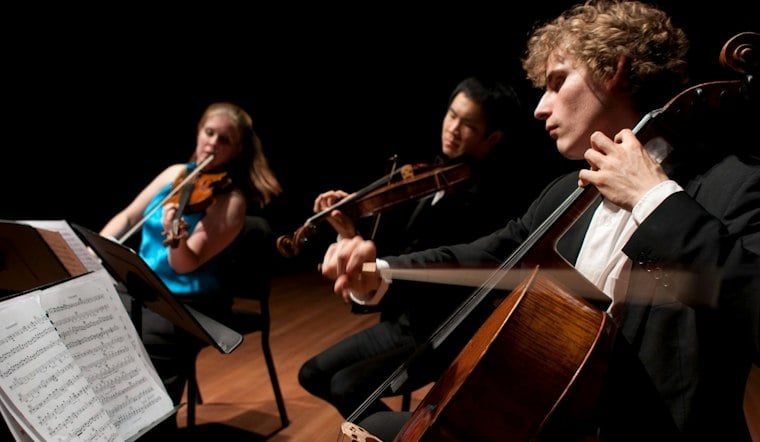
A Grammy-caliber touring ensemble is bringing Bernard Herrmann's shrieking Psycho strings, Aaron Copland's Appalachian Spring, and more to Clemson next week, and nobody has to buy a ticket to see it. The Chamber Music Society of Lincoln Center performs its American Soundscapes program at Clemson University's Brooks Center for the Performing Arts on October 6 at 7:30 p.m., with doors open to the public at no cost.
The concert is presented free of charge as part of Clemson's Lillian and Robert Utsey Chamber Music Series, as reported by Greenville Journal. That no-cost model is baked into the series itself: established in 1986 by Clemson music professor Lillian “Mickey” Utsey Harder and her husband, it stands as the only endowed chamber music series in South Carolina, according to Clemson University's College of Arts and Humanities. The series was founded in memory of Harder's parents and has spent four decades bringing internationally recognized classical artists to campus, per the same source.
This fall's concert also doubles as the series' 40th anniversary, with the Chamber Music Society of Lincoln Center performing the show free of charge, per Greenville Journal's reporting. The hosting organization carries serious institutional weight of its own: founded in 1969 and headquartered at Alice Tully Hall in New York City, the Chamber Music Society of Lincoln Center is regarded as the nation's premier chamber music organization, according to the Chamber Music Society of Lincoln Center.
A Statewide Honor Behind a Free Concert
Clemson's commitment to the series isn't just sentimental — it's decorated. In 2007, the university received an Elizabeth O'Neill Verner Governor's Award for the Arts, South Carolina's highest official arts recognition, specifically citing the Utsey Chamber Music Series' contributions, the college notes. Harder herself won an individual Governor's Award for the Arts in 2002 for her work presenting classical music across South Carolina.
The concert takes place in the Brooks Center's 979-seat main proscenium auditorium, part of an 87,000-square-foot facility that opened April 15, 1994, according to Clemson University. Named for alumnus Robert Howell Brooks, the building serves as the central hub for Clemson's Department of Performing Arts and anchors the venue's 32nd season, which also features Charlotte Ballet, Reduced Shakespeare Company, and Dudok Quartet Amsterdam, per Clemson News.
From Appalachian Spring to a Shower-Scene Scream
The program leans hard into American musical identity, fitting for a tour built around the nation's 250th anniversary. It closes with Copland's Appalachian Spring Suite, performed in its original 13-instrument version — the same scoring Copland wrote for choreographer Martha Graham before the piece won the 1945 Pulitzer Prize for Music, according to The Pulitzer Prizes. Violinist Kristin Lee, who has performed with the Chamber Music Society for 15 years, called the piece a masterpiece, per Greenville Journal's account.
Also on the bill is Amy Beach's Piano Quintet in F-sharp minor, Op. 67, composed in 1907 and considered a landmark of early 20th-century American chamber literature, according to the LA Phil. Beach, who had already become the first American woman to write and publish a symphony with her 1896 Gaelic Symphony, published much of her work under the name Mrs. H.H.A. Beach amid the social pressures of her era; her compositions have since undergone major modern revivals. Greenville Journal describes the quintet as a large three-movement work combining virtuosity, lyricism, and rich romantic harmonies.
Herrmann's Screeching Strings and Bolcom's Ragtime Revival
Then comes the program's most unexpected turn: Bernard Herrmann's 1960 string suite from Alfred Hitchcock's Psycho. Herrmann deliberately scored the film for strings alone to match its stark, black-and-white visual aesthetic, with screeching high notes in the shower scene built to mimic human screams, the Chamber Music Society notes. Lee said the music powerfully contributes to creating fear, according to Greenville Journal.
Opening things up is William Bolcom's Three Rags for String Quartet, published in 1989 and made up of three movements — Poltergeist, Graceful Ghost, and Incinerator Rag — according to Chamber Music Broadcasting. Bolcom became known in part for weaving ragtime syncopation back into the classical concert hall, helping lead the late 20th-century revival of the form, Greenville Journal reports.
Part of a Broader National Tour
Clemson's stop is one leg of a larger American Soundscapes tour, which also includes regional dates at Emory University in Atlanta on October 2 and Bucknell University in Pennsylvania on October 4, just ahead of the October 6 Clemson performance, according to the Chamber Music Society of Lincoln Center. The tour is organized to commemorate the 2026 U.S. Semiquincentennial through a diverse sweep of American repertoire.
For Upstate audiences, the appeal is straightforward: a touring lineup normally associated with major concert halls, available without a ticket. The concert is set for 7:30 p.m. on October 6 at the Brooks Center for the Performing Arts, 141 Jersey Lane in Clemson, with more information available by calling 864-656-7787.




