

























































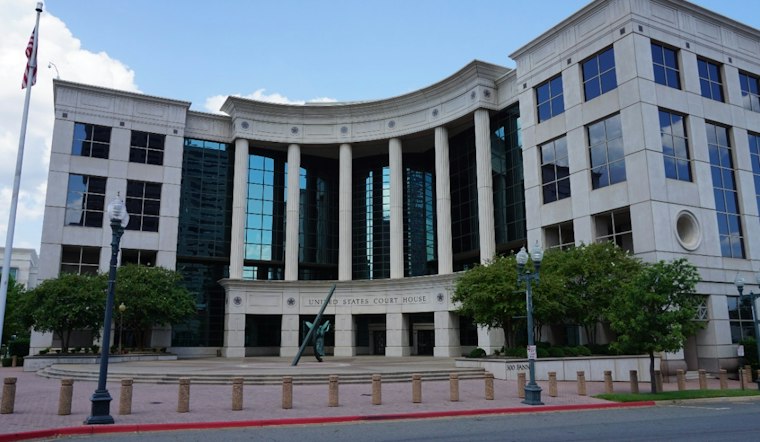
A three-judge federal panel in Shreveport is weighing whether Louisiana v. Callais should remain open to a challenge involving the state’s only remaining Black-majority congressional district. The panel issued no immediate ruling after hearing arguments this week, leaving the status of the 2nd Congressional District — represented by U.S. Rep. Troy Carter and located mostly in New Orleans — unresolved for now.
The case began with a challenge to the state’s 6th Congressional District. In April, the U.S. Supreme Court ruled that district an unconstitutional racial gerrymander, according to Verite News. Phillip Callais and 11 other plaintiffs now argue that the same constitutional issues apply to the 2nd District, alleging violations of the 14th and 15th Amendments, Verite News reports.
At the Tom Stagg Federal Courthouse in Shreveport, the Power Coalition for Equity and Justice, the ACLU of Louisiana and Black Votes Matter argued that keeping the case open could put Louisiana’s only Black-majority congressional district at risk of elimination, according to the Louisiana Illuminator. District 2 is the state’s only remaining Black-majority district, according to KALB.
Dismissal Sought by Defenders of the Current Map
The NAACP Legal Defense Fund has asked the panel to dismiss the case, arguing that the Callais plaintiffs already received relief through the earlier ruling on the 6th District, according to Verite News. Attorneys for the Legal Defense Fund and the state of Louisiana argued there is no active violation remaining, KALB reports. They also say a new racial-gerrymandering claim would require a separate lawsuit and new evidence.
Victoria Wenger said the Callais attorneys should bring a separate lawsuit if they want to challenge the 2nd District, and that the current case should be dismissed. She also said she believes they lack sufficient evidence to prove the district was racially gerrymandered. The argument that a challenge to a different district belongs in a separate case was also reported by KTAL.
A December Deadline Looms
The panel set December 15 as the deadline for Callais attorneys to present evidence of an unconstitutional gerrymander in the 2nd District, according to Wenger. The judges did not rule at the hearing, the Louisiana Illuminator reports. Whatever the panel decides, the outcome will not affect the map used for this year’s midterm elections, according to KALB.
Carter, who has represented the 2nd District since 2021, said in a statement that the case should be dismissed. He argued that fair representation depends on meaningful opportunities for people of color to be heard and access services. Carter also said the Supreme Court’s ruling further weakened the Voting Rights Act and enabled efforts to eliminate Black-majority congressional districts, and predicted that Black communities’ political representation would take a huge blow on election day.
Advocates Push Back on Renewed Challenge
Sarah Brannon said in a statement that the Callais attorneys are trying to finish the job, and that courts must not let one ruling silence Black voters in Louisiana. Press Robinson said the case could eliminate opportunities for Black voters to be represented, adding that Black voters are not pawns and that voting maps affect their lives.
Ashley Shelton said the loss of the 6th District was already a blow to voting rights, according to Verite News. She called the plaintiffs’ renewed challenge outrageous and immoral, and said she believes the ruling and continued case will energize people to vote.
How Louisiana's Map Got Here
Louisiana has six U.S. House seats, according to Bloomberg Government, and the redistricting plan tied to this litigation would retain a single majority-Black district stretching from the New Orleans area to the Baton Rouge area. Under that 2022 plan, the 2nd District had a Black voting-age population of 58%, Bloomberg Government reported — a figure that differed from the roughly 59.7% recorded under the congressional maps approved in 2011, according to The Advocate. About a third of Louisiana's population is Black, according to the 2020 Census, per Bloomberg Government's reporting.
The current fight traces back to the Supreme Court's ruling in Louisiana v. Callais, which found that the state's prior second majority-minority district map was an unconstitutional racial gerrymander, according to SCOTUSblog. That decision followed years of legal wrangling over the state's congressional boundaries, including a 2018 lawsuit in which nine Louisiana plaintiffs sought a second minority-majority congressional district, alleging that lawmakers had diluted Black voting power by packing Black voters into one district while spreading others across the remaining seats, The Advocate reported at the time. That same 2018 reporting noted that redistricting challenges were pending in a dozen states nationwide.
Earlier cases, different legal questions
In a separate case, the Congressional Research Service notes that on June 8, 2023, the Supreme Court affirmed preliminary rulings that Alabama’s congressional map likely violated Section 2 of the Voting Rights Act in Allen v. Milligan. That Alabama case addressed Section 2, a distinct legal issue from the racial-gerrymandering claim at the center of the Louisiana dispute. See the Congressional Research Service.
For now, the 2nd District remains intact, and the question of whether Louisiana v. Callais stays open to challenge it rests with the three-judge panel in Shreveport. The next milestone arrives in mid-December, when Callais attorneys are expected to present the evidence the judges have demanded.



