

























































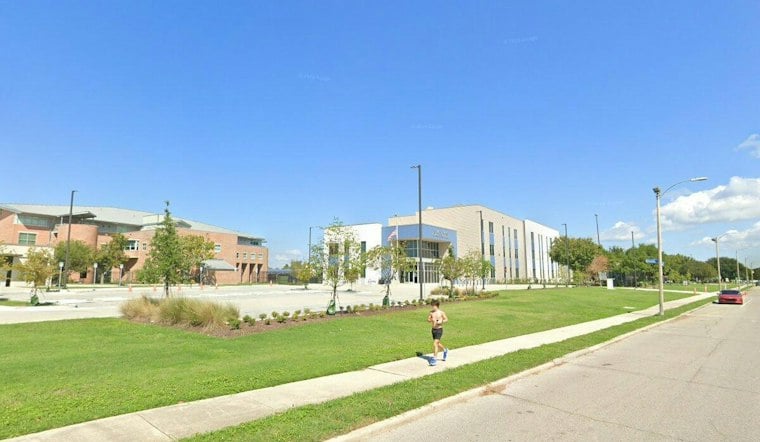
Several nonprofits operating out of offices on the LSU New Orleans campus were told last month to clear out by October 31 so the university's athletics department could move its coaches into the space, according to the groups' directors. Project NOLA, Court Watch NOLA, Soul NOLA and Silence Is Violence all received notices to vacate the Training, Resource, and Assistive-Technology Center, a Lakefront campus facility historically used for disability and rehabilitation services.
As reported by NOLA.com, the tenancy termination notices went out September 28, giving the organizations roughly a month to pack up and move out. LSU New Orleans did not disclose how many nonprofits were asked to leave the building, but university officials told the outlet the space is needed to make way for athletics department offices. The TRAC facility has long housed training and evaluation labs, administrative offices, a conference center and lodging, and it provides services to people with disabilities, rehabilitation professionals, educators and employers.
Project NOLA, a 501(c)(3) nonprofit that runs a networked HD crime-camera program feeding footage to a Real-Time Crime Information Center on campus, held a month-to-month lease at TRAC, per the group's own description on its about page. The nonprofit's directors say they were initially told they could keep their month-to-month arrangements, with the university's report characterizing the situation as one where nothing would change and new leases would be written when possible. Instead, the notice to vacate arrived. Project NOLA has since secured a prospective secondary location through a partnership with another university and plans to use that site as its new home base, the report notes.
Survivors' Advocacy Group Says Services Were Interrupted
Silence Is Violence, which provides care and advocacy for survivors of violent crimes, had occupied space at TRAC for eight years, leasing six offices for four full-time and two part-time employees. Founder Tamara Jackson, who holds a doctorate in social work, requested a five-day extension so the organization could move into available space on November 5 — a request LSUNO denied. The displacement interrupted the group's in-person services to survivors.
Jackson said the sudden move was disheartening and forced a pause in operations, and that scrambling to find a venue at the last minute was costing the organization an exorbitant fee, according to the same report. Court Watch NOLA, which trains civilian volunteers to monitor criminal court proceedings, said it had no intention of leaving and received no warning before its lease was terminated. That group will return three to five employees to Propeller, a building it left in 2021 after Hurricane Ida damaged the space.
Nonprofit Leaders Wanted More Notice
Jesse Manley and Jackson both said they wanted at least 90 days' notice before being forced out — far more than the roughly one month LSUNO officials gave them. Manley said the displacement could significantly disrupt the nonprofits' ability to help the people they serve, and said he felt let down by the LSUNO community. Soul NOLA, which plants native trees across the city to mitigate climate change, also received a notice to vacate.
LSU New Orleans told the outlet it could not renew leases while in the midst of switching over to the LSU System and was not issuing new contracts during the transition. That transition became official July 1, 2026, when responsibility for the Lakefront campus formally shifted from the University of Louisiana System to the LSU System, according to LSU.
Athletics Office Plans Shifted After Earlier Lakefront Arena Proposal
The athletics department had initially been scheduled to move out of the Human Performance Center and into Lakefront Arena. But per spokeswoman Sarah Bergez, that relocation plan was abandoned because the arena could not accommodate all athletics operations and the necessary renovations were deemed too costly. The Human Performance Center itself is being leased to neighboring Benjamin Franklin High School under a 30-year agreement so the A-rated charter school can expand, LSU New Orleans said in March, noting the lease would also let the university reclaim classrooms in the Bicentennial Education Building that Benjamin Franklin had used for years.
Reported figures on how much the Benjamin Franklin lease will net LSU New Orleans annually vary. Fox 8 reported the university would gain $432,000 a year, while a separate account put the net revenue figure at $423,000 after the charter school's $360,000 annual rent and other costs. The lease is part of a broader financial squeeze: LSU New Orleans has grappled with declining enrollment and a fiscal crisis that led to layoffs, the elimination and combination of academic programs, and a shrunken physical footprint across campus.
Enrollment and Construction Continue Amid Cuts
The university reported 5,533 students enrolled this fall, down from 5,670 a year earlier and short of the 6,000 students projected in the campus budget, though it also recruited 21% more new students than the previous fall and improved retention, according to the Louisiana Illuminator. Enrollment at the Lakefront campus has never approached its pre-Hurricane Katrina peak of roughly 17,000 students, which fell to about 6,000 immediately after the 2005 storm — close to the university's current enrollment target.
Even as nonprofits were pushed out, new construction is moving forward on campus. A $9.18 million permit was filed for a roughly 18,500-square-foot gymnasium and classroom building at 6400 Saint Anthony Avenue, with all-new structural, mechanical, electrical, plumbing and fire-protection systems, according to New Orleans CityBusiness. Woodward Design+Build is slated to complete the project. LSU New Orleans separately said earlier this year it had closed the Liberal Arts Building and Milneburg Hall and shrunk its operational footprint to 2.5 million square feet, saving close to $1.67 million, as the campus continues reshaping itself under its new LSU System identity.





