

























































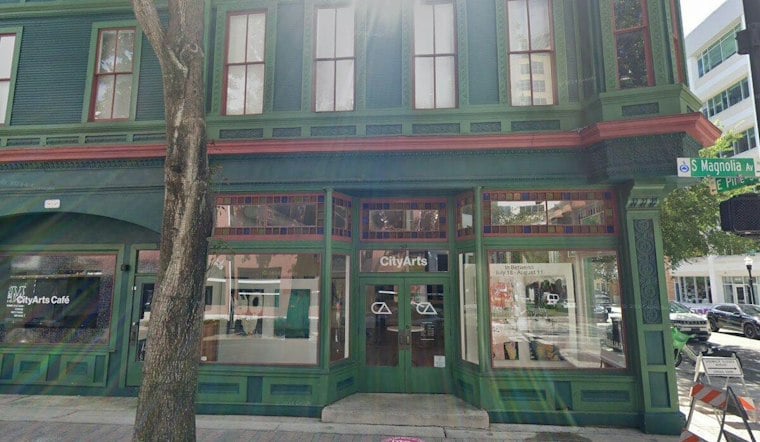
Downtown Orlando's Magnolia Avenue goes car-free Thursday night as CityArts throws its 17th annual Día de los Muertos & Monster Event, a free street festival blending Day of the Dead altars and artwork with Halloween-season pop culture. The block party runs from 6 p.m. to 10 p.m. between Pine Street and East Central Boulevard, converting a stretch of downtown's commercial corridor into a pedestrian-only celebration for one night.
From Gallery Show to Downtown Block Party
According to Bungalower, the festival began modestly in 2009 as a gallery exhibition before expanding over 17 consecutive years into the outdoor street party it is today. As Orlando Weekly reports, this year's event features Day of the Dead- and Halloween-inspired artwork from local and international artists, alongside a Magnolia Avenue street party packed with art vendors, face-painting, installations, live performances, food, and drinks. Admission is free, though the outlet notes ticket options range as high as $63 for those seeking added perks.
A Día de los Muertos procession remains part of the night's programming, per the same report, with performances lined up from Ravelli, Mariachi Nuevo Guadalajara, Ballet Folklórico México Lindo, belly dancer Sadira, Banda Alternativa, and vocalist Francisco Gabriel. The procession route carries participants from CityArts through downtown before looping back to Magnolia Avenue by way of the Orange County Regional History Center, according to the Downtown Arts District's event listing.
New VIP Tier Joins Free General Admission
For 2026, organizers introduced a $50 VIP ticket called the Sugar Skull Experience, which bundles gallery entrance with a food truck meal voucher and drink tickets, as reported by BroadwayWorld. General admission still carries no cost beyond a suggested $5 donation, keeping the festival's core public access intact even as the new tier gives attendees a paid upgrade option.
The 2026 cultural programming was curated by Central Florida non-profit CABETCAL, with official participation from the Consulate of Mexico in Orlando and Casa de México, BroadwayWorld notes. Diplomatic and community organizations regularly partner on Central Florida's Hispanic Heritage Month programming, lending the festival institutional backing beyond its roots as a neighborhood art show.
A Historic Building With a 20-Year Mandate
The festival's home base, CityArts, operates inside the 1886 Rogers-Kiene Building at 39 S. Magnolia Ave., a Queen Anne-style structure clad in pressed zinc metal that stands as the oldest functioning commercial building in downtown Orlando, according to the City of Orlando. The building was added to the National Register of Historic Places in 1983. Local philanthropist Ford W. Kiene donated the structure to the city in 2018 under a deed condition requiring it be dedicated to arts and cultural uses for at least 20 years, with the Downtown Arts District managing operations, as previously detailed by Orlando Weekly.
CityArts marked its own 20th anniversary in June, reporting that since its 2006 founding it has presented 1,536 exhibitions, exhibited more than 20,000 artists, welcomed 1.2 million visitors, and generated over $1 million in art sales, per the Downtown Arts District. The gallery originally operated on Orange Avenue before relocating to its current Magnolia Avenue home. Hoodline previously covered CityArts hosting the kickoff reception for a citywide mural festival inside the same Rogers-Kiene Building.
Parking and Demographics Behind the Draw
Festivalgoers can find $4 validated parking at the Cobb Plaza Parking Garage at 189 S. Orange Avenue, a partnership the Downtown Arts District arranged to ease the usual downtown parking crunch during major block parties. The practical detail matters for an event expected to draw heavy foot traffic to a corridor that closes entirely to vehicles for the night.
The festival's popularity also tracks with Central Florida's demographics: Hispanic or Latino residents make up 35.4% of Orlando's population and 35% of Orange County's roughly 1.53 million residents, according to U.S. Census Bureau data. That makes Central Florida one of the state's largest Hispanic population hubs, context that helps explain why a celebration rooted in Mexican tradition has grown into one of downtown Orlando's flagship annual gatherings.





