

























































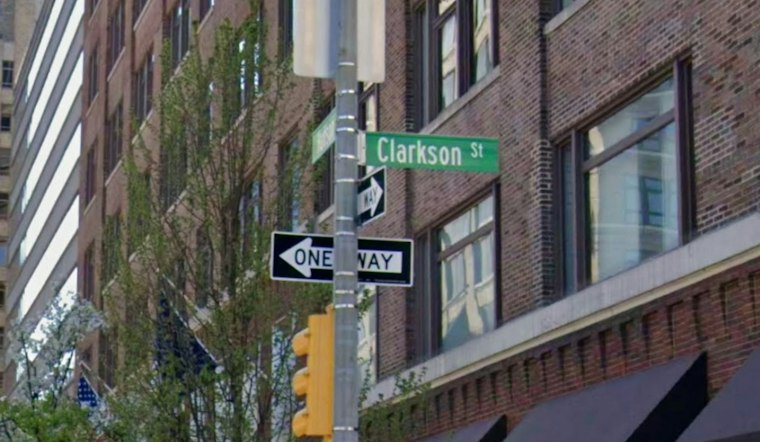
A stretch of Clarkson Street in Lower Manhattan just became the first permanent School Street in New York City, with swing-arm gates now bolted into the roadbed at both ends of the block to shut it to vehicles every school day. The gates serve City-As-School High School and P.S. M721, closing the street between Varick Street and Hudson Street from 10:30 a.m. to 3 p.m. before reopening it to traffic for the rest of the day.
Unlike the movable metal gates used at other School Streets citywide, these new gates are fixed to the pavement itself, eliminating the need for volunteers or staff to haul barriers in and out each morning, according to amNewYork. NYC Department of Transportation Commissioner Mike Flynn said the old movable gates created challenges involving movement, maintenance, storage, and security, and that the agency will now evaluate how well the swing-gate model performs before deciding whether to bring it to other School Streets and Open Streets. The design draws on Paris's Rues aux Écoles infrastructure, which uses roadbed-anchored swing gates to close streets during school hours without daily manual setup, as reported by Patch.
More Than Just a Closed Block
The redesign goes beyond keeping cars out. Patch reports the project includes a Street Seat with wooden benches and a communal student gardening space, giving kids somewhere to sit and grow things instead of just an empty roadway. Nonprofit Open Plans helped fund the installation in part through a $100,000 grant from the Project for Public Spaces, which is backed by General Motors, per the same outlet. The gate followed more than a year of community engagement, according to amNewYork.
The Hudson Square Business Improvement District, which covers the area bounded by Clarkson Street, Canal Street, 6th Avenue, and West Street, was a key local partner in designing and launching the project, Patch notes. The same BID previously oversaw a $27 million streetscape overhaul along nearby Hudson Street. City-As-School High School, at 16 Clarkson Street, has operated since 1972 as one of the nation's oldest alternative experiential-learning public high schools, sending 11th and 12th graders into community internships; its alumni include artist Jean-Michel Basquiat and musician Adam Horovitz, according to InsideSchools.
A Small Share of a Much Bigger Problem
Clarkson Street's new gate lands amid a citywide reckoning over how little outdoor space many schools actually have. Comptroller Mark Levine released a report in August 2026 finding that 371 New York City public schools serving nearly 200,000 students lack dedicated outdoor physical education space, though 324 of those campuses have adjacent streets eligible to become School Streets. Open Plans released its own report earlier in 2026 identifying more than 370 city public schools without on-site recreation space and recommending broader use of school plaza blocks and limited-entry School Streets.
Yet participation in the existing program remains tiny. Only 48 of the city's 1,619 public schools took part in School Streets during the 2025–2026 school year, joined by 14 private schools, 10 charter schools, and two child care facilities for 74 locations citywide, per BKReader. Levine has identified the long and cumbersome application process as a key barrier keeping more schools from signing up, according to amNewYork. Open Plans community planner Sabina Sethi Unni said the permanent gate creates a safer public space with less administrative burden than the old movable-barrier system.
Safety Data Behind the Push
The urgency behind these redesigns is backed by crash numbers. During the 8 a.m. school arrival hour, streets near schools see 57% more traffic crashes and 25% more injuries per mile on school days compared to non-school days, with more than 70% of youth traffic injuries occurring within 250 feet of a school, according to the Office of the New York City Comptroller. That data has fed into the city's broader rollout of 15 mph School Slow Zones, which the Department of Transportation launched at more than 200 locations in September 2026, with a goal of reaching 800 sites under new authority granted by Sammy's Law, as reported by CBS New York.
The push to expand car-free school blocks has also reached City Hall's education policy arm. In October, the New York City Panel for Education Policy introduced a resolution urging the city to streamline the School Streets application process, which currently allows up to 90 days for administrative review, so hundreds of space-constrained schools could more easily convert adjacent streets, as Hoodline previously reported.
Not every street closure has gone smoothly. A federal judge allowed a disability rights lawsuit against the city's Open Streets program to proceed in March 2026, after plaintiffs alleged that movable barricades and planters obstruct paratransit, taxi, and emergency vehicle access in violation of the Americans with Disabilities Act, Hoodline has reported. Whether the fixed Clarkson Street gates sidestep those concerns or raise new ones of their own remains to be seen as the city weighs expanding the model.



