

























































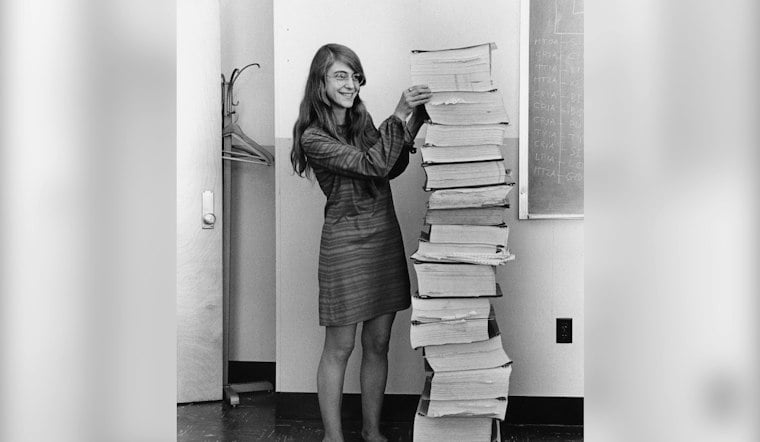
Margaret Hamilton, the programmer whose code kept Apollo 11 from aborting its lunar landing in 1969 and who helped invent the very idea of software engineering, has died at age 90. Her death was reported per MIT, though no cause has been disclosed.
From Meteorology to the Moon
Hamilton's path into computing began almost by accident. According to KITV, she was born in Paoli, Indiana, in 1936, studied at the University of Michigan, and earned a mathematics degree from Earlham College in Indiana. The Guardian reports that after graduating in 1958 she taught high school math and took her first software job at MIT in 1959 to support her family while her husband attended Harvard Law School, having originally planned to pursue graduate studies in abstract mathematics at Brandeis University.
That first MIT job placed her in the meteorology department, where she wrote weather simulation software on LGP-30 computers for meteorologist Edward Lorenz, work that fed into early research behind chaos theory and the concept of the butterfly effect, according to MIT Lincoln Laboratory. At the time, software programming was learned on the job, since no formal computer science degrees yet existed. Between 1961 and 1963 at MIT Lincoln Laboratory, she developed radar tracking software for the Semi-Automatic Ground Environment air defense system on the prototype AN/FSQ-7 computer, helping the military detect potentially hostile aircraft, per MIT News. SAGE was the nation's first computerized air defense network and pioneered real-time radar processing.
Leading the Apollo Software Team
Hamilton worked at MIT starting in 1959 and remained there until the mid-1970s, per the same KITV account. In 1961, the software engineering division of the MIT Instrumentation Laboratory secured a NASA contract, and Hamilton went on to manage that division, leading a team of roughly 100 engineers who designed the software guiding NASA's Apollo missions. Olivier de Weck said, as KITV reports, that Hamilton was a pioneer and was ahead of her time.
It was during this era that she intentionally coined and promoted the term software engineering, demanding equal professional legitimacy for writing code alongside the mechanical and electrical engineering that built spacecraft hardware, according to Britannica. Writing software had originally been treated as a secondary task compared to physical engineering disciplines. Her push helped establish software engineering as a professional practice in its own right.
The Three Minutes That Saved Apollo 11
Hamilton's defining moment arrived during Apollo 11's lunar descent on July 20, 1969. Per KITV, her software overrode an errant attempt to switch the spacecraft's primary flight computer processing to a radar system just three minutes before the first lunar touchdown, and NASA said the intervention allowed the mission to safely continue. CBS News adds technical detail: a misconfigured rendezvous radar switch had overwhelmed the guidance computer with spurious tasks during final approach, triggering the now-famous 1202 and 1201 overload alarms. Her priority-scheduling architecture dropped non-essential radar processing so that critical landing guidance remained uninterrupted.
The alarms did not mean the guidance computer had simply failed: extra signals from the rendezvous radar overloaded its task system, prompting it to restart while preserving critical landing functions and dropping the troublesome radar work. The computer’s recovery was only part of the safety net; flight controller Jack Garman recognized the alarms and advised Mission Control to let the descent continue.
Hamilton also built in safeguards to keep astronauts from repeating mistakes made during simulations once they were actually in flight, including what KITV describes as the Lauren error failsafe, named for her daughter. A 1969 photograph of Hamilton standing beside the bound binders containing more than 60,000 lines of Apollo guidance software became an iconic image in computing history, one that later inspired the character Margo Madison on the television series For All Mankind, according to a post on Bluesky. KITV also notes she appeared in an Apollo command module mock-up at the Cambridge School in November 1969.
Life After Apollo
When the MIT Instrumentation Laboratory became the Charles Stark Draper Laboratory — now known simply as Draper Laboratory — after the Apollo program ended, Hamilton did not join it. Instead, per KITV, she formed her own company. Following Apollo, she had also contributed flight software design concepts to NASA's Skylab space station and early Space Shuttle software architectures before moving fully into the private sector in the mid-1970s, according to the World Economic Forum, with her fault-tolerant software principles later adapted across subsequent crewed space programs.
Hamilton’s Apollo work was rooted in a Cambridge institution that outlasted the lunar program. The MIT Instrumentation Laboratory that developed the guidance software was renamed the Charles Stark Draper Laboratory in 1970; MIT divested the lab in 1973, making it an independent research and development corporation. The lab’s evolution linked Hamilton’s work to a lasting local aerospace research presence.
She went on to co-found Higher Order Software in 1976 and later founded Hamilton Technologies in 1986 in Cambridge, Massachusetts, where she created the Universal Systems Language, a methodology she called Development Before the Fact that aimed to make entire categories of software bugs structurally impossible by design, MIT News reports.
Recognition and Lasting Legacy
Hamilton's contributions were honored repeatedly in her later years. She received NASA's Exceptional Space Act Award in 2003 for her contributions to science and space travel, and in April 2017 the Computer History Museum named her a Fellow Award honoree for her pioneering software leadership on Apollo and defense projects, an award recognizing innovations that have transformed human society. In 2016, President Barack Obama awarded her the Presidential Medal of Freedom, per KITV's reporting.
Her legacy has also crossed into popular culture. In November 2017, Lego released its Women of NASA building set, featuring a minifigure of Hamilton alongside a miniature model of her iconic stack of Apollo flight software source code listings, according to Space.com. The 231-piece set, created through Lego Ideas, highlighted four women pioneers of space exploration — a fitting tribute to a woman whose insistence that code deserved the same rigor as hardware helped build the discipline that now underpins nearly every corner of modern technology.



