

























































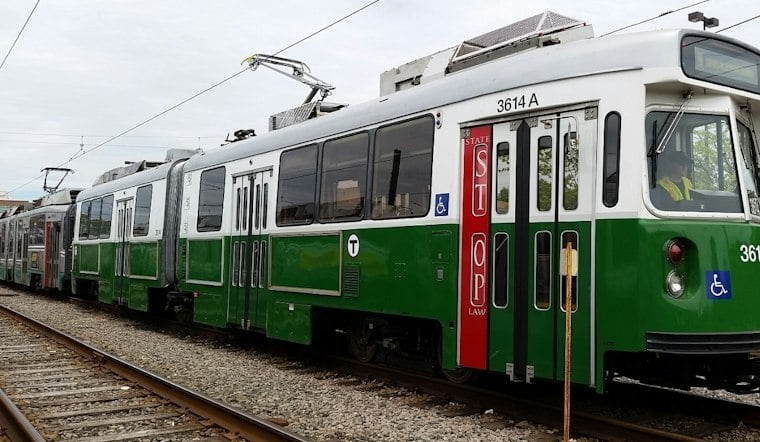
The MBTA's long-promised Green Line makeover took a tangible step forward Wednesday, September 30, when the first Type 10 pilot cars arrived on truckbeds at the Riverside maintenance facility in Newton, kicking off track testing before the new fleet begins carrying passengers. The cars are the vanguard of what officials call a fleet of 102 light rail vehicles being built to replace trains that have rattled through Boston's tunnels since the 1980s.
According to NBC10 Boston, the new cars are manufactured in Elmira, New York, and feature a low-floor design for accessible boarding, wider doors, and improved technology. The outlet reports that just over 100 of the cars are being produced, with the first expected to enter passenger service next year, at an estimated cost to the MBTA of $816 million.
That price tag lines up with the contract history behind the project. The MBTA Board of Directors approved an $810.9 million contract in August 2022 with CAF USA Inc., a subsidiary of Spanish rail manufacturer CAF, to produce and deliver the 102 Type 10 vehicles, according to Mass Transit Magazine. The vehicles are being made at CAF USA's Elmira facility, the trade publication notes.
Why They're Calling Them Supercars
The nickname isn't just marketing hype. The Type 10's seven-module articulated design is about 40 feet longer than current Green Line cars, per Metro Magazine.
The scale of the new cars also changes how the MBTA can staff them. Because each 114-foot supercar functions as a single continuous high-capacity train, the agency can run it with one operator instead of the two-person crews needed for coupled legacy cars, Commonwealth Beacon reported, a shift that could free up staffing for more frequent service.
The Type 10 is also fully low-floor across every module, offering 32-inch clear interior aisles, bridge plates at all double doors, and four designated areas for passengers using wheeled mobility devices, per the same Mass Transit Magazine report. The design eliminates entry stairs for passengers.
Retiring a Fleet Approaching Its 40th Year
The 102 new vehicles will let the MBTA fully retire its legacy Green Line fleet over the next decade, including Type 7 cars that first entered service in 1986 and 1987, along with Type 8 cars, according to CBS News Boston. Those cars have been carrying riders through Boston's tunnels for nearly 40 years.
Safety features are also part of the pitch. The Type 10 incorporates a fully closed operator cab with improved line-of-sight visibility, along with crash-safety hardware designed to integrate with the MBTA's Green Line Train Protection System, Mass Transit Magazine reported. The system's second phase includes automatic braking retrofits on newer Type 9 and future Type 10 trains. Hoodline previously reported on Somerville crash footage that underscored why collision-avoidance technology has become a focal point for transit officials following past collisions and regulatory scrutiny.
Even the paint job had a public hand in it. In October 2023, the MBTA finalized the Type 10's exterior scheme — green and dark gray with green doors and a white and navy blue lower stripe — after a public survey drew more than 16,300 votes, with the winning option collecting 9,566 of them, according to Boston 25 News.
Tunnels and Platforms Need Work Too
Fitting longer, wider trains into a system built in the 19th century requires more than new paint. In late September, the MBTA executed a 9-day shutdown of the central Green Line trunk to replace century-old tunnel signals and modify overhead catenary wires and platform edges to accommodate the Type 10's dimensions, according to Streetsblog Massachusetts.
The Green Line serves major Boston medical, educational, and residential hubs.
Under the MBTA's procurement timeline, pilot Type 10 vehicles will undergo track testing through 2026, with initial passenger revenue service expected to begin in early 2027 and full fleet delivery completed by 2031, according to the agency's own project page. For now, Wednesday's arrival at Riverside is a testing milestone — commuters may be able to step aboard in early 2027.


