

























































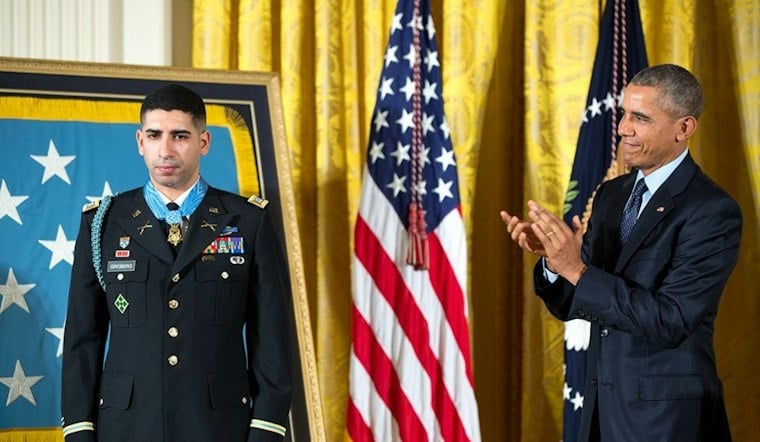
Twenty-five years after the first American bombs fell on Afghanistan, retired Army Capt. Florent “Flo” Groberg still carries the physical and emotional weight of eight seconds in 2012 — the seconds in which he tackled a suicide bomber and, in doing so, helped keep a catastrophic attack from becoming even deadlier. Groberg, a Medal of Honor recipient, is reflecting on that moment and on the two-decade conflict that reshaped his life and American foreign policy alike.
The Afghanistan War began on October 7, 2001, when U.S. and British forces launched airstrikes against Taliban and al-Qaeda targets, less than a month after the September 11 terrorist attacks, according to FOX31 Denver. What followed was more than two decades of war that sent hundreds of thousands of American service members into combat and reshaped U.S. foreign policy for a generation. Groberg, then a captain, was leading a security detail in eastern Afghanistan on August 8, 2012, when he and Sgt. Andrew Mahoney were escorting senior American and Afghan officials to a security meeting.
As the group moved, Groberg charged toward a suspected attacker, and he and Mahoney forced the man away from the formation before the attacker detonated an explosive device on the ground. That blast triggered the vest of a second, unseen suicide bomber prematurely, before he could reach the formation — preventing a far more deadly explosion inside the 28-person group, according to the Congressional Medal of Honor Society. Groberg was thrown roughly 30 feet by the blast and suffered a 50 percent loss of his calf muscle, deafness in his left ear, and a traumatic brain injury, per the same account.
Four Americans Lost, One Civilian Among Them
The attack killed four Americans: Army Command Sgt. Maj. Kevin Griffin, Army Maj. Thomas Kennedy, Air Force Maj. Walter Gray, and USAID Foreign Service Officer Ragaei Abdelfattah, an Egyptian-born naturalized U.S. citizen, as reported by the Forbes. Abdelfattah was an architect who was helping build electricity infrastructure and schools for girls in rural Afghanistan, according to the National Medal of Honor Museum. Groberg's actions that day helped prevent a greater loss of life among the protected officials and troops present, and his Medal of Honor citation credits him with significantly reducing the impact of the coordinated attack while saving fellow service members and senior leaders, per FOX31 Denver.
President Barack Obama placed the Medal of Honor around Groberg's neck during a White House ceremony in 2015, recognizing what FOX31 Denver described as extraordinary courage and sacrifice during eight chaotic seconds in Afghanistan. Groberg was born in Poissy, France, immigrated to the United States at age 12, and became a naturalized U.S. citizen in February 2001 before renouncing his French citizenship in 2008 to accept his Army commission — making him the first foreign-born Medal of Honor recipient since the Vietnam War, according to the National Medal of Honor Museum. He grew up in Bethesda, Maryland, and competed in varsity track at the University of Maryland before entering Officer Candidate School.
Deployed Twice To One Of Afghanistan's Deadliest Regions
Groberg deployed twice to Afghanistan's volatile Kunar Province with the 4th Infantry Division — first in 2009 as a platoon leader in the Pech River Valley, and again in 2012 as a personal security detachment commander — before he was medically retired as a captain in July 2015, according to the U.S. Army. He earned two Bronze Star Medals and a Purple Heart alongside the Medal of Honor. Since leaving the military, Groberg has taken on public service roles, including his 2021 appointment as a Commissioner of the American Battle Monuments Commission, the independent federal agency that operates and maintains U.S. military cemeteries and memorials worldwide, according to Keppler Speakers.
The war that shaped Groberg's life killed nearly 2,500 U.S. service members and wounded thousands more, per FOX31 Denver's reporting. Those numbers sit alongside broader figures from the conflict: Department of Defense data cited by the A-Mark Foundation put total combat deaths at 2,456 and wounded at 20,770 between 2001 and 2021, while roughly 832,000 U.S. military service members and 25,100 Department of Defense civilian employees served in the country over the course of the war. Brown University's Costs of War Project estimated the war's total financial toll, including long-term veterans' healthcare costs, at $2.261 trillion, the same report notes.
A Museum Built To Remember The War's Cost
In 2021, Afghanistan's Taliban government regained control of the country after American forces withdrew, closing a chapter that had defined Groberg's generation of service members. Today, his story is preserved at the National Medal of Honor Museum in Arlington, Texas, which dedicated an exhibit to his actions in 2012. The 101,000-square-foot museum, designed by architect Rafael Viñoly, officially opened to the public on March 25, 2025, according to the City of Arlington; its entrance features five outdoor columns representing each branch of the military.
Hoodline previously reported on a Veterans Day event at the museum featuring a book signing and meet-and-greet with Groberg. Groberg has said the museum tells American stories of ordinary men doing heroic acts, a sentiment FOX31 Denver included in its reporting as part of its special, “Afghanistan: 25 Years Later.” A total of 20 service members were awarded the Medal of Honor for actions during the Afghanistan War, according to the Congressional Medal of Honor Society, with 15 of those recipients living as of 2026 — a small circle carrying the memory of a two-decade war that reshaped so many American lives, Groberg's among them.





