

























































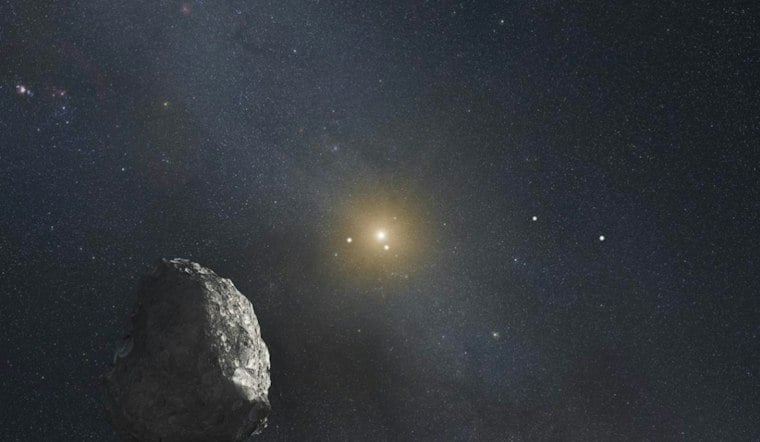
Asteroid 2024 YR4, first spotted on December 27, 2024, briefly had a small chance of hitting Earth in 2032, according to NASA's Center for Near-Earth Object Studies (CNEOS). As astronomers gathered more observations, they refined their estimates of the object's path. The episode illustrates how NASA's planetary-defense work depends on tracking objects and updating risk assessments as new data arrives.
A Newly Discovered Rock Raises Alarms
NASA's Planetary Defense Coordination Office (PDCO), based in Washington, D.C., coordinates the agency's work to identify and assess asteroid threats, according to Washingtonian. Its work is part of a broader effort that draws on observations from asteroid surveys and orbital analyses.
Washingtonian reported that astronomers estimated 2024 YR4 was about 60 meters, or roughly 200 feet, in diameter. An impact could have released energy equivalent to 7.4 megatons of TNT — about 500 times the energy unleashed at Hiroshima — the outlet reported, citing NASA's assessment.
NASA's Own Numbers, and a Later Reversal
NASA's Center for Near-Earth Object Studies at the Jet Propulsion Laboratory put a figure on the danger in a January 31, 2025 analysis, stating that 2024 YR4 had a small chance of impacting Earth on December 22, 2032, according to NASA's Center for Near-Earth Object Studies. More than a year later, the picture shifted again. A March 2026 update from NASA Science said that new observations, drawn from James Webb Space Telescope data collected in February, had refined the asteroid's orbit and were ruling out a chance of a 2032 lunar impact.
The planetary-defense effort relies on observations from programs including the Catalina Sky Survey. Washingtonian reported that the survey can discover as many as 50 asteroids during a good overnight shift. Kelly Fast, NASA's planetary defense officer, became acting director of the Planetary Defense Coordination Office in May 2024, the outlet reported.
The Tools Built to Spot the Next One
Once an asteroid is found, it gets run through Sentry, a highly automated collision monitoring system that continually scans the most current asteroid catalog for possibilities of future impact with Earth over the next 100 years, according to NASA's Center for Near-Earth Object Studies. Whenever Sentry flags a potential impact, the results are analyzed and published.
Looking ahead, NASA is also building a dedicated space telescope for this exact job. The NEO Surveyor mission will carry a 50-centimeter telescope operating in two heat-sensing infrared wavelengths, capable of detecting both bright and dark asteroids — the dark ones being the hardest to find, per NASA's Jet Propulsion Laboratory. Its launch is planned for no earlier than September 2027, according to NASA Science.
What NASA's Budget Request Covers
NASA's FY 2025 budget request proposed $252 million for continued development of NEO Surveyor and funding for OSIRIS-APEX, according to NASA. The figure was a budget request for those efforts, not a stated total for all planetary-defense work.
Detection is only half the equation. NASA has also tested whether it could actually change an asteroid's path if needed. The agency's Double Asteroid Redirection Test, known as DART, was its first successful planetary defense test: the spacecraft deliberately impacted the asteroid Dimorphos and successfully altered its orbit, according to NASA Science.
WKYC has profiled the Washington, D.C.-based scientists working on planetary defense, framing their work as something close to real-life guardians of the galaxy. NASA's ground-based surveys, Sentry system and planned NEO Surveyor telescope are among the tools used to find and assess objects that could pose a future risk.





