

























































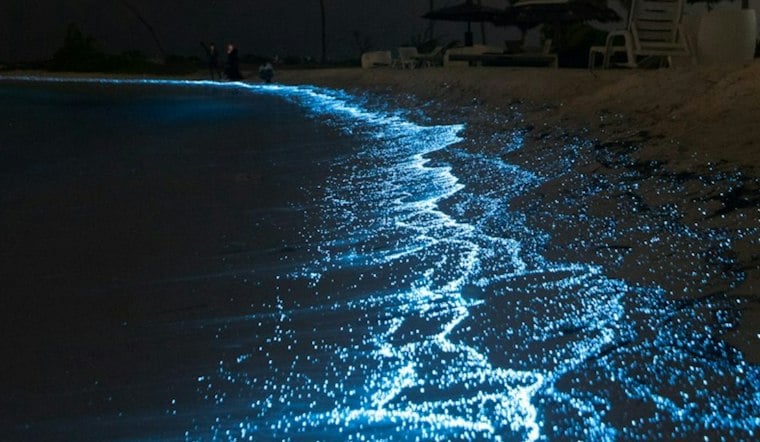
San Diego's waters have been putting on a glowing show again. Reports over the past week describe neon-blue bioluminescence rippling through Mission Bay, especially around Sail Bay and Ski Beach Park.
The sightings, detailed in a report from sandiegored.com, describe a glow that could be present one night and gone the next, underscoring just how unpredictable the phenomenon can be. UC San Diego photographer Erik Jepsen, who documents bioluminescence events around San Diego, has also been capturing footage of the display, which the Scripps Institution of Oceanography shared in a reel urging “bioluminescence lovers” to tune in.
Scientists say the glow traces back to microscopic organisms known as dinoflagellates, and in Southern California, one species in particular tends to get the credit. According to Scripps Institution of Oceanography, Lingulodinium polyedra is the species most often responsible for these glowing displays, and each microscopic cell contains pigments that give it a reddish-brown color during daylight hours, which is why the blooms are known as red tides even though they light up blue at night.
Why the Water Turns Electric Blue After Dark
The transformation happens only when something stirs the water. Scripps explains that when the phytoplankton are disturbed by waves or other movement in the water, they emit a neon-blue glow, which is why the brightest flashes tend to trail behind breaking surf, boat wakes or swimming animals.
Per NBC San Diego, researchers have described red tides as patchy and mobile, with sightings in the 2024 event reported from Carlsbad down to Ocean Beach and from San Clemente up to Santa Barbara. The outlet also notes that triggers can come from a breaking wave, a boat, a dolphin or a surfer, all of which can set off the same flickering reaction in the water.
Scientists believe the light serves a purpose beyond spectacle. Scripps describes bioluminescence as a possible predator-avoidance mechanism, one that may startle or confuse organisms that might otherwise eat the plankton.
Tracking the Bloom From Scripps Pier
Researchers keep tabs on these blooms through consistent, old-fashioned fieldwork. Manual plankton sampling takes place at Scripps Pier, and this sampling primarily tracks toxin-producing species rather than the bioluminescent ones making headlines.
For the organisms behind the glow specifically, the California Ocean Observing Systems portal shows weekly cell counts for bioluminescent plankton at Scripps Pier, drawing on data collected at the site. The same location also hosts broader monitoring: per habs.sccoos.org, phytoplankton cell abundances are tracked there for Akashiwo sanguinea, Alexandrium species, Dinophysis species and Lingulodinium polyedra. As of now, bioluminescence has not been reported near Scripps Pier itself, even as it lights up Mission Bay.
Beyond manual counts, the pier also relies on more automated tools. An Imaging Flow Cytobot at the pier captures thousands of pictures in the water samples that flow through it, according to sccoos.org, with machine-learning algorithms sorting through the images for insights into which species are present and in what numbers. That same site recorded a similar glowing bloom of Lingulodinium polyedra under the pier in La Jolla back in November 2024.
How This Bloom Compares to Past Red Tides
Red tide events are notoriously variable in how long they stick around. Fox 5 San Diego reports that these blooms can last anywhere between several days to over a month, meaning this current patchy event could fade quickly or linger for weeks.
The gold standard for comparison remains 2020, when a massive red tide bloom extended from waters off Baja California to Santa Barbara, lasting nearly two months by some accounts. NBC San Diego reported that the 2020 red tide was so powerful it produced a potent smell that could be detected miles from the beach, while researchers at UC San Diego found that more than 70 years of climate data showed the bloom created physical and chemical conditions in the water column that deviated sharply from normal.
Whether today's bloom reaches anywhere near that scale remains to be seen. Evidence suggests that local red tides have become more common since the 1960s, according to Scripps, and conditions can shift quickly: if wave activity decreases, the bioluminescence could begin appearing along more of the coast rather than staying confined to patches like Mission Bay. Bioluminescence can show up almost any time of year, though NBC San Diego notes a slight seasonal lean toward spring through early fall, making this October glow a bit of a later-season surprise for anyone hoping to catch the waves lighting up after dark.



