

























































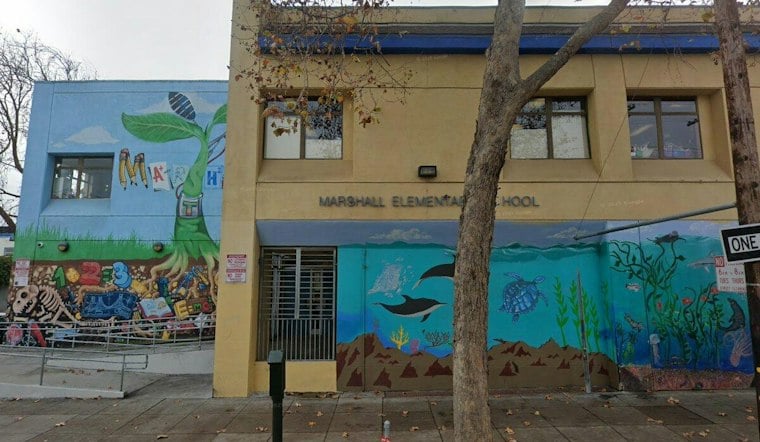
A first-grader found a needle on the playground at Marshall Elementary last month. Weeks later, a beer bottle thrown from a nearby building nearly struck a student outside the Mission District school. For parents walking their children to the 1575 15th Street campus each morning, these are not isolated scares but part of a pattern they say has made the walk to class genuinely frightening.
A Father's Terrifying Walk to School
Yair Wong, whose 9-year-old daughter has attended Marshall Elementary since kindergarten, described a recent incident in which a homeless person screamed and threw objects at him and his daughter as they crossed the street toward campus, according to KRON4. Wong said his daughter was terrified by the encounter, and his family has since considered moving her to another school. “The area around the school is not safe for children,” Wong told the station.
Other parents describe similarly alarming conditions just steps from the schoolyard. Lola Escudero, who walks her godchildren to Marshall Elementary, said she has seen people suffer public overdoses and others exposed on the sidewalks along 15th Street. She said the conditions sometimes force her and the children to walk in the street because people who are high are bent over blocking the sidewalk. “Children do not deserve to see such conditions while going to school,” Escudero said, adding that she has also seen women walking with their pants down in the area.
What Reporters Found on the School Steps
The station's own reporting documented the physical evidence of the crisis firsthand: discarded Narcan packaging, a condom wrapper, and a strong odor of urine on the steps leading up to the school. A Marshall Elementary staff member also reported that a first-grade student discovered a needle on the school playground, per the same account. Marshall Elementary serves roughly 265 students across grades K through 5 and runs a full Spanish Two-Way Immersion program, according to SFUSD, making it a cornerstone bilingual campus in the inner Mission.
The deterioration traces in part to the closure of Mission Cabins, an interim shelter that once stood adjacent to the school whose security staff had kept open drug activity off Capp Street, according to SFist. The site was shuttered in late 2025 to clear the lot for a permanent affordable housing development. Teachers reported earlier this year that illicit drug smoke from 15th Street frequently drifted into open classroom windows, as Mission Local reported, with staff struggling to answer young students' questions about the odors.
Civilian Escorts Cut as Police Step In
Compounding the problem, San Francisco eliminated 14 community ambassador positions managed by the Office of Civic Engagement and Immigrant Affairs in May, ending a civilian program that had previously escorted Marshall Elementary students and monitored sidewalks during drop-off and pickup, Mission Local reported separately. The cuts came as part of citywide budget reductions that removed the non-police escort team.
In response to the mounting complaints, San Francisco Police Department community ambassadors began monitoring the area around Marshall Elementary during dismissal this week, KRON4 reported. The ambassador program, created in 2020, deploys retired police officers equipped with radios and Narcan to boost public safety visibility while the department manages shortages of sworn officers, according to CBS News. The ambassadors carry no weapons and focus on de-escalation, safety escorts and emergency calls rather than enforcement.
Separately, the city has also contracted Ahsing Solutions, a firm employing formerly unhoused and formerly incarcerated individuals, to deploy street ambassadors along Mission Street between 15th and 16th streets since July 2025. Those ambassadors work daily from 11:30 a.m. to 8 p.m. to de-escalate conflicts and clear pathways for Marshall Elementary families, per Mission Local's reporting.
Citywide Numbers Offer Some Context
The neighborhood-level crisis unfolds against a backdrop of improving citywide overdose data. San Francisco recorded 351 accidental drug overdose deaths through August, a 24 percent decrease from the 460 fatal overdoses recorded over the same period in 2025, according to GrowSF. City health officials attribute part of that decline to expanded treatment access and coordinated outreach, even as individual blocks like 15th Street continue to strain under visible street drug use.
California law already imposes steep penalties for drug sales near schools. Under Health and Safety Code Section 11353.6, adults convicted of selling or possessing controlled substances for sale within 1,000 feet of an operating elementary school face mandatory sentencing enhancements of three to five additional years in state prison, according to FindLaw. The statute, enacted under the Juvenile Drug Trafficking and Schoolyard Act, underscores how seriously state law treats the exact conditions parents describe outside Marshall's gates.
The block has seen civic investment before. In 2014, the San Francisco Municipal Transportation Agency designated the residential corridor around Marshall Elementary as the city's first Home Zone traffic pilot, installing raised crosswalks and sidewalk bulbouts at 15th and Capp streets to slow traffic near the school. Mission Local reported at the time that average vehicle speeds dropped below 20 mph following the changes. For parents like Wong and Escudero, that era of visible civic attention feels distant as they now watch for needles and sidewalk overdoses instead of speeding cars.





