

























































Governor Wes Moore signed two executive orders in South Baltimore on Thursday, October 1, 2026, aimed at chipping away at Maryland's housing shortage and the regulatory delays that have slowed new construction for years. One order creates a Maryland Housing Incubator and a modular workforce training partnership, while the other launches a Permitting and Licensing Acceleration Team tasked with finding and fixing bureaucratic bottlenecks across state agencies.
The signing comes as Maryland Housing and Community Development Secretary Jake Day said the state has underproduced housing by roughly 8,000 units a year for the past two decades, according to the Maryland Daily Record. Moore framed the orders as part of a broader push to speed up approvals and open new paths to work and homeownership, saying Maryland is “building faster, building smarter, speeding up permits and creating more pathways to work, wages and wealth,” per the same report.
A New Permitting Team With Nine Staffers
The Permitting and Licensing Acceleration Team, created under Moore's second order, will pursue statewide reforms to licensing, permitting and certification processes, identifying administrative, regulatory, statutory, operational and technological barriers slowing housing construction, the Daily Record reports. The team consists of nine contractual employees, with the Maryland Department of Planning providing fiscal oversight, the outlet notes.
Four jurisdictions — Baltimore City, Montgomery County, Wicomico County, and the Town of Thurmont — will serve as the initial pilot locations for state-local permitting roadmaps under the initiative, according to Conduit Street. Local participation in building those roadmaps remains voluntary for municipal governments, the outlet notes. Moore said eliminating red tape that keeps people from becoming homeowners is a “fundamental problem,” per the Daily Record, while Day added that Maryland cannot rely exclusively on costly, time-consuming traditional construction to produce housing at scale.
Building on Last Year's Permitting Push
The October orders build on Moore's September 2025 “Housing Starts Here” executive order, which state officials report reduced review times for multifamily housing applications by 26% and cut Maryland Department of the Environment permit processing times by an average of 25%, according to The MoCo Show. That 2025 order also directed state agencies to identify surplus state-owned land suitable for residential development, the outlet reports.
Those administrative moves followed the Maryland General Assembly's April 2024 passage of the Housing Expansion and Affordability Act, which granted density bonuses for affordable housing built near transit stations and capped local public hearing requirements at two per project review, as Hoodline previously reported on builder costs. That law took effect in January 2025 to restrict municipal delays on housing projects.
Scale of the Shortage
The need behind the push is significant. Maryland will require approximately 590,186 new housing units by 2045 to keep pace with projected household growth, according to the state's 2025 Housing Needs Assessment, a study conducted with the National Center for Smart Growth at the University of Maryland College Park. A separate state report calculated that to eliminate its forecasted shortage by 2030, Maryland must complete 36,957 housing units annually over five years — more than double its current pace, which is projected to yield only 94,620 total units, according to Conduit Street.
Housing costs are also tied to broader financial strain across the state. A September 2026 study by the Pew Charitable Trusts found that 21% of poverty in Maryland is directly attributable to high housing costs, with the state's median rent exceeding $1,800 compared to a national median under $1,400.
Maryland Housing Incubator and Modular Training
Moore's first order creates the Maryland Housing Incubator, which develops new housing policies, along with a Housing Innovation Advisory Council that provides legislative and regulatory recommendations to state and local officials aimed at addressing Maryland's housing shortage, the Daily Record reports. The order also establishes a Modular Workforce Partnership, creating on-the-job training for the housing construction industry that serves high school-level registered apprentices and Maryland Corps service-year participants.
“The housing initiative will give more people skills to build housing,” Moore said, according to the Daily Record. The emphasis on modular construction and workforce training reflects an administration strategy of cutting costs through alternative building methods, since factors like interest rates, labor availability, and material costs remain outside state control.
Baltimore's Vacant Property Push
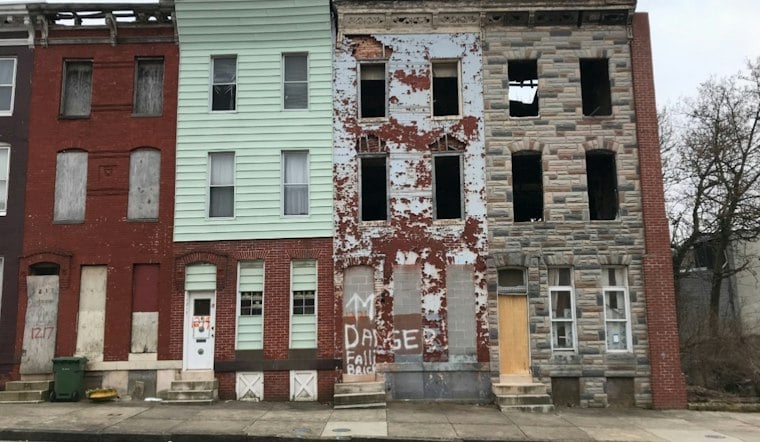
Baltimore's vacant housing stock remains central to the state's strategy. The Baltimore Vacants Reinvestment Council seeks to convert at least 5,000 vacant Baltimore properties into homes or community spaces by fiscal year 2029, with Maryland planning to invest $250 million in the project through 2030, per the Daily Record. Moore said the council has already converted more than 2,800 vacant properties.
Baltimore Mayor Brandon Scott, who has prioritized reducing the city's vacant-home count throughout his tenure, said the city had approximately 16,000 vacant properties when he took office in 2020 and now has 11,423, according to the same report. The state backed that effort with a $50 million grant through the Baltimore Vacants Reinvestment Initiative in July 2025, supporting community development organizations acquiring, stabilizing, and demolishing blighted properties, paired with $1 million from philanthropic partners including the Goldseker and Annie E. Casey foundations.
Hoodline has reported extensively on the scale of Baltimore's vacant-property challenge, and on how a former convent site was recently converted into affordable housing amid the city's estimated 33,000-unit affordable housing deficit.
Other State Tools Aimed at Buyers and Builders
Governor Moore approved Maryland's 2026 Qualified Allocation Plan in May, introducing a “Housing Starts Now” incentive that awards higher application scores for Low-Income Housing Tax Credits to projects that are already pre-zoned or have full site approvals, a plan guiding more than $300 million in combined federal tax credits and state funding. The state also launched the Maryland Community Compass AI portal in September, giving developers address-level analyses of zoning regulations, environmental constraints, and state grant options, as Hoodline previously reported.
On the demand side, Maryland introduced the $50 million First Homes for First Responders and Teachers program in September, offering discounted mortgage rates paired with a 0% interest, 5% down-payment assistance loan, as Hoodline detailed in September. Together, the supply-side permitting reforms and demand-side buyer assistance programs represent two sides of the same push to close Maryland's housing gap, even as local zoning and land-use authority remain outside the governor's direct control.




