

























































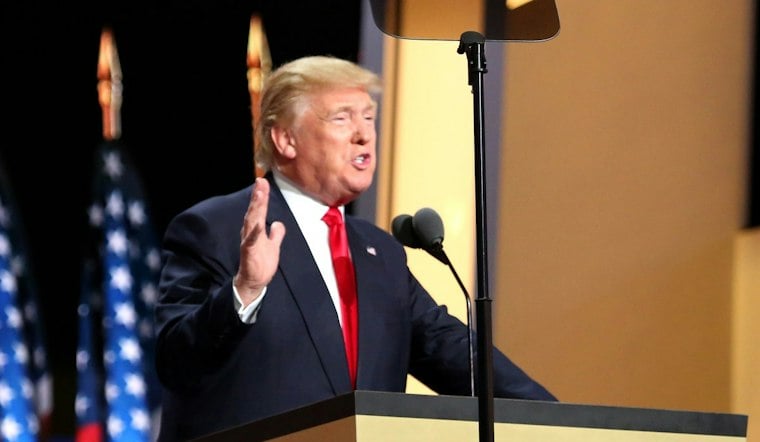
More than half of North Carolina adults say their life and financial standing have gotten worse since the 2024 elections, and the overwhelming majority place at least some blame on President Donald Trump or congressional Republicans. The findings land just as early voting kicks off across the state and days before voters head to the polls in a midterm election already shaped by economic anxiety.
The poll, conducted for WRAL and WSOC by SurveyUSA between Oct. 7 and Oct. 11, surveyed 900 North Carolina adults, including 643 who had either voted by mail or said they were likely to vote. Fifty-one percent of respondents said their life and financial standing had gotten worse since the 2024 elections, while just 17% said things had improved. That's a reversal from a September 2024 WRAL News poll, in which 45% of respondents described themselves as optimistic about their financial future and 55% expressed at least some doubt.
Of those who said life had gotten worse, 52% blamed Trump directly, while another 27% spread blame across Trump, congressional Republicans, congressional Democrats, and local North Carolina politicians all at once. Congressional Republicans drew blame from 7% of that group, congressional Democrats from 9%, and local North Carolina politicians from just 4%. Overall, 86% of respondents said Trump or congressional Republicans deserved at least some blame for their worsened circumstances — a striking number in a state Trump has carried three times, winning 51% of the vote there in 2024.
Economy and Healthcare Dominate Voter Concerns
The poll asked respondents to rate how motivating 11 different issues were on a scale of one to ten. The economy topped the list, with 70% of respondents rating it a 9 or 10. Healthcare came in second at 62%, followed by defending democracy at 53%. Education and international conflicts tied at 44%, crime came in at 43%, mental health or addiction at 42%, gun rights or gun control at 37%, and abortion and immigration and border security tied at 36%. The environment rounded out the list at 34%.
Western Carolina University political scientist Chris Cooper told WRAL that voters' choices in the upcoming election are being driven largely by Trump and the economy, and that voters tend to blame whichever party holds power when their personal finances are struggling. That dynamic helps explain why even people who said their lives had improved since 2024 spread their credit around: 28% credited Trump, 19% credited congressional Republicans, 17% credited congressional Democrats, 11% credited local North Carolina politicians, and 15% credited all of the above.
Medicaid and ACA Cuts Loom Over the Race
Trump's approval rating in North Carolina sits at 37%, according to the poll, and healthcare looms large as a secondary worry behind the economy. Trump and congressional Republicans reduced subsidies for Affordable Care Act insurance, and more than 200,000 North Carolina residents dropped off Obamacare coverage this year as a result, per WRAL's reporting. Medicaid provides health insurance to more than 3 million North Carolina residents, and WRAL reported that federal Medicaid cuts could remove hundreds of thousands of North Carolinians from the program as soon as 2027.
Those federal cuts track with separate reporting from North Carolina Health News, which found that new federal Medicaid work requirements taking effect in 2027 are projected to affect roughly 732,000 North Carolinians enrolled under Medicaid expansion, with county social services agencies already reporting double-digit staff vacancy rates ahead of doubled recertification caseloads. North Carolina expanded Medicaid under the Affordable Care Act in December 2023, and more than 669,000 low-income adults had enrolled by mid-2025, bringing total statewide Medicaid coverage above 2.85 million residents, according to the NC Institute of Medicine. Trump and most congressional Republicans supported sweeping Medicaid cuts last year, while retiring Sen. Thom Tillis, who served 12 years in the Senate, opposed them.
Lawmakers Rushed a Gas Tax Holiday — But Relief Is Slow
North Carolina legislative leaders convened a special session the week before Oct. 14 and moved to suspend the state's 41-cent-per-gallon gas tax, a maneuver WRAL reported would cost roughly $350 million. Gov. Josh Stein signed the gas tax holiday into law on Oct. 9, and it runs through Nov. 30. Under the law, formally known as Session Law 2026-62, the state controller will transfer approximately $360 million from North Carolina's Stabilization and Inflation Reserve into transportation accounts to cover the lost tax revenue, according to NC Political News, which reported the General Assembly approved the measure nearly unanimously.
But drivers hoping for an immediate 41-cent drop at the pump have been disappointed. State officials and East Carolina University economists warned that gas stations must first cycle through fuel inventory purchased before the tax suspension took effect on Oct. 10, meaning savings will phase in gradually rather than all at once, the station's report noted. Attorney General Jeff Jackson has launched a monitoring initiative called N.C. Fuel Check to verify that stations pass along the savings once tax-free fuel deliveries arrive.
Senate Race Adds Urgency to Early Voting
The economic sour mood is playing out directly in North Carolina's marquee U.S. Senate race, where Democrat Roy Cooper leads Republican Michael Whatley by 14 points, per the same WRAL poll. Cooper has centered his campaign on affordability with the slogan “Make Stuff Cost Less,” a message he road-tested during a Charlotte rally earlier this year, while Whatley has countered with “Make More, Keep More.”
Catawba College political scientist Michael Bitzer told WRAL that Republicans are bearing the brunt of voters' reaction to the president's policies, pointing to unfulfilled promises as part of the problem. Bitzer said Trump promised tariff refund checks and so-called DOGE rebate checks that were never sent, and that the political mood in the state is toxic for the president. Trump had promised American adults a $5,000 check, conditioned on voters keeping Republicans in control of Congress. The White House defended Trump's record and criticized Democratic politicians in a written statement to WRAL.
Tillis did not seek reelection after a falling out with Trump, opening the seat Cooper and Whatley are now fighting over. Early voting begins the week of Oct. 14 and runs through Oct. 31, offering same-day registration at designated polling sites for North Carolinians who missed the standard registration deadline. Election Day is Nov. 3.





