

























































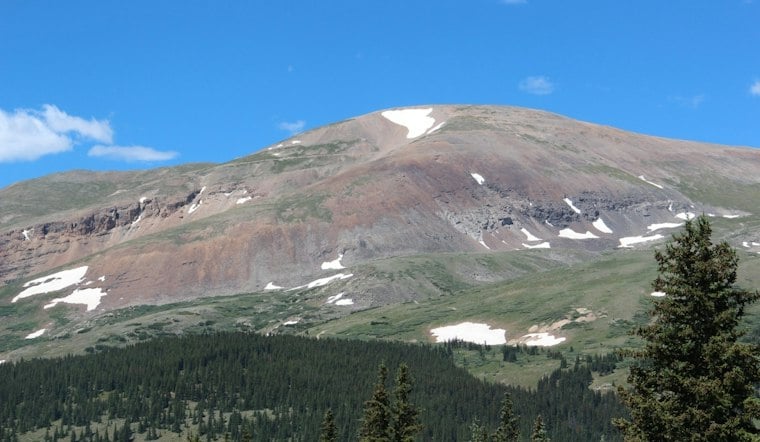
A skier was buried in snow on Mount Bross over the weekend when an early-season avalanche broke loose on the 14er's east-facing terrain, and the person's own ski partners dug them out within minutes, before any outside rescuers could reach the scene. No injuries were reported, but the slide has become a stark warning sign for backcountry travelers as Colorado's snowpack season ramps up early.
The accounts agree that the avalanche happened Sunday, October 25, 2026. According to The Denver Post, the slide ran 300 feet down Mount Bross's east face on Sunday, October 25, 2026, and buried one skier fully, roughly 350 feet below the summit. The Denver Gazette also reported the incident unfolded on October 25, in the mountain's east-facing Moose Creek Bowl near the popular DeCaLiBron loop hike, and described the skier as partially buried with their airways under the snow. The accounts differ on the burial description: the Post described the skier as fully buried, while the Gazette described them as partially buried with their airways under the snow.
Witnesses who watched the event described it to CBS News Colorado, which reported on the avalanche on Mount Bross and the skier who was buried by snow and subsequently rescued. The slide struck a group that included two skiers and one snowboarder, and the Post reports it was triggered by the third person in that group, about 50 feet below a ridge.
A Five-Minute Companion Rescue
Whatever the precise burial depth, both accounts agree on how the rescue played out: the skier's own partners got them out fast. The Denver Gazette reported that skiing partners performed a swift companion rescue, recovering the skier in about five minutes, and the group was able to evacuate without needing outside help. The Post's reporting adds that it marked the first time Park County Search and Rescue had fielded an avalanche rescue call since 1992 — a sign of just how rare these events have historically been in that corner of the state.
A separate group of skiers who happened to be positioned above the slide photographed it as it ran and reported the incident to the Colorado Avalanche Information Center, per the Post's reporting. The Gazette, drawing on CAIC's assessment, described the slide as a wind slab avalanche estimated at R2/D2 in size that ran down to roughly 13,550 feet of elevation.
Why the Terrain Turned Dangerous So Early
The timing matters because Colorado's formal daily avalanche forecasting season hadn't even started yet. Per the Colorado Avalanche Information Center's own guidance, backcountry travelers are urged to check forecasts both when planning a trip and again before heading out for the day, and the agency typically issues its daily avalanche forecasts by 4:30 p.m. But as reported by Unofficial Networks, those daily backcountry forecasts weren't slated to resume until November 1 — meaning the Mount Bross slide happened in a seasonal gap when formal daily guidance wasn't yet available.
That doesn't mean CAIC was silent. The agency had already warned that recent wind-drifted snow had formed stiff, potentially unstable slabs on high-elevation alpine slopes, according to Unofficial Networks. Separately, as Summit Daily reported, CAIC had cautioned that avalanche hazards were developing on steep, snow-covered slopes, with the added risk that rain falling on existing snow could trigger loose wet avalanches. The Gazette also noted that between October 23 and October 26 alone, CAIC had already published 12 field reports of slides statewide — a striking number of early-season incidents clustering in just a few days.
A Season of Declining Fatalities, But Real Risk Remains
The Mount Bross incident arrives against a backdrop that avalanche researchers have been tracking closely. The Colorado Sun reported that the state had gone 22 winters without reaching the end of February without investigating at least one avalanche fatality, and that by the season-to-date point reported in February, CAIC had counted 35 backcountry travelers caught in 31 avalanches, including 11 burials and four injuries — the smallest tally of avalanche incidents through February in the past decade, per the same report.
Fatal slides still happen, even amid an otherwise improving trend. The Colorado Sun separately reported that a March 7, 2026 avalanche in the Boss Basin area near Ptarmigan Pass, south of Vail Pass, killed 58-year-old Silverthorne skier David Pickett-Heaps; that slide was about 400 feet wide, ran for 180 vertical feet, and buried him under snow as deep as 9 feet. By March 8 of that season, CAIC had counted 39 avalanches involving 45 backcountry travelers statewide, 17 of whom were buried, the outlet reported. It also noted that across the five ski seasons from fall 2020 through spring 2025, eight of the 33 people killed in Colorado avalanches had been traveling solo — underscoring, in that reporting, how partners on the snow can make the difference between a scare and a tragedy.
For now, the Mount Bross slide stands as a reminder that Colorado's steep alpine terrain can turn dangerous well before the official forecasting season begins. The skier involved walked away unharmed thanks to quick-acting partners, but the incident adds to a string of early slides that avalanche officials have been logging across the state's high country in recent days.



