

























































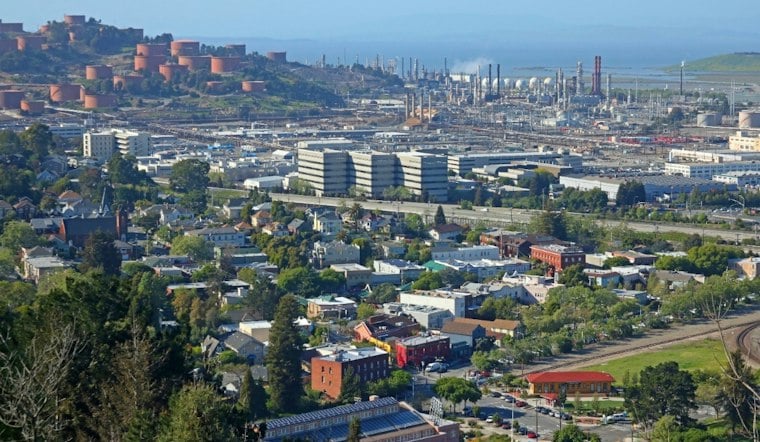
A text survey circulating among Richmond residents asks them to consider a possible phaseout of Chevron’s century-old refinery and the city’s relationship with the company. The 33-question survey’s commissioning party remains unknown; people involved in local politics or activism who spoke to Richmondside said they did not know who sent it.
The survey, first reported by Richmondside, devotes 23 of its 33 questions to Chevron’s relationship with Richmond or the oil industry at large, asking respondents how important city council support would be for a phaseout and how long the refinery should be given to wind down operations. It also asks about Mayor Eduardo Martinez and city government, offering response options like very favorable, somewhat favorable, somewhat unfavorable, very unfavorable, no opinion, and never heard of. The text message identified its sender as Ada with US Speaks, a service that Richmondside reports is run by Survey 160, a New York City-based firm.
Survey 160 says on its own site that it conducts public opinion surveys for academic, non-profit, governmental, political, and corporate clients. Its CEO and founder, Nathaniel Lubin, did not respond to Richmondside’s questions about who hired the firm for this survey. The outlet reported that the survey was still accepting responses; its commissioning party remains unidentified.
Officials and groups deny involvement
In Richmondside’s reporting, the mayor’s office and several elected officials denied writing the survey or said they did not know who did. Mayoral aide Tony Tamayo said the office did not write it and he did not know its source. City council candidates Ahmad Anderson and Claudia Jimenez — the top two finishers in Richmond’s first-ever primary on June 2, 2026, now facing off in the Nov. 3 election — both denied writing it. Primary mayoral candidates Demnlus Johnson and Mark Wassberg also said they had not written it; no sitting council member told Richmondside they had a hand in creating it.
Other people and organizations Richmondside contacted likewise denied involvement or said they knew nothing about the survey. Public opinion consultant Eric Zell, whose company lists Chevron and the City of Richmond among its clients, said he was unaware of it. BK Williams said the Richmond Progressive Alliance did not author it, while Chevron spokespeople Caitlin Powell and Brian Hubinger said the company neither sent the survey nor hired anyone to do so. Bay Area Anti-Chevron Coalition members Matt Leonard and Clio Soiffer said their organizations did not write or distribute it; Shiva Mishek and Kerry Guerin said they knew nothing about it. The coalition includes Bay Resistance, the Asian Pacific Environmental Network, East Bay Democratic Socialists of America, the Oil and Gas Action Network, and Chevron Out of Palestine/Palestinian Youth Movement, but has no centralized office or spokesperson, Richmondside reported. The City of Richmond said it had no related records because the survey was not a city survey.
No public council debate on a shutdown
The survey raises a possibility the Richmond City Council has not publicly discussed: gradually ending refining at Chevron’s Richmond refinery. Richmondside reports that the council has not taken up a shutdown at a public meeting since the outlet began covering it in June 2024. Chevron has operated in Richmond for about 124 years and remains the city’s largest employer and taxpayer, providing almost a quarter of Richmond’s General Fund dollars in fiscal year 2024-2025, according to Richmondside.
Even if the political will existed, the legal path would be murky. Attorney Deborah Ann Sivas told Richmondside that local governments lack inherent authority to shut down an oil refinery, though she said cities could consider ordinances requiring testing of contaminated soil and groundwater, and that Richmond could discuss Chevron’s transition responsibilities — including cleanup and environmental remediation — to make the land usable down the line. Separately, a 2023-24 bill in the California Legislature would have authorized a local entity to limit or prohibit oil and gas operations by ordinance, though the legislative record reviewed does not establish that the measure became law or would apply to Chevron’s Richmond refinery, per California Legislative Information.
Health Risk Assessment Adds Pressure
The survey lands amid a separate, independent process already putting Chevron under scrutiny. A preliminary assessment from the Bay Area Air District estimated a maximum cancer risk of 37 additional cases per million people near the refinery, well above the district’s threshold of 10 in a million, according to the San Francisco Chronicle. People living within about three miles of the refinery face the greatest estimated cancer and short-term health risks, the Chronicle reported, and the district may revise its findings after public comment and Chevron’s response.
Roughly 74% of that estimated risk traces back to the pollutant benzo(a)pyrene, largely from small leaks at pipe fittings and storage tanks, the Chronicle reported — a figure Richmondside’s own account of the Air District findings also attributes to leaks, storage tanks, and generators. If the risks remain above the state-mandated safe level after the review, Chevron will have to draft and implement a remediation plan within roughly five years, Richmondside reports. Chevron has said it has significant issues with the assessment and believes it materially overstates the risk, arguing the modeling includes equipment no longer in operation and assumptions that don’t reflect actual refinery conditions. The public comment period on the assessment closes Nov. 23, 2026.
A $550 Million Settlement Still Being Decided
The survey’s Chevron-related questions also touch on territory the city council is actively navigating: how to spend a $550 million settlement Chevron agreed to pay Richmond over 10 years, which Richmondside reports was made to remove a ballot measure that would have taxed refined oil had it passed. The council voted to hire a consultant, at a cost of $150,000 to $300,000, to gather resident input on how those funds should be allocated — though accounts of the vote differ. Richmondside reported the tally as 5-1, while Contra Costa News reported it as 5-1-1, with Councilmember Jamelia Brown dissenting and Councilmember Soheila Bana abstaining, per Contra Costa News.
City staff warned the council in September that some of the settlement money may need to go toward reducing Richmond’s operating deficit rather than new programs, Richmondside reports. Councilmember Claudia Jimenez has argued that with 20% of the General Fund coming from one industry, the city needs to diversify its revenue, while Vice Mayor Doria Robinson has said the funds could be used to attract other industries and build up alternative revenue streams, according to Contra Costa News.
The refinery’s financial and health footprint
A city-record snapshot underscores Richmond’s financial reliance on Chevron: the company paid more than $58.8 million in taxes and settlement payments in the prior fiscal year, nearly 24% of the city’s budgeted General Fund revenue, according to a city spreadsheet reported by Richmondside. The refinery’s health history also includes the Aug. 6, 2012, pipe rupture and fire. The U.S. Chemical Safety and Hazard Investigation Board reported that the incident released a plume and was followed by approximately 15,000 people from the surrounding area seeking medical treatment.
What a Shutdown Elsewhere Has Looked Like
Richmond isn’t the only Bay Area city grappling with refinery questions. Valero planned to begin winding down operations at its Benicia refinery by April 2026, and separate reporting on the company’s Benicia refinery offers a glimpse of what such a transition can cost a community. Valero announced plans to idle, restructure, or cease Benicia operations within a year, citing California’s regulatory and enforcement environment, and expected to permanently idle most processing units while laying off about 240 employees — nearly 70% of its payroll — according to The Guardian. That refinery was Benicia’s largest employer and the source of nearly 20% of its tax revenue, the Guardian reported, processing about 145,000 barrels of crude oil a day — though ABC7 News separately reported the plant produced 170,000 barrels of fuel per day.
Benicia Mayor Steve Young told the Guardian that converting the site into a fuel-storage terminal, an option California’s governor’s office reportedly negotiated to help maintain supply and stable prices, would leave the city with no significant taxes or jobs while the emissions from storage tanks remained. Phillips 66 shut down its Southern California refinery operations in 2025, and Chevron executive Andy Walz has said the company could leave California altogether due to the state’s tax and regulatory environment, according to Richmondside. Chevron has also faced its own regulatory scrutiny at home: the company was fined more than $15 million by the Bay Area Air District between 2015 and 2025, the second-highest total among companies regulated by the district, per Richmondside.
For now, the survey’s origin remains as unresolved as the policy questions it raises. Whoever is behind the 33 questions reaching Richmond phones, the people who’d actually have to act on its premise — the mayor’s office, the city council, Chevron itself, and some of the activist groups pushing against the refinery — have said it wasn’t them or that they knew nothing about it.


