

























































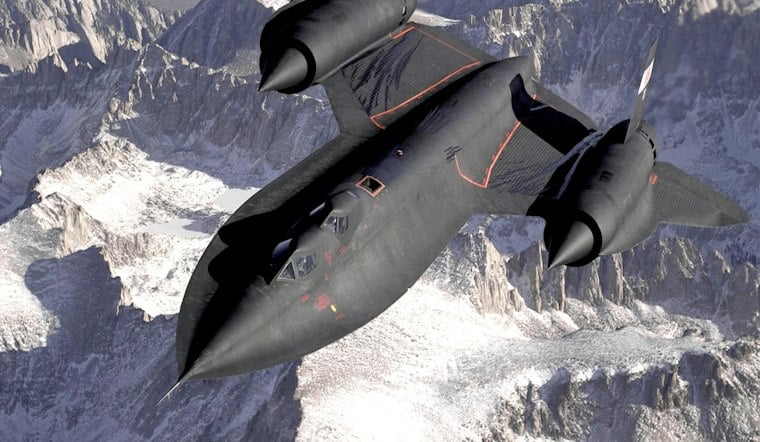
An unresolved question about a vanished NASA SR-71 has a local historical echo: could the jet that visited Oklahoma City in 1988 be the same aircraft now known as tail No. 844? The aircraft has disappeared from its longtime display perch at California's Armstrong Flight Research Center, stirring speculation—not confirmation—that NASA may be considering a return to flight.
A Jet Disappears From Its Perch
Commercial satellite imagery reviewed by The War Zone showed tail No. 844 was no longer at its usual display location by May 17, 2026. Sources cited by that outlet said the aircraft had been moved into a hangar for inspection, prompting speculation about a possible return to flight. Separately, Aviation Week reported that NASA employees moved the SR-71A into the hangar once used for the Space Shuttle at Edwards Air Force Base.
Tail No. 844 originally carried U.S. Air Force serial number 61-7980 and was the last Blackbird produced and the last one to fly, per the same outlet's reporting. That final flight came on October 9, 1999 — a date that marked the end not just for No. 844, but for any Blackbird anywhere, as Aviation Week noted. The aircraft had been displayed at Armstrong Flight Research Center, located at Edwards Air Force Base, since that retirement.
Former Engineers Quietly Approached
Behind the scenes, NASA reportedly reached out to people who knew the jet best. The agency approached former SR-71A test engineers Mike Relja and Tim Conners, among others, about working on a possible return-to-flight effort, according to the Aviation Week report. By the time a job offer was extended to Relja in August, NASA already had crews working on the SR-71A inside the hangar, the outlet reported.
The scale of the task is not small. The proposed effort would involve restoring to airworthiness a 59-year-old airframe that has not flown in nearly 27 years, per the same account. Still, NASA has not confirmed that the return-to-flight project exists, and a spokesperson said the agency had no additional information to share regarding the aircraft at that time, both according to Aviation Week.
Isaacman Hints at Flying High and Fast Again
Publicly, NASA has offered little beyond suggestive language about its broader ambitions. NASA Administrator Jared Isaacman said the agency was rebuilding its X-plane fleet to pursue aeronautics breakthroughs, per Aviation Week's reporting. During a presentation at the All-In Summit, Isaacman said NASA was getting back in the business of flying high and fast again, as reported by The Aviationist.
Sources cited by Aviation Week said NASA had been exploring whether the SR-71 could potentially return to flight, though NASA had not confirmed that information, according to The Aviationist. Aviation International News has framed the speculation as NASA teasing a potential SR-71 return to flight as an X-plane candidate. Nothing so far confirms an actual flight is planned, as MiGFlug's coverage of the disappearance put it plainly.
The Blackbird's Oklahoma City Moment
An SR-71A assigned to the 9th Strategic Reconnaissance Wing at Beale Air Force Base was part of the Aerospace America airshow at Will Rogers World Airport in June 1988, News On 6 reported. The aircraft was a ground display, not a flight demonstration; The Oklahoman described the appearance as the SR-71's first in the Southwest.
The show drew a crowd of roughly 35,000 people on its biggest day in the event's three-year history, per The Oklahoman's account. When the Blackbird departed Oklahoma City for California on Monday, June 20, 1988, the Air Force granted a News 9 crew exclusive access to the operation, including footage of the pilot and reconnaissance systems officer climbing into their pressure suits before takeoff, News On 6's report noted.
A Storied, Shrinking Fleet
The SR-71 program itself was always a study in extremes. The Air Force operated SR-71 jets from 1966 until 1989, briefly bringing some back out of retirement in the 1990s before NASA became the last operator, retiring its final jet, tail No. 844, in 1999, per News On 6. The aircraft could exceed Mach 3 and fly higher than 80,000 feet, making it a uniquely powerful reconnaissance tool during its operational decades.
A Separate 1990s Military Proposal
A distinct precedent came in 1994, when Senator Byrd told the Senate that the conference committee had accepted his proposal for a small, three-plane SR-71 reconnaissance contingency group, according to the Congressional Record. The proposal concerned a military reconnaissance capability; it is not confirmation that NASA’s reported consideration of tail No. 844 would become a research-flight program.
Published accounts give conflicting production totals, so this article does not present a single figure. Surviving Blackbirds were sent to museums across the United States and to one museum in England, leaving the status of the aircraft inside the Edwards hangar unresolved.




