

























































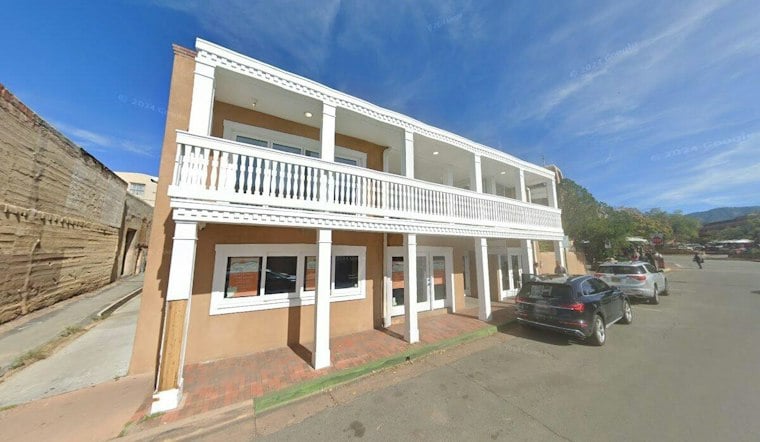
A Navajo-owned arts retailer that built its name in Old Town Scottsdale has planted a second flag a block south of the Santa Fe Plaza, opening a storefront at 125 E. Water St. that will swap artwork and artists back and forth with its original Arizona location. Native Art Market, launched in 2020 by Heather Tracy and her mother, Denise Rosales, now says it represents roughly 600 small businesses across the two stores and has funneled more than $6 million to hundreds of Indigenous artisans since it began.
The expansion was driven by simple overcrowding, according to Tracy, a co-founder of the family-run enterprise and member of the Diné family behind it. As reported by KJZZ, Tracy said the original Scottsdale location, at 7215 E. Main St., became full and crowded, with too many artisans and not enough room to display their work. She described the Santa Fe and Scottsdale shops as virtually identical in concept, and said the plan is to let artwork and artists circulate between the two: pieces from Arizona-based makers will appear in Santa Fe, while Santa Fe artists will be featured back in Scottsdale.
A Family Business Generations in the Making
Tracy has described the venture as generations in the making, tracing its roots back to her great-grandmother, who once sold her artwork by the roadside near the Grand Canyon's South Rim after a trading post offered her only pennies on the dollar for it, per the same KJZZ account. That origin story underpins the current ownership structure: the Navajo Times has reported that Native Art Market is owned by Rosales and her daughters, Tracy and Devin Shea Tunney, in a business the family describes as spanning five generations, according to Navajo Times.
The Scottsdale store features more than 300 artists representing more than 28 Native American tribes, including First Nations of Canada, Navajo Times has reported. Under the market's model, sales go directly back to the artists, who set their own prices and pay for the space they occupy inside the store rather than consigning work through a traditional gallery markup.
Landing in a Crowded, Hard-to-Measure Art Scene
Santa Fe gives Native Art Market a presence in a city with more than 250 galleries and studios, and KJZZ's reporting describes Santa Fe as the nation's third-largest art market behind New York City and Los Angeles — though the Santa Fe New Mexican has separately reported Forbes ranked the city third behind New York City and San Francisco, a discrepancy that underscores how differently the market gets measured. That ambiguity extends to sales figures generally: the Santa Fe New Mexican has reported there is little to no hard data examining how much art actually sells in the city each year, even as the global art market contracted 12 percent in 2024 and U.S. sales, which made up 43 percent of the global total, fell 9 percent.
Native Art Market enters that uncertain landscape alongside a stark gap in local ownership. Santa Fe officials have said that of the city's more than 11,000 registered businesses, fewer than 1 percent are Native-owned, and that most Native entrepreneurs seeking help need guidance on business licensing, permitting, access to capital, market opportunities and navigating city processes, according to the same newspaper. The city has responded by launching a Native Business Development Initiative aimed at assisting and connecting Native entrepreneurs, creatives and business leaders.
Joining an Existing Web of Native-Owned Spaces
Native Art Market is not the first Indigenous-owned retail concept to stake a claim in Santa Fe. The American Craft Council has noted that 4KINSHIP, an Indigenous-owned retail space on the city's famed Canyon Road, opened in 2022 to support Native makers and communities, as detailed by American Craft Council. The Santa Fe New Mexican has also reported on the Revolve Collective at 407 Guadalupe St., an artists' co-op that features a handful of Indigenous artists, including Jimmy Dean Horn and Choclo Clayton.
Clayton told the newspaper that the cooperative model may be a good way for more young Native entrepreneurs to break into business ownership by keeping overhead low. Native Art Market says it aims to keep its own inventory distinct from nearby businesses, and Tracy has said she believes that varied mix of artists and goods will help the new storefront thrive. The city's broader Native arts economy gets its biggest annual spotlight each August, when the Southwestern Association for Indian Arts hosts the Santa Fe Indian Market, which the group describes as an artist-centered marketplace positioning Native artists as leaders, entrepreneurs and cultural innovators, drawing more than 1,000 Native artists representing more than 200 Tribal Nations.





