

























































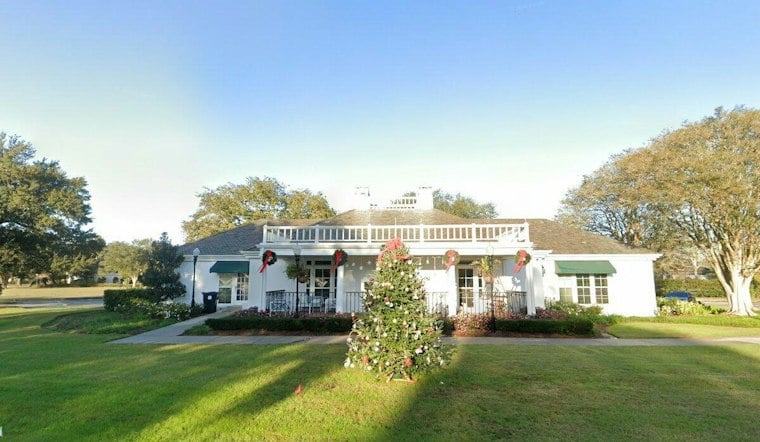
Orleans Parish Criminal District Court Judge Kimya Holmes filed a criminal complaint against WWL-TV with the New Orleans Police Department on September 11, accusing the station of revealing her home address and vehicle information in a story about a $765,000 house. The complaint invoked a Louisiana statute whose criminal penalty had already been repealed weeks earlier, and the NOPD says its investigation remains ongoing.
The dispute traces back to an August 24 report from WWL-TV investigative reporter David Hammer detailing how Holmes’ former fiancé, Arthur Allen, transferred ownership of a house in the English Turn neighborhood to Holmes while he was negotiating a federal fraud plea deal. According to WWL-TV, the station’s video initially showed an image of the public document transferring the house, including the home’s address, and displayed the license plate of a Corvette leased by Allen, which WWL says it obtained from a confidential source. The station has said Holmes has never disputed the accuracy of its reporting.
The property transfer carried real consequences in federal court. U.S. District Judge Jay Zainey said he only learned about the transfer after watching the WWL report, and he wrote that Allen had donated the remaining portion of his home ownership within days of being formally charged, according to nola.com. Zainey had been prepared to sentence Allen to probation but instead denied Allen’s request to soften his punishment and sentenced him to two years in federal custody. Allen had pleaded guilty to providing a false statement to a federal agency and defrauding Covid-relief programs of $712,000, and he is expected to pay some or all of that amount in restitution under federal sentencing rules. Holmes, who is running for reelection in New Orleans’s fall municipal cycle, has denied any wrongdoing in connection with the transfer.
A Letter, Then a Police Complaint
Before Holmes went to police, Criminal District Court Judicial Administrator Rob Kazik sent a letter dated September 10 to WWL-TV General Manager Tod Smith demanding the station remove Holmes’ address and the Corvette’s license plate number within 72 hours. Kazik also asked WWL to reveal its anonymous sources, a request the station declined. The report notes that WWL removed the images from its online report within 24 hours of the letter and later reposted the videos with the address and license plate blurred.
Holmes filed her criminal complaint with the NOPD First District the day after Kazik’s letter went out, invoking Louisiana Revised Statute 44:11.2, which bars dissemination of certain officials’ personal information and had allowed those who shared such information 72 hours to remove it. The complication is one of timing: Act 543 of 2026, which took effect August 1, stripped references to private third parties from the statute and repealed its criminal penalty provision entirely, meaning the law Holmes cited no longer carried the misdemeanor punishment of up to 90 days’ imprisonment and a $1,000 fine it once did, as reported by the Guardian.
Threats and a Political Backdrop
Holmes has said that revealing her address and license plate put her at risk, and her office received calls containing racial epithets. Her campaign has said no one should threaten judges with hate speech or photograph their cars in a secure garage to win a political campaign. First Amendment attorneys, however, have said Holmes’ request to police threatened news organizations’ rights, and they have questioned the constitutionality of the statute she invoked.
Bruce Hamilton, director of Tulane University’s First Amendment Clinic, called Holmes’ request a phenomenally bad decision. He said attempts to criminalize news gathering and reporting could cause journalists to self-censor, and that special statutory privacy protections carved out for certain individuals amount to bad policy. Hamilton added that criminalizing news gathering could ultimately produce a less-informed public and a less robust marketplace of ideas.
Part of a Wider Pattern at the Courthouse
The complaint against WWL-TV is not an isolated flashpoint between journalists and Louisiana’s court system. On July 2, Orleans Parish Sheriff’s Office court security officers handcuffed WWL-TV producer Danny Monteverde and First Amendment lawyer Elana M. Beiser in a courthouse hallway after the pair asked Criminal District Court Judge Leon Roche to reopen his courtroom for the return of a grand jury indictment naming Louisiana Attorney General Liz Murrill. Monteverde and Beiser were briefly detained and released without charges; Louisiana law requires grand jury indictments handed up in state courts to be returned in open court, according to nola.com. The Guardian has described the complaint against WWL-TV as only the latest in a series of high-profile matters pitting Louisiana journalists against members of the state’s court system.





