

























































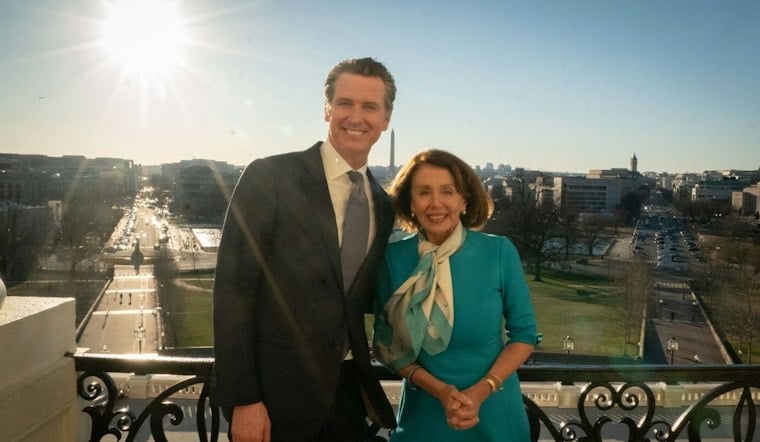
Governor Gavin Newsom and former House Speaker Nancy Pelosi stood together Friday at Laborers Local 261 headquarters in San Francisco's Mission neighborhood, rallying supporters against Proposition 39, the statewide ballot measure that would require voters to show government-issued identification at the polls. The event brought out a lineup of California Democratic officials aiming to shore up opposition to the measure just days before the November 3 election.
What Proposition 39 Would Actually Change
As reported by the Sacramento Bee, Newsom and Pelosi used the rally to sharpen Democratic messaging against the initiative, which is led by Republican Assemblymember Carl DeMaio of San Diego. Under the proposal, in-person voters would need to present a government-issued ID, while mail voters would have to supply the last four digits of a selected identification number on their ballot envelope, according to the Los Angeles Times. Election officials would also be required to verify registered voters' citizenship using government data and publish the results publicly.
California currently asks residents for identification and a Social Security number only when they register to vote, not when they cast a ballot in person, per CalMatters. Under Prop 39, in-person voters without ID could be turned away, and mail ballots missing the matching identification information could be rejected, the Los Angeles Times reported. The state would be required to provide free voter ID cards to eligible voters who request them.
Pelosi Draws a Line to the Federal SAVE Act
Pelosi, now serving as speaker emerita, linked Proposition 39 directly to the federal SAVE Act, a stalled Senate bill that would require voters to show ID in federal elections and direct officials to routinely audit and purge voter rolls. She said Republicans have tried to fold pieces of that federal measure into other legislation even as the SAVE Act itself remains stuck. “They are putting up obstacles to participation to vote,” Pelosi said at the rally.
Newsom, for his part, tied the fight to a separate controversy playing out in Alaska, where the U.S. Department of Justice requested a block on election results if Republican Senate candidate David Sullivan loses. He called the DOJ's request “a preview of what could happen more frequently nationwide” and said the Alaska race should “scare the hell out of everybody,” urging turnout so Trump “cannot contest this race.”
A Disputed List of 20,000 Names
The rally also touched on an escalating dispute over a federal claim that roughly 20,000 people on California's voter rolls had cast ballots after falsely claiming citizenship. Federal authorities made that allegation even as they acknowledged the figure could be an overcount, according to CalMatters. The claim followed earlier White House estimates that put the number of noncitizens on California voter rolls as high as 190,000. Attorney General Rob Bonta's court filing in the matter cites the state's 23 million registered voters as context for the dispute.
Los Angeles County officials who conducted a preliminary review of 200 people on the federal list described it as unreliable, per NPR. Federal prosecutors separately claimed to have found fraud on California's voter rolls ahead of the election, and authorities arrested 11 people and brought charges against 28 defendants statewide earlier this week. Newsom, Pelosi and their allies at the rally argued that Proposition 39 would suppress turnout rather than solve any documented fraud problem, while critics quoted elsewhere have said the measure bolsters unfounded conspiracies about voter integrity and undermines confidence in elections.
Who Else Showed Up at the Mission District Rally
The rally drew a broad slate of Democratic officials beyond Newsom and Pelosi. Lieutenant Governor Eleni Kounalakis and California Democratic Party Chair Rusty Hicks both attended, alongside U.S. Representative Zoe Lofgren of San Jose. San Francisco Supervisor Connie Chan and Laborers Local 261 Secretary-Treasurer David de la Torre also joined, along with Planned Parenthood Affiliates of California President Jodi Hicks.
Two state senators running for Congress, Scott Wiener of San Francisco and Mike McGuire of Santa Rosa, rounded out the roster of speakers. The large turnout of elected officials underscored how central Proposition 39 has become to California Democrats' closing message ahead of Election Day, even as the measure's outcome remains undecided.
Where the Polls Stand Heading Into Election Day
Public polling suggests the measure faces a steep climb. The UC Berkeley Institute of Governmental Studies Poll found in late September that 52% of likely California voters planned to vote no on Proposition 39, compared with 39% planning to vote yes and 9% undecided, according to the Berkeley IGS Poll. That 13-point deficit had widened from a 9-point gap in early August, the same poll found, and support split sharply along party lines, with more than nine in ten Republicans backing the measure and roughly eight in ten Democrats opposed.
Nationally, the picture looks different. About seven in ten registered voters favored requiring photo identification at polling places in an October AP-NORC poll, as reported by U.S. News & World Report. The outlet also noted that nearly 90% of California's ballots were cast by mail in the August primary, a detail that opponents say makes the mail-ballot identification requirement especially consequential.
How Prop 39 Compares to the Federal SAVE Act
Despite the comparisons drawn at the rally, Proposition 39 differs from the federal SAVE Act in key respects. The state measure would not require proof of citizenship during registration and would not restrict mail-in voting, according to KQED. The Los Angeles Times has described Prop 39's provisions as echoing the federal bill while being less onerous overall.
The California Legislative Analyst's Office estimated that implementing Proposition 39 would raise state and local government costs by tens of millions to low hundreds of millions of dollars annually, a figure confirmed in the measure's official title and summary from the California Secretary of State. Supporters say the requirements are necessary to prevent voter fraud and stop noncitizens from casting ballots, though the Los Angeles Times noted that supporters have not presented evidence such problems are widespread in the state. Opponents, including the Democratic officials who gathered Friday, argue the measure would disenfranchise eligible voters, particularly people of color, rural and low-income residents, and people who have moved or changed their names.





